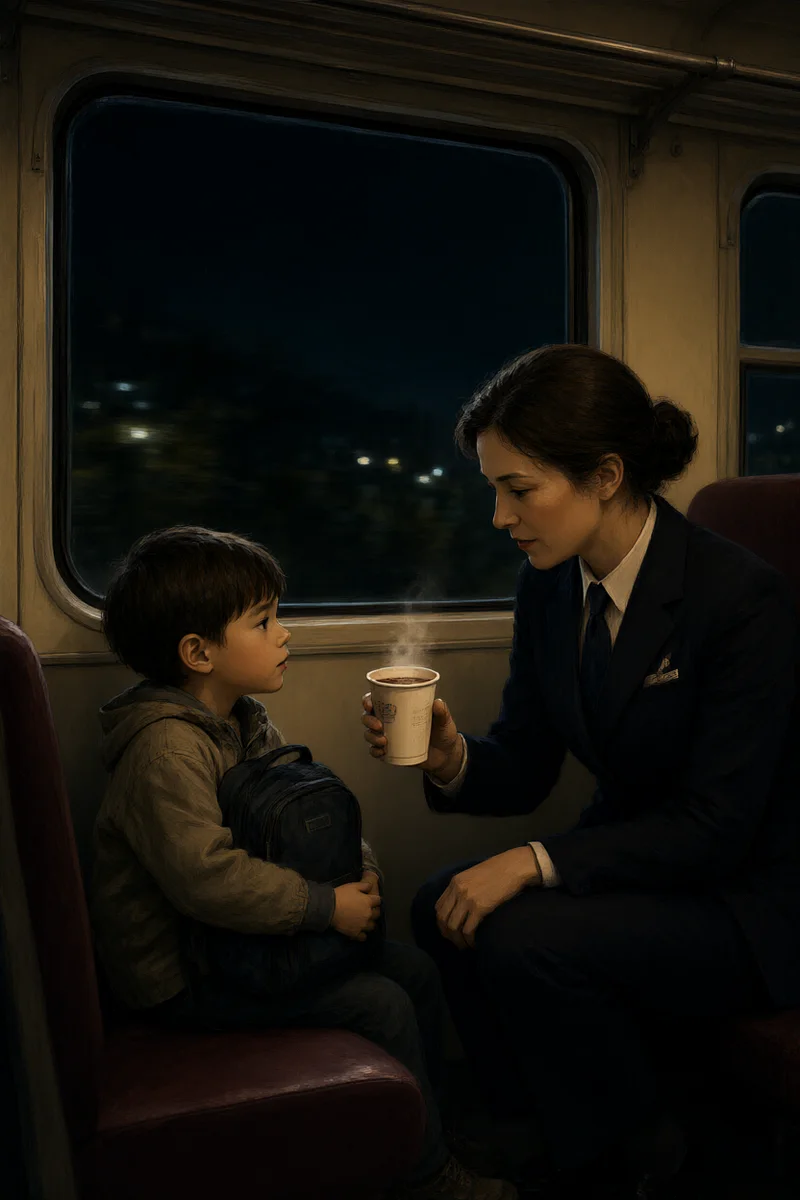
 The Night Train Conductor
Chapter 5
Ten Past Five
At twenty to five she touched his shoulder. “Left side. Now.” The embankment dropped away. Where the land had been there was a different black, flatter, with one ship's light sitting on it and a grey seam along the far edge. Emeka put his forehead on the glass and counted under his breath. He got to eleven, and a cutting took it away. “Eleven,” he said. “You said exactly.”
“I've had twenty-two years to check.”
He sat back. “If he isn't there. Do I go in the car?”
“Yes. And I find out where they've put you, on my own time, and I bring the bad hot chocolate. That one I can promise.”
At ten past five the train pulled into Calder Junction, and an old man in a dressing gown and a raincoat was already running down the platform. He ran badly, in unlaced shoes, with a carrier bag banging against his knee, looking into every window. He had been on that platform since ten to two, the porter said afterwards, which was why a telephone had rung six times in an empty house.
Marguerite stepped down first and stood where he would have to pass her. He stopped two yards short and did a thing she had not expected. He did not look past her for the boy. He looked at her uniform, and pulled the carrier bag open.
“My passport. My pension book. A gas bill, with the address. My daughter's birth certificate, so you can see the names agree. She rang at one o'clock from a neighbor's telephone and she had two minutes. I didn't know what you would want, so I brought the drawer.”
Sergeant Pryce took the bag from him as if it were hot. “Mr. Eze—”
“And this.” He drew a flask out of the raincoat pocket. “It is only tea. With a great deal of sugar.”
Then he looked at the boy in the doorway, and Marguerite looked at him, with twenty-two years of practiced answers behind her. His eyes were wet and he was making no use of it. He kept his hands down at his sides.
“Emeka. I am your grandfather. We have met twice, but you were a baby both times, so I don't count them, and you needn't either.” He swallowed. “You don't have to come to me. You have had a long night. I only want to know, have you eaten?”
Emeka considered. “I had a hot chocolate. It wasn't very good.”
“No,” Mr. Eze agreed gravely. “On trains it never is.”
The boy came down the step and stood beside him, not touching. After a little he held out the backpack, and the old man took it in both arms, the way it had been carried all night.
“I shall need to see the house, Mr. Eze,” Pryce said. “Today, and again after.”
“Come every day. Bring the young man. There is a kettle.”
Her phone buzzed, and she read it. “She answered the door herself,” she told Marguerite, under her breath. “She's asked us about Friday.”
At the foot of the footbridge Emeka turned round. “Do you check everybody twice?”
“No,” Marguerite said. “Hardly anybody.”
On Friday, at twenty-five to midnight, she stood at the door of Car C for longer than she had any business to. With a minute in hand a woman came through the barrier at a walk that was trying not to be a run. She had one bag and no coat. The constable beside her stopped at the barrier, and stayed there until she was aboard. Cash, at a machine. One way, to the end of the line. Marguerite punched it once.
“Is something wrong with it?” the woman asked. Her voice was very steady.
“Not a thing. Seat 14 is free. Sit on the left, and stay awake till twenty to five.”
The End









