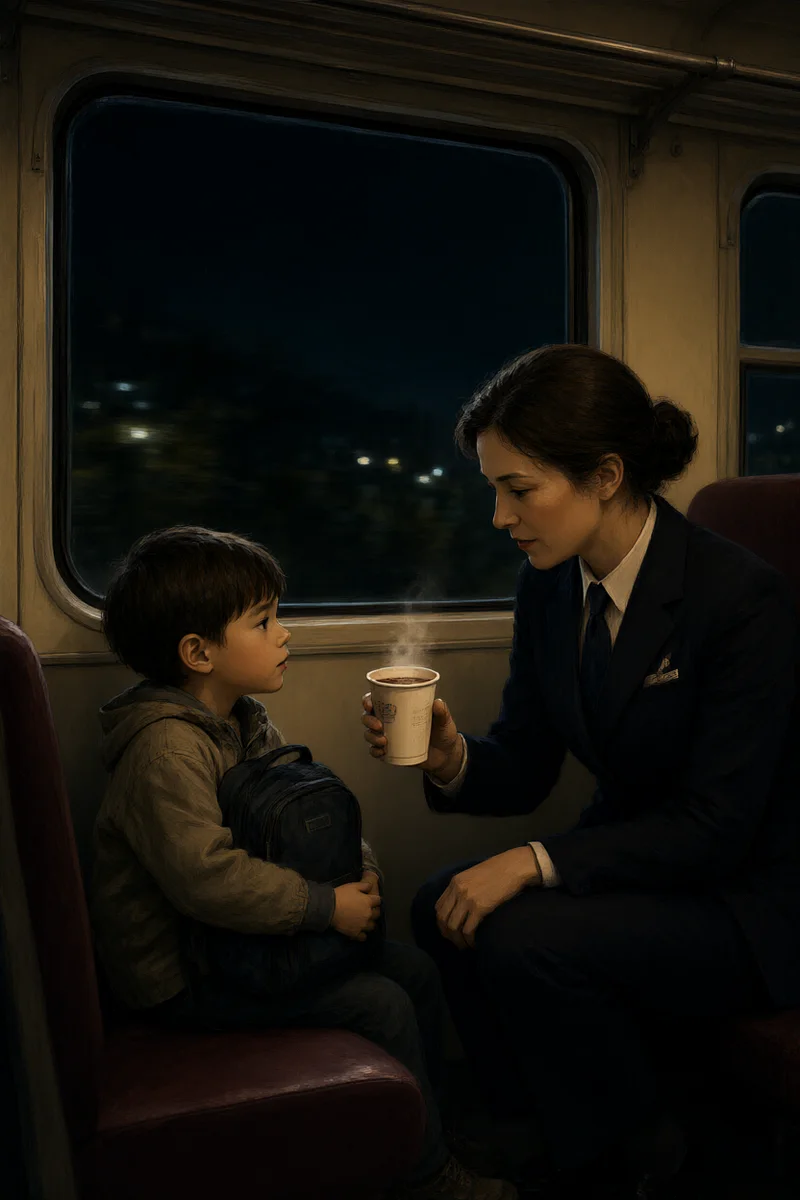
 The Night Train Conductor
Chapter 4
Papa
The sergeant came aboard first: a broad woman of fifty with reading glasses pushed up into grey hair. Her badge said PRYCE. The constable behind her was young and carried a child's blanket, which Marguerite noted in his favor.
“Emeka? I'm Sergeant Pryce. You've given some people a fright, love. Let's get you home.”
Emeka looked at Marguerite. He did not move.
“Sergeant,” Marguerite said. “The man who reported him is not his father. The certificate is in this sleeve. And his mother packed his bag.”
“His mother.”
“He thinks he ran away. She put in his papers and a letter to her own father, and I'd stake my pension she walked behind him to the station. Read it before you take him anywhere.”
Pryce looked at the envelope. “That's not addressed to me. Or to you.”
“I'll open it,” Emeka said. “She's my mum.” He tore it along the top, carefully, with his thumb.
On the platform a whistle went. “This train stands here two minutes,” Marguerite said, “and I've used one. You can read that out there in the cold, and I go on without ever knowing what's in it. Or you can read it sitting down, and get off at Calder Junction, where there's a kettle.”
The sergeant looked at the boy, and at the page in his hands. “Ring the car, Owen. Tell him to meet us at the Junction.” She sat down in seat 13.
It was one page, written fast. Emeka read it first, with his lips moving, then held it out without a word and turned to the window. Pryce put her glasses on and read it aloud, low.
“Papa. This is Emeka. He will tell you he ran away, and you must let him think so, because he planned it for months and he is proud of it. I found the jar in March. I put in what was missing. Tonight I will walk behind him to the station and watch him on to the train, and then I will go home, so that nobody is looking for him before morning.”
“Do not ring the house. Dennis will say he is the boy's father. He is not; the paper is in the bag. I cannot leave tonight. He has my bank card, and the phone is in his name. I will come on Friday by the same train if I can. If I am not on it, keep him anyway. I am sorry it has been nine years. Ngozi.”
“Only somebody did look before morning,” Marguerite said quietly. “So he knows the boy has gone, and she's in that house with him.”
“Yes.” Pryce already had her phone out. “There'll be two of ours at that door inside half an hour, asking her how she is, on her own, with him in a different room. We do know how to do that part.” She spoke to the back of the boy's head. “Your mum's clever. I'd like to meet her.”
“Is she in trouble?”
“No, love. Not with me.”
Later, by the vestibule door, she was less gentle. “Understand me. That letter gets him as far as the platform. It doesn't get him an inch further. If the grandfather isn't there, or isn't fit, or doesn't want him, the boy comes with me, and it's a foster bed by tonight. You said you meant to look the man in the eye. So do I.”
There was a telephone number under the address in the pencil case. Control had been trying it since Wend Halt.
“Still nothing, Marguerite,” the radio said. “It rings out. That's six times.”
It was a quarter past four. Calder Junction was fifty-five minutes away, and as far as anyone on the train could tell, nobody at the other end knew they were coming.
The End









