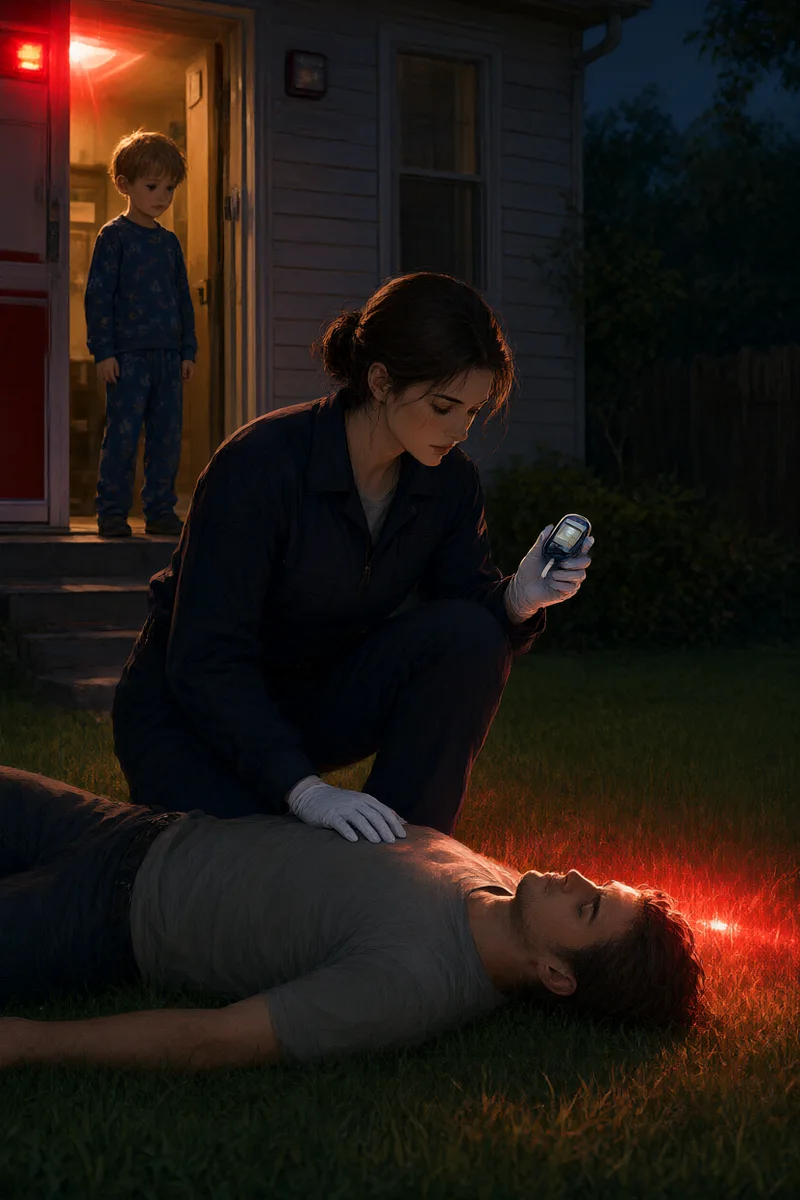
 The Man on the Lawn
Chapter 3
Narrative Field
Kit was sixteen now. She had been seven when a pickup truck ran a red light on Delancey Avenue at 11:20 on a Friday night and folded the passenger side of her father's car around her booster seat. Etienne had died at the scene. Kit had spent four months in a hospital bed and two more years learning to walk without the brace, and she still could not run, and she still could not stand the smell of the hospital soap.
Joelle had been on shift that night. She had not been on that call. She had heard it go out over the radio, and the address, and had not understood yet, and had kept eating her sandwich.
She texted back from the ambulance bay: Who told you that?
Kit's answer came fast. Scanner app. I recognized the street. Is he okay?
Joelle stared at that for a long time. Is he okay. Not who was it, not are you okay. Is he.
She did not answer. She finished the shift. It was a slow night after that, a fall at the nursing home and a kid with a fishhook in his thumb, and at seven in the morning she sat in the crew room with a laptop open to the electronic run report for Quince Court, and every field was filled in except the one at the bottom labeled Narrative.
The narrative was the part that mattered. Anyone could read numbers. The narrative was where a paramedic said what she saw, smelled, believed. Lawyers read the narrative. Judges read the narrative.
Fergus came in with two coffees and set one down by her elbow. He looked at the empty box on the screen.
“You want me to write it?” he said. “I was there. I can say what I saw.”
“It's my patient. It's my report.”
“Jo.” He sat down across from her, heavily. Fergus was sixty-one and had a bad knee and had stood beside her at Etienne's funeral holding Kit's crutch. “Nobody would blame you. For anything. For feeling anything.”
“I know.”
“That boy's going to have a social worker at the door by Tuesday. And Penhallow's supervision officer is going to read Strand's report and then he's going to read yours.”
“I know, Fergus.”
She did know. She knew exactly how little it would take. She would not have to lie. She could write found on ground, slurred speech, combative, history of alcohol offense per law enforcement, and she could leave out the word odor, leave out the speed of the recovery, and every word would be true. The blood test would probably clear him eventually. Probably. After a hearing. After a few nights in county. After a seven-year-old learned what it was like to watch his father taken away in a car.
Kit had been seven.
She closed the laptop without saving and drove home.
The house was quiet. Kit's school bag was gone from its hook; she had left already. Joelle went down the hall to put her jacket away, and stopped.
The closet door was open. The shoebox was on the floor of the closet, the lid beside it.
Every one of the nine envelopes had been slit neatly along the top with a knife. The letters had been taken out, read, folded, and put back, in order, the oldest at the front.
Tucked behind the last one was a tenth envelope Joelle had never seen. It was addressed in her daughter's careful, upright handwriting, to Mr. R. Penhallow, care of the Office of Victim Services, and it had a stamp on it, and it had never been mailed.
The End









