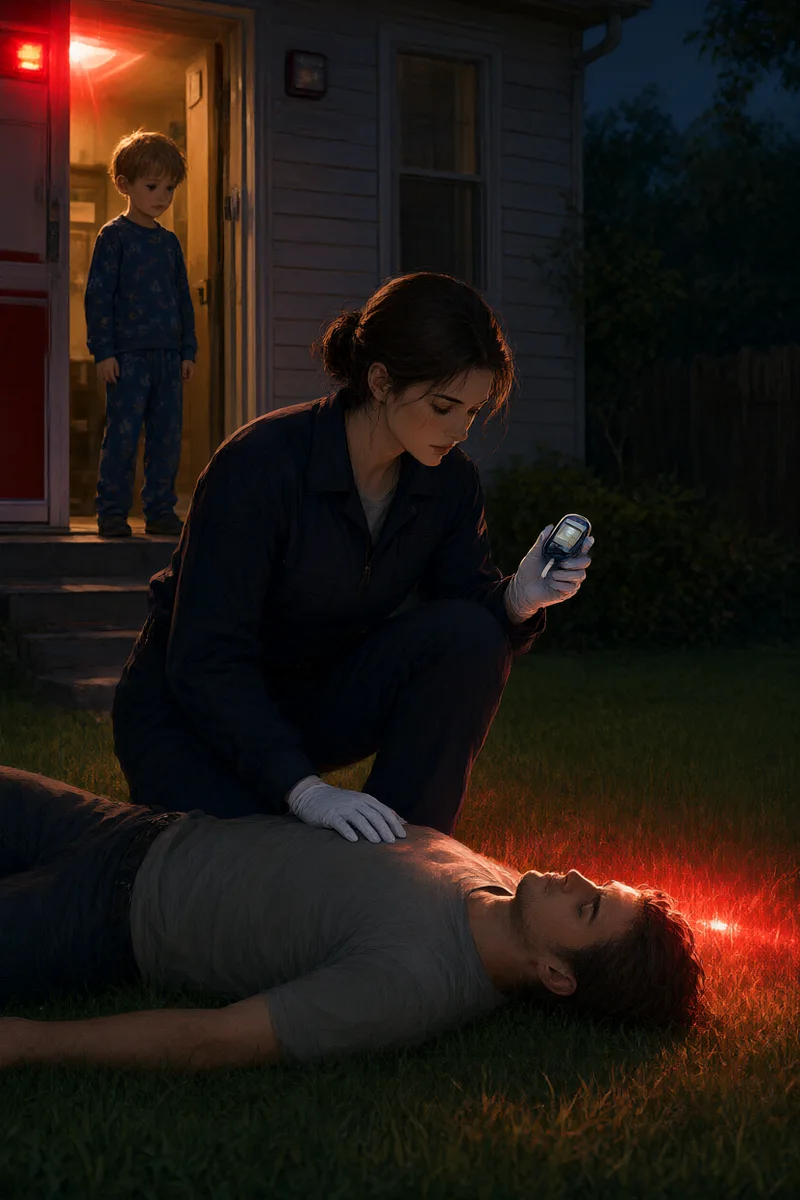
 The Man on the Lawn
Chapter 1
Altered Mental Status
The call came in at 6:48 on a Sunday evening as an altered mental status, male, forties, caller is a child. Joelle Arceneaux read it off the screen while Fergus Albright pulled Medic 9 out of the bay, and she felt the small extra tightening she always felt at the words caller is a child.
“Kid's on the line still,” the dispatcher said over the radio. “Seven years old. Says his dad's talking funny and fell down in the yard. Deputy's en route, about the same time as you.”
“Copy,” Joelle said. “Ask him if Dad has any medical problems.”
A pause, static, then: “Kid says, quote, he has the sugar thing.”
Fergus glanced at her. He had been her partner for eleven years and had a way of glancing that saved a lot of talking. Diabetic. Probably low. Probably fine in ten minutes, with the right bag hanging.
The address was on Quince Court, a loop of small ranch houses with chain-link fences and basketball hoops leaning over the driveways. A sheriff's cruiser was already nosed in at the curb. In the front yard of number 14, a man was on his hands and knees in the grass, trying to get up and failing, like a calf on ice.
A boy in dinosaur pajamas stood on the porch step holding a cordless phone to his ear with both hands.
The deputy, a young one named Strand whom Joelle had met twice, was standing six feet from the man with his thumbs hooked in his belt. “Watch him,” Strand said as she came up with the bag. “He took a swing at the air when I got here. He's hammered.”
“Is he,” Joelle said, and knelt.
The man's shirt was soaked through, dark at the collar and under the arms, though the September evening was cool. His skin was gray and slick. When she put her hand on his shoulder he flinched and said something long and thick that had no consonants in it.
She leaned close and breathed in. Cut grass. Sweat. Nothing else. No sweet sour reek, no beer, nothing.
“Sir, I'm Joelle, I'm a paramedic. I'm going to check your sugar. Little pinch.”
Fergus had his arm. She wiped a fingertip, lanced it, touched the strip to the bead. The meter thought about it.
31.
“Thirty-one,” she said, and Fergus was already opening the IV kit. “He's not drunk, Deputy. He's running on fumes. His brain's starving.”
Strand shrugged, unconvinced. “Ran him on the way over. Prior DUI. A bad one. He's on supervised release till next spring.”
Joelle had the tourniquet on, was tapping the inside of the man's elbow for a vein, and she did not look up. “Doesn't matter what's on his record. Matters what's in his blood.”
She got the line on the first try. Fergus handed her the bag of dextrose and she hung it off the hook on his shoulder strap, and they watched the drip. It is almost unfair how fast it works. Within three minutes the man's breathing slowed. His eyes stopped sliding. He sat back on his heels in the grass and looked at his own hands, and then at the boy on the porch, and said, quite clearly, “Bram. It's all right, bud. Daddy's back.”
Then he turned his head and looked at Joelle, and his face changed completely.
She knew before she read the medical alert bracelet on his wrist, before her eyes reached the engraved name. She knew from the shape of his mouth. She had watched that mouth say I'm sorry across a courtroom eight years ago.
Royce Penhallow. Type 1 diabetic. Insulin dependent.
“Oh, God,” Royce said quietly. “It's you.”
The End









