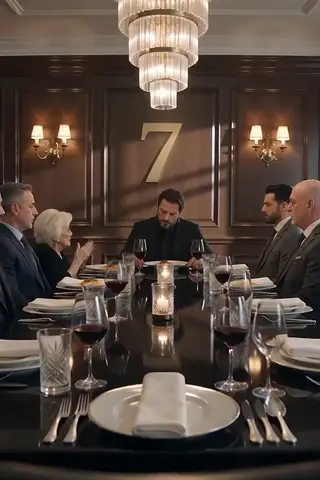
 The Mafia Boss Ignored His Deaf Mother’s Signs
Chapter 5
The Shadow of the Past
Two weeks of lessons transformed the limestone mansion in Greenwich into something resembling an unorthodox, high-stakes language academy.
Every Tuesday and Thursday morning, Gabriel Costello sat in the sunlit solarium with his hands held awkwardly in front of his chest, clumsily signing basic phrases while his mother corrected him with the stern, unforgiving patience of an Italian matriarch.
“No, Gabriel, not like that,” Chloe corrected gently, stepping in and adjusting the position of his thumb. “You’re signing ‘angry’ instead of ‘hungry.’ If you sign that to her at dinner, she’s going to think you want to start a bar fight instead of asking for pasta.”
Gabriel let out a low groan, dropping his hands into his lap. “My fingers are too stiff. I spent twenty years holding a pen or a grip, not doing ballet with my joints.”
“Excuses,” Beatrice signed sharply from her armchair, her eyes sparkling with malicious delight. Tell him my grandmother had more flexibility in her knuckles at ninety.
Chloe translated it with a straight face. “Your mother says your grandmother was more agile than you are.”
Gabriel glared at his mother, though a reluctant smile tugged at the corner of his mouth. “Remind me who pays your consultancy fee, Chloe.”
“The consultancy fee covers translations, not emotional abuse,” Chloe shot back smoothly, picking up her notepad. “Now, let’s go over the family vocabulary again. If you screw up ‘daughter-in-law’ and accidentally sign ‘enemy combatant’ when you introduce your cousin’s wife on Sunday, I’m not stepping in to save you.”
Despite the banter, a quiet rhythm had settled over the household. Chloe found herself actually looking forward to the mornings in Greenwich. The money was arriving like clockwork, her mother’s medical bills were paid in full, and for the first time since Leo’s death, signing didn't feel like reopening a bleeding wound. It felt like a bridge.
But the real world—the world of docks, containers, and violent men—was never far behind.
It happened on a rainy Thursday afternoon in late November.
Chloe was in the kitchen with the household cook, helping prepare a tray of biscotti, when the heavy oak front door slammed open with a force that shook the floorboards.
Voices echoed from the grand foyer—loud, urgent, and angry.
“I don't care if he’s having tea with the Pope!” a harsh, gravelly voice barked. “The North Pier warehouse just got hit! Half our inventory is gone, and the federal task force is swarming the loading bays!”
Chloe froze, a wooden spoon slipping from her fingers and clattering against the counter.
Paulie marched past the kitchen doorway, followed by two other lieutenants, their suits damp from the autumn rain. Gabriel stepped out from his study down the hall, his jacket off, his sleeves rolled up, his face set into the cold, ruthless mask of Il Fantasma.
“Who tipped them off?” Gabriel demanded, his voice dropping into a register that made the air in the hallway feel heavy.
“We don't know,” Paulie growled, wiping water from his forehead. “Only three people knew the exact manifest numbers for the North Pier drop: you, me, and Vincent.”
Gabriel’s eyes went dark. “Vincent.”
“He hasn't answered his phone in two hours. His car was found abandoned near the Holland Tunnel.”
The tension in the hallway was thick enough to cut with a butcher’s knife. This wasn't business; this was betrayal from within the inner circle. In Gabriel’s world, betrayal carried only one currency, and it was paid in blood.
Suddenly, a soft tap-tap echoed from the solarium doorway.
Everyone turned.
Beatrice stood at the edge of the room, holding her knitting basket. She had heard the raised voices. Her eyes darted from Paulie’s tense posture to Gabriel’s rigid shoulders.
What is happening? Beatrice signed, her hands moving with nervous haste. Who is dead?
Gabriel stopped in his tracks. All the lethal fury that had just filled the hallway vanished, replaced instantly by a protective, heavy dread. He looked at his mother, then looked at Chloe.
“Chloe,” Gabriel said, his voice tight. “Take my mother upstairs. Now.”
“Gabriel, wait—”
“Take her upstairs!” he snapped, the mob boss returning in full force.
Beatrice caught the tone, even if she couldn't hear the volume. Her hands flashed defensively. I am not a child! Tell me what is happening! Is it the police? Is it a war?
Gabriel turned away, refusing to look at her hands. “Paulie, get the cars ready. We’re going to Brooklyn.”
“Gabriel!” Beatrice stepped forward, her fingers trembling as she tried to force him to look at her. Look at me! You are walking into a trap!
Gabriel didn't look. He turned his back on her and strode toward the front exit, his lieutenants falling in step behind him like executioners.
The heavy front door slammed shut.
Silence descended upon the grand foyer, broken only by the steady patter of rain against the stained-glass windows.
Beatrice stood frozen in the center of the room, her hands dropping slowly to her sides. The frail, fierce old woman suddenly looked impossibly small, a solitary figure abandoned in a fortress built entirely of violence and silence.
Chloe felt a sharp, burning ache in her chest.
She walked over to Beatrice, placing a gentle hand on the older woman’s shoulder.
He is an idiot, Chloe signed, her fingers steady and deliberate.
Beatrice looked up, a watery, heartbroken smile touching her lips. She signed back, her hands shaking slightly: He thinks protecting me means locking me out of the fire.
Chloe looked toward the front door, then down at her phone lying on the kitchen counter. Gabriel had spent two weeks learning how to talk to his mother, but when the real storm hit, his first instinct had been to retreat into the very silence that had nearly destroyed their family.
“No,” Chloe murmured aloud.
She turned to Beatrice. Stay here. Lock the doors.
Where are you going? Beatrice signed frantically.
To teach your son a lesson about listening.
The End









