 The Mafia Boss Ignored His Deaf Mother’s Signs
Chapter 1
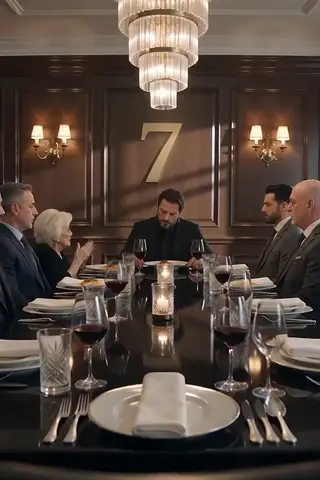
Table 7
“Table 7 is here.”
Three words silenced the kitchen at Il Canto. The chef stopped shouting in the middle of a command about medium-rare strip loins. A dishwasher stopped stacking plates, the ceramic clatter freezing mid-air. Even Marco, the floor manager whose nerves were usually made of frayed wire and cheap espresso, lowered his voice to a low, gravelly whisper.
“Who’s taking it?”
Chloe Bennett reached for her rectangular serving tray, her fingers wrapping instinctively around the polished rim.
“I am.”
Marco stared at her across the stainless-steel prep counter, his eyes wide behind grease-smeared glasses. “You worked eleven hours straight. You pulled a double yesterday, too.”
“I noticed,” Chloe said, her voice flat, carrying the bone-deep fatigue of someone whose rent had just gone up fifty dollars while her tips had gone down.
“And Costello brought family tonight. The real family. Not the guys in suits who pretend to be uncles; the actual syndicate brass.”
Chloe adjusted her black apron, smoothing down the crisp fabric over her white button-down shirt. “Family still eats. And tables that spend four hundred dollars on wine leave twenty percent, whether the patriarch kills people for a living or just sells bad real estate.”
Marco caught her arm, his grip surprisingly firm. “Chloe. I’m serious. Don’t be funny in there.”
“I’m never funny.”
“You’re funny when you’re nervous.”
“Then pray I’m relaxed.”
She didn’t wait for him to argue further. She pushed through the swinging mahogany doors of the kitchen, stepping from the humid, chaotic roar of the line into the hushed, velvet-draped luxury of Il Canto’s premier VIP room.
Behind the heavy wood, wrapped in shadows and expensive leather booths, sat Gabriel Costello.
Six men in bespoke, charcoal-gray suits surrounded him. They didn't look like diners; they looked like pallbearers waiting for a funeral they’d scheduled themselves. Gabriel occupied the head of the table without needing to announce that he was in charge. Thirty-nine years old, broad-shouldered, dark-haired, with the chiseled jawline of an Italian cinema star and the exhausted, predatory expression of a man who trusted almost nobody—least of all the people sitting across from him.
Beside him sat an elderly woman.
Tiny. Frail as dried winter twigs. Snow-white hair swept up into an immaculate French twist. A thick, triple-strand choker of saltwater pearls rested against her black velvet dress.
Gabriel's mother, Beatrice.
Chloe kept her head down, sliding into the rhythm that had kept her employed through three recessions and two restaurant management changes. She stepped up to the table, her tray balanced easily on one palm, and began pouring ice water into heavy crystal goblets.
“Shipment arrives at midnight,” one of the lieutenants—a scarred man named Paulie—said in a low murmur.
Gabriel opened a black leather folder resting beside his bread plate. His fingers, long and manicured, turned a single page covered in neat handwriting. “Any problems at the docks?”
“Union representative complained about the offloading schedule.”
Gabriel didn't look up from the papers. “And?”
“He stopped complaining.”
The table fell quiet, save for the musical clink of ice hitting crystal as Chloe moved down the line. She reached Beatrice last. The old woman sat remarkably straight, her hands folded neatly in her lap, her eyes fixed on the empty space in front of her plate.
Then Beatrice raised her hands.
Chloe nearly dropped the heavy glass pitcher. The water splashed over the rim, wetting the immaculate white tablecloth.
ASL.
Where is the bread?
Gabriel wasn't looking. He was pointing at a figure on the invoice. “Paulie, verify the container numbers from Marseille. I don't want a repeat of the autumn shipment.”
Beatrice tapped the edge of the mahogany table with a single, sharp fingernail.
Gabriel glanced over, his expression softening by a fraction—the only vulnerability he ever showed in public. “Not now, Ma. We’re discussing business.”
Beatrice signed again, her fingers moving with crisp, irritated precision.
I don't want bread now. I want wine. Why is the waiter ignoring me?
Gabriel sighed, rubbing the bridge of his nose between his thumb and forefinger. “Bread’s coming. Just hold on a minute.”
Chloe stared at him, the pitcher suspended mid-pour.
He didn't understand her.
His own mother. Sitting two feet away from him, trying to communicate in a language she had likely used every day of her life, and he treated her like a child tugging on a coat sleeve during a boring meeting.
Dinner continued. The appetizers arrived—carpaccio for the men, a delicate poached veal dish for Beatrice. Beatrice tried again when Chloe collected the small plates. Her hands flashed in the dim candlelight.
I hate the veal. It tastes like cardboard. I want seafood risotto.
Gabriel sighed again, a sound heavy with the weight of a thousand identical arguments. “Ma, please. Eat what’s in front of you.”
He turned toward Chloe, flashing a brief, apologetic smile that didn't reach his cold eyes. “She’ll have the veal. She’s just being difficult.”
Beatrice's hands dropped into her lap.
Something about the defeated expression on her face hit Chloe harder than it should have. It struck her right in the center of her chest, a physical blow that knocked the breath from her lungs.
Leo.
Her younger brother had worn that exact expression a thousand times.
At school, when the teacher skipped over him during reading circle. At restaurants, when the waiter asked Chloe what her brother wanted instead of looking at him. At family gatherings, when relatives spoke loudly and slowly as if volume could cure silence.
Leo had been deaf since a childhood fever took his hearing at age four.
Chloe had learned ASL before she learned long division. She had translated the world for him, fought bullies for him, and built her entire universe around the silent cadence of his hands.
Then, two years ago, a drunk driver ran a red light on 4th Street.
Leo was gone. And Chloe hadn't signed since. Not once. Not even in private, staring at old photographs in her tiny, drafty apartment. The language had become too painful, a monument to a voice she would never hear again.
Gabriel noticed her standing there, motionless, the empty tray clutched against her ribs.
“Is there a problem?”
Five men at the table turned their collective gaze toward her. The temperature in the private room seemed to drop ten degrees. Paulie narrowed his eyes, his hand drifting casually toward his lap.
Chloe’s heart pounded against her ribs like a trapped bird. She had seventy dollars in her checking account. Her rent was due on Friday. If she got fired tonight, she wouldn't make it through the month.
Walk away, a voice in her head screamed. Keep your head down. You’re just a waitress.
Instead, she put down her tray.
She stepped closer to Beatrice’s chair. And for the first time in twenty-four months, she raised her hands.
Hello, Chloe signed, her fingers trembling slightly before steadying into muscle memory.
Beatrice’s eyes widened, the dull film of isolation vanishing instantly. She sat up straight, her mouth falling open.
My name is Chloe, Chloe signed, her heart hammering. Your son speaks for you, but he isn't listening.
The older woman stared at her as if she were a ghost materializing through the velvet drapes.
Chloe’s fingers danced across the space between them, fueled by a sudden, fierce wave of accumulated grief and long-buried anger. The veal really is terrible. It overcooks every night. You made the right choice wanting the risotto.
Beatrice’s mouth twitched, fighting back a triumphant smile. Her hands flew into motion, faster now, energized.
Tell him I want seafood risotto. And wine. Red wine. Something expensive that he hasn't hidden in his cellar.
A chair scraped violently against the floorboards behind Chloe.
“What are you doing?”
Gabriel.
He was standing now, towering over her, his broad shoulders blocking out the light of the chandelier. His face was a mask of hard, suspicious granite.
Chloe didn't flinch. She continued signing to Beatrice, finishing the sentence before turning around.
Beatrice answered her immediately with a sharp, mocking flash of her fingers.
Gabriel stepped closer, his hand closing around Chloe's shoulder. The grip wasn't crushing yet, but it carried the distinct, casual threat of a man accustomed to breaking obstacles.
Chloe finally turned to look him in the eye.
“She doesn't want the veal,” Chloe said, her voice entirely steady, belying the terror clawing at her throat.
Gabriel stared down at her, his dark eyes narrowing to slits. “Excuse me?”
“She wants the seafood risotto.”
Silence descended upon the VIP room so absolute that the hum of the refrigerator in the back kitchen sounded like a jet engine.
“You understood all of that?” Gabriel asked, his voice dangerously low.
“Yes.”
His grip remained locked on her shoulder, his fingers pressing into the fabric of her uniform. “Who taught you sign language?”
“My brother,” Chloe said, her chin lifting. “He was deaf. Unlike some people, I actually learned how to talk to him.”
The insult hung in the air, sharp and unyielding. Paulie half-rose from his seat, his hand tightening into a fist, but Gabriel held up a single finger, stopping him.
Gabriel didn't look angry anymore. He looked stunned, as if someone had just dropped an anchor through the floor of his carefully controlled world.
“If you're going to break my collarbone,” Chloe added quietly, glancing down at his hand, “could you wait until after I put her order in? The kitchen closes in twenty minutes, and if the chef has to clean the sauté station twice, he’ll quit.”
One of the younger lieutenants down the table let out a sudden, involuntary snort of laughter before coughing into his napkin.
Beatrice didn't laugh. She reached out with surprising strength and slapped Gabriel's arm right where his hand gripped Chloe's shoulder.
Gabriel flinched, releasing Chloe immediately as if he’d touched a live wire.
His mother signed furiously, her hands a blur of motion, her face flushed with indignant victory.
Chloe watched the hands, translating automatically in her head, though she kept her expression neutral for Gabriel’s benefit. Then she looked back at the most feared man in the city.
“She says your manners are atrocious,” Chloe deadpanned.
Someone else choked on their water.
Beatrice continued, her fingers flying. And she wants you to stop treating her like she's stupid just because she can't hear your shouting.
Gabriel’s face changed. Only slightly—a micro-expression of shock that quickly hardened back into control. But Chloe saw the fracture beneath the surface. He looked down at his mother, really looked at her, perhaps for the first time in years.
Beatrice turned her head away, staring stubbornly at the wall, her jaw set.
Gabriel stood still for a long, agonizing moment. Then he exhaled sharply through his nose, running a hand through his dark hair.
“Risotto,” Gabriel said, his voice clipped.
Chloe blinked. “What?”
“Bring her the seafood risotto,” he ordered, his eyes fixing on Chloe with a strange, complicated intensity. He glanced down at his mother's empty crystal glass. “And bring a bottle of the 2015 Barolo from the private stock.”
Chloe nodded slowly. She turned back to Beatrice and signed the confirmation.
The older woman’s face brightened like the sun breaking through storm clouds. She reached out, catching Chloe’s wrist in a warm, papery grip.
Thank you, Beatrice signed, her eyes shimmering with unshed tears.
Then she added a final, cheeky flash of her fingers: My son is an idiot, but he tips well. Don't let him shortchange you.
A genuine laugh broke out of Chloe’s throat, bright and unscripted.
Gabriel’s eyes narrowed further. “What did she say?”
“Nothing.”
“Translate.”
Beatrice shook her head violently, grinning like a schoolgirl.
Chloe picked up her empty tray, stepping back into the aisle. “Sorry, Mr. Costello. Confidential communication between client and server.”
She turned on her heel and walked out of the VIP room, leaving the syndicate boss standing at the head of his table.
For the first time in years, someone at Gabriel Costello's table laughed out loud. It was Beatrice.
And Gabriel sat motionless in the dim candlelight, staring at his mother’s hands as if realizing, with sudden and terrifying clarity, that they contained an entire world from which he had spent decades excluding himself.
The End









