 The Fourth Window
Chapter 3
The County Courier
She read it sitting on the iron bed, because her legs had made the decision for her.
Detective Sergeant Alan Garrick, fifteen years with the county force, said his wife had been “unwell and confused” for some time. She had collected the boy from nursery on Friday and had not come home. Anyone sheltering them was committing an offence. His colleagues were giving up their rest days to search.
The Friday was the fourteenth of March. It was the date on the lowest pencil line. Thornley was two hours away. Hetty had gone to school there, and could not remember a word about a missing boy.
Hetty's first thought was an ugly one, and she made herself look at it. A widow, alone, and a missing child behind a hidden door. But there were two beds, and the bolt was on the wrong side for that story.
She read “unwell and confused” again. She had sat through enough contract disputes to know how a man sounds when he is getting his version in first.
The desk drawers were full of exercise books. The early ones had a child's fat pencil numerals, and red ink in the margins that she recognised from the signature on the will. “Good. Show your working.” “Untidy. Again.” She turned through fractions and long division and, near the bottom of the pile, quadratic equations in a neat, slanting hand.
The carpet was worn in a line from the small bed to the window, and in a second line around the edge of the room. It took her a moment to see it for what it was. Somebody had walked laps.
In the wardrobe hung a woman's cardigan and nothing else. On the wall by the door a calendar showed June 2006, with the twenty-third ringed in red.
The reason was in a biscuit tin on the bookshelf: a second cutting, two inches long, from February 2006. A retired detective, Alan Garrick, 58, had died when his car left the Thornley bypass in fog. No other vehicle was involved.
So they had stayed until it was safe, and four months more to be sure, and then they had gone. Nine years in eleven feet by twelve. The milk had not been for cats.
She thought about ringing the police, and could not work out what she would be reporting. Irene was dead. The sergeant was dead. A woman and a boy had walked out of this room twenty years ago and she had no idea where.
The dust still bothered her. Irene had gone into hospital in July. That was ten weeks, and dust does not wait for anyone.
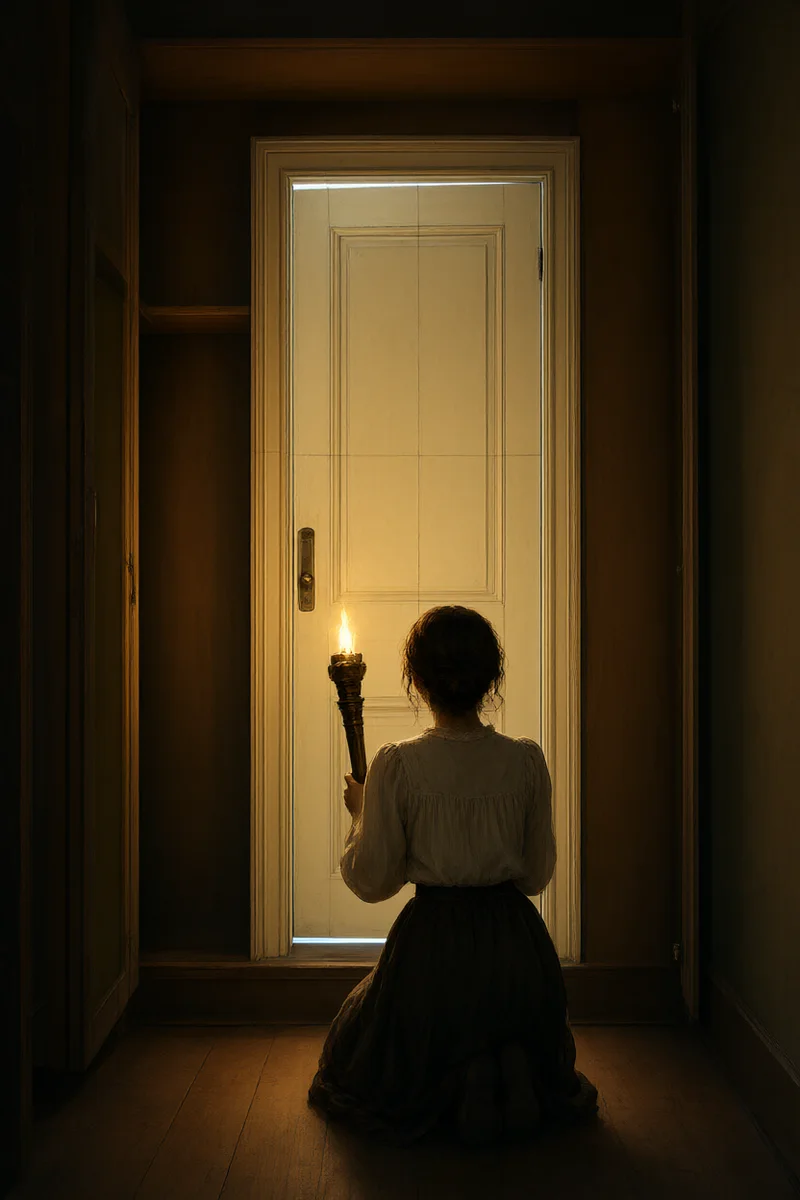
She fetched the torch from her bag and went back to the door frame, meaning only to photograph it.
There was an eleventh line.
It sat nearly at the lintel, more than a foot above the others, and on the first day she had taken it for a scratch in the paint. It was in ballpoint, not pencil. “D. 6 ft 1 — 14 March 2026.”
Last spring. Irene had been alive, and somebody had come back to be measured.
Below the window, a mower that had been droning for half an hour cut out. Hetty went to the net curtain and looked down. The man called Dom was standing on the back lawn with one hand on the mower's handle. He was looking straight up at her, at the one window this house was not supposed to have.
The End









