 The Fourth Window
Chapter 1
Four Windows
Hetty Hale counted things for a living, so she had counted the windows before she had the key out of the solicitor's envelope.
There were four across the back of the upper floor of 9 Coldwater Lane. The plan clipped to the probate valuation showed two bedrooms and a bathroom up there, with a linen cupboard closing off the end of the landing. Three rooms. She walked down the garden to the hedge and counted again.
She was a quantity surveyor. Plans lied to her every week, though usually by inches.
Aunt Irene had died in September at eighty-one, in the cottage hospital, thirty years a widow. Hetty had met her twice. The second time was at her own mother's funeral in 2004, where Irene stood at the back in a grey mackintosh and left before the last hymn without a word to anyone. Hetty had been eighteen, and had hated her for it cleanly and simply ever since.
And now the house was hers, the whole of it. “To my niece Henrietta,” the will said, “who counts.”
A man had been mowing the front lawn when she pulled up. He was tall, somewhere past thirty, and he cut the engine when he saw her. “You'll be the niece. I'm Dom. I did the grass for Irene.” He said he would keep on until she sold, if that suited, and that there was no charge. He looked at the house for a moment longer than the conversation needed, then pulled the cord again.
Inside, it smelled of coal-tar soap and cold ash. There was one chair at the kitchen table and one cup on the draining rack.
Upstairs she paced the landing, then each room along the back wall, heel to toe, and did the subtraction on the back of the envelope. The house was eleven feet longer outside than in.
The linen cupboard held sheets, ironed and stacked. The shelves were loose boards resting on battens. She lifted them out one at a time and leaned them against the banister.
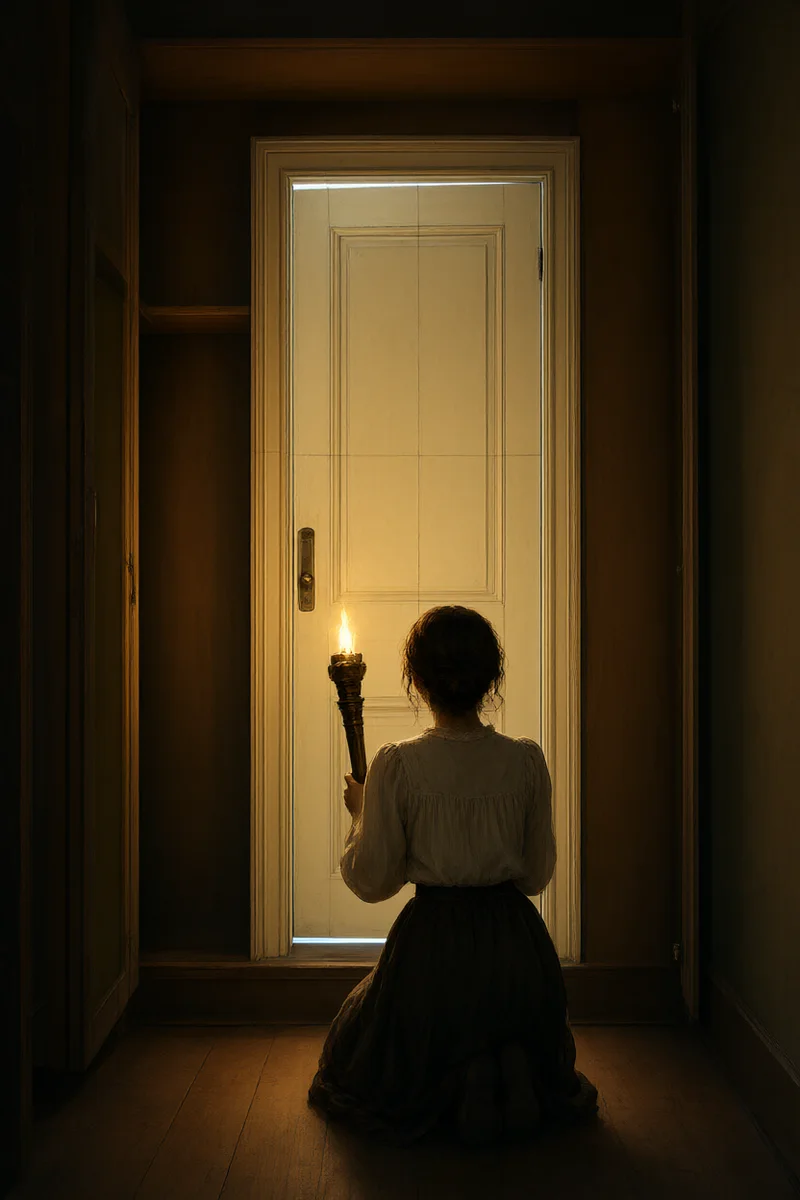
The back of the cupboard was a door. It had been painted the same cream as the walls and it had no handle, only a keyhole. It was locked.
She might have gone downstairs then to look for a key, if she had not seen the pencil.
The lines ran up the right-hand side of the frame, each one ruled straight and labelled in small figures. The lowest was level with her hip: “D. 3 ft 4 — 14 March 1997.” The next was a hand's width higher, dated the same day a year on. She followed them up with her finger to the last, at the height of her own eyes. “D. 5 ft 3 — 14 March 2006.”
Uncle Gerald had died in November 1996. There had been no children. Everybody in the family knew what Irene did afterwards: she shut her front door and lived behind it by herself.
Hetty noticed one more thing, because she noticed everything and filed it. The lowest line was in a different hand from the rest. Whoever wrote it had put a small bar through the stem of each seven.
She knelt. Daylight showed under the door in a thin, even strip. It was coming from the fourth window.
Ten lines, she counted. Nine years. A child had stood in this cupboard every fourteenth of March, a little taller each time, in a house where no child had ever lived.
The End









