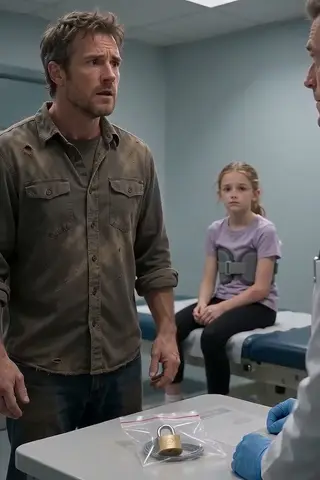
 The Brass Padlock: Echoes Behind the Closed Door
Chapter 5
The Unraveling at the Kitchen Table
The drive home from the clinic was the longest forty minutes of my life, spent in the back seat of the faded station wagon with Ms. Parker’s state-issued sedan following directly behind us like an iron anchor dragging us toward an inevitable reckoning. My father sat in the front passenger seat next to Clara, neither of them speaking a single word the entire way, their bodies stiff and separated by a chasm of unspoken betrayal that felt wider than the Columbia River. Clara had spent the final five minutes in the clinic lobby screaming about ungrateful orphans and unchristian doctors, but once Ms. Parker informed her that a formal neglect investigation had been opened and that a protective custody order was being prepared, my grandmother had retreated into a stony, terrifying silence that was far more intimidating than her rage. When we pulled into our gravel driveway, the engine died with a wet, rattling cough that sounded like a dying animal, and we all sat there in the gloom of the late afternoon as the gray mist began to drift down from the fir trees above the roof.
“Tom,” Clara said finally, her voice cold and flat as she reached for the door handle. “You go inside and put the kettle on. I need to talk to this social worker alone in the kitchen about how we’re going to handle your daughter’s schooling while the county investigates these lies.”
“No, Mom,” my father said, his hand staying on the passenger-side armrest without turning around to look at her. “We aren't going into the kitchen to discuss schooling. Ms. Parker wants us all at the dining table right now, and she wants to look at every single medical record you’ve been keeping in the cedar chest since Sarah’s mother passed away.”
Clara froze, her gloved hand resting on the chrome door latch as she turned her head slowly to stare at her son with an expression of pure, unadulterated venom. “You’re taking their side over your own mother’s? After everything I sacrificed to keep this roof over your head after your wife died in that miserable county hospital? You’d throw me out on the street for a whimpering, ungrateful child?”
“You lied to me, Mom,” Dad said, his voice dropping into a low, rumbling bass that sounded like the deep timbers groaning under a heavy load before the break. “You told me the doctor locked that brace. You told me it was standard procedure. You let me walk out of this house every morning thinking I was being a good father while you were treating my little girl like a prisoner in her own bedroom.”
He pushed his door open and stepped out into the wet gravel, not waiting to see if she followed, while Ms. Parker parked her sedan behind us and walked up the steps with her leather briefcase held against her chest like a shield. We all filed into the house in a miserable, silent procession, the smell of boiled potatoes and wood smoke hanging heavy in the narrow hallway where my mother’s framed portrait still hung crookedly beside the umbrella stand. Clara marched straight into the kitchen, her back rigid as a ramrod, and sat down at the head of the long oak table where we ate every meal, folding her hands over her leather purse as if she were a judge presiding over our execution.
Ms. Parker didn’t sit down; she stood at the opposite end of the table, pulling a thick pad of yellow legal paper and a black ballpoint pen from her case with the unhurried efficiency of a bureaucrat who had seen a thousand versions of this exact tragedy.
“Mrs. Henderson,” Ms. Parker began, her tone completely neutral, which somehow made it ten times more terrifying than Clara’s anger. “Before we discuss the temporary placement order for Sarah while the court evaluates her medical neglect, I need you to hand over the key to the padlock we recovered at the clinic today.”
Clara let out a short, dry laugh that sounded like dry leaves scraping across a concrete sidewalk. “There is no key. I threw it off the old logging bridge into the river three weeks ago when I realized she was trying to pick the lock with a bobby pin. She doesn't need to take that brace off; if she takes it off, her spine will collapse like a wet paper bag by the time she’s twenty.”
“You threw the key away?” Dad asked, turning to stare at his mother with a look of stunned disbelief. “You mean you didn't even have a way to open it in an emergency? What if there had been a fire in the night?”
“God protects the righteous, Tom,” Clara snapped, her eyes flashing behind her wire-rimmed glasses. “And she wouldn't have burned if she had stayed in her bed where she belonged instead of wandering around the hallways like a ghost.”
Ms. Parker didn’t argue with her; she simply wrote something down on her yellow legal pad, tore off the top sheet, and slid it across the oak table toward my father.
“Mr. Henderson,” Ms. Parker said quietly, looking him straight in the eye. “Under state law, I am issuing an emergency protective custody order for Sarah. She will be staying at the regional medical center tonight for observation and treatment of her skin infections, and tomorrow morning the family court judge will determine whether she returns to this house or goes into temporary foster care while the investigation proceeds.”
Clara stood up so fast her wooden chair fell backward onto the braided rug with a heavy, wooden thud. “You can’t take her! That’s my granddaughter! I raised her when her mother died like a stray dog, and you have no right to tear this family apart over a few scratches on her back!”
Dad didn’t stand up. He just sat there at the table, staring down at his large, calloused hands resting on the wood, and for the first time in three years, I saw a tear slip out of the corner of his eye and land squarely on the grain of the oak table, darkening the wood like a drop of rain.
The End









