 The $4 Million Mistake: How a Corrupt CEO Forged My Signature
Chapter 1
The Four-Million-Dollar Rust Bucket
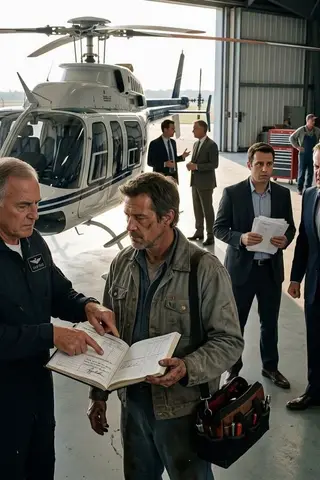
The twin-engine Bell helicopter sat in the darkest corner of Hale Executive Aviation’s premier hangar like a bruised giant. Its polished white and navy fuselage was marred by a jagged, carbon-scored fracture across the lower belly cowling—the violent signature of a heavy emergency landing in high-altitude crosswinds. To anyone else, it looked like a total write-off, a four-million-dollar paperweight destined for a salvage yard or a scrap metal shredder. To Victor Hale, CEO and primary shareholder of the charter company, it was an urgent financial bleeding wound.
"Two different maintenance facilities turned this job down, Mercer," Victor said, his voice echoing off the corrugated metal walls of the hangar. He wore an expensive bespoke suit that looked entirely out of place smelling of aviation fuel and solvent. "They said the drivetrain torque-shock distorted the primary housing beyond repair. They told me to part it out."
I didn't answer right away. I ran a gloved thumb along the fractured aluminum of the transmission deck, feeling the microscopic ripples where metal had screamed under extreme rotational stress. I was Daniel Mercer: thirty-eight years old, a licensed Airframe and Powerplant mechanic for over fifteen years, and an FAA Inspection Authorization holder. In the world of aviation, my signature was a legal guarantee that a machine would not fall out of the sky.
"They didn't want to do the math," I finally replied, my voice steady. "Or more likely, they didn't have the tooling to mill the housing back to exact factory tolerances without compromising structural integrity. It's not impossible, Victor. It's just tedious."
Victor narrowed his eyes, studying me as if trying to calculate whether I was a genius or a fraud. "You can actually fix this thing?"
"I can rebuild it correctly," I said, meeting his gaze. "Every single bearing, every gear cluster, every wiring harness, and every bolt will meet or exceed FAA type-design standards."
He smirked, a cold, sharp expression that didn't reach his eyes. "That's not what I asked. I asked if you could get it flying before my peak charter season kicks off next quarter."
I should have walked away right then. My internal warning system, honed by a decade and a half of working around high-strung corporate operators and arrogant executives, screamed at me to pack my tools, climb into my rusted truck, and drive away. But my mind instantly flashed to a far more grounding reality: the stack of medical bills sitting on my kitchen counter from my late wife's prolonged illness, our looming mortgage payment, and ten-year-old Emily's upcoming private school tuition installment. In the quiet, unglamorous trenches of working-class life, principles don't pay the electric bill.
"We need a contract," I said, keeping my tone strictly professional. "Seventy thousand dollars flat rate for total labor, restoration oversight, and NDT coordination. Replacement parts billed directly through your accounts. Fifty percent upfront, the remaining balance due upon final inspection and the signing of the FAA airworthiness release."
Victor waved a dismissive hand, as if seventy thousand dollars were pocket change. "Done. Craig will draw up the paperwork. Just don't make me regret hiring a backyard mechanic."
Craig Danner, Victor’s slick operations director who stood silently in the shadows behind his boss, immediately produced a pre-printed corporate agreement from a leather portfolio. I scanned the clauses quickly—standard boilerplate indemnity, arbitration clauses, payment schedules—and signed my name at the bottom. It was a binding legal pact. Or so I foolishly believed.
For the next four months, my life shrank to the dimensions of that concrete hangar. The work was grueling, microscopic, and relentlessly demanding. I practically lived on a folding cot beside my heavy-duty Snap-on tool chest. Day after day, I stripped the transmission down to its individual housing halves, meticulously measured tolerances down to ten-thousandths of an inch using precision micrometers, replaced scorched wiring looms, rebuilt hydraulic actuators, and coordinated with an independent Level III Non-Destructive Testing specialist to perform ultrasonic and magnetic particle inspections on every critical load-bearing component.
There was no room for error. In aviation, a single overlooked torque stripe or a contaminated bearing race doesn't just cause a mechanical failure; it kills people. I poured every ounce of my professional expertise and physical endurance into that helicopter.
I missed dinners. I missed weekends. Worst of all, I missed Emily's fifth-grade school play—a moment she had practiced for weeks, standing on stage in her handmade butterfly costume. I remember calling her from the hangar floor at 9:00 PM while she whispered into the phone, trying bravely to hide her disappointment.
"It's okay, Dad. I know you're fixing the big helicopter," she had said, her small voice cracking slightly before she handed the phone back to her aunt.
That conversation broke something inside me, hardening my resolve. I wasn't just fixing a machine for a wealthy corporate predator; I was securing a future for my daughter. I vowed that the moment that machine was certified, I would take a full week off, pack up our camping gear, and spend every single waking hour with her.
By the end of the fourth month, the Bell helicopter was a masterpiece of mechanical precision. Every fluid line was pristine, every control cable was tensioned to exact factory specs, and the newly rebuilt drivetrain hummed with smooth, vibration-free resonance during initial ground run tests.
On a bright Tuesday afternoon, Victor Hale walked back into the hangar, flanked by two prospective investors—wealthy resort developers wearing linen suits and expensive sunglasses. He brought along a bottle of chilled champagne, popping the cork with a theatrical flourish that echoed against the metal rafters.
"To the resurrection of our flagship aircraft!" Victor announced, handing plastic flutes to the investors.
Craig Danner, the operations director, walked up to the aircraft's gleaming white fuselage and slapped the side panel with an open palm. "Looks brand new, Dan. I gotta hand it to you, you actually pulled it off."
I stood wiping grease from my hands with a dirty shop rag, my back aching from twelve hours bent over the engine bay. "It isn't brand new," I said flatly, refusing to smile. "It's airworthy. There's a distinct difference."
Victor grinned, waving away my technical distinction with a dismissive flick of his wrist. "Same thing to our high-paying customers, Mercer. Nobody cares about the metal; they care about the luxury."
The investors chuckled, clinking their glasses together. I didn't join in. I reached into my back pocket, pulled out the final itemized invoice clearly detailing the remaining thirty-five thousand dollars for labor and final inspection completion, and handed it directly to Victor.
"Here is the final bill," I said, keeping my voice even. "Once this is settled, I'll execute the official FAA logbook entries and sign off the return-to-service paperwork."
Victor took the paper, glanced at it for barely two seconds, and folded it in half without reading a single line. He slipped it into his jacket pocket as if it were a discarded gum wrapper.
"We're not paying this," Victor said casually, turning back to his investors to point out the leather interior upgrade.
I froze. The ambient noise of the hangar seemed to recede into a low, distant hum. My chest tightened as a cold wave of disbelief washed over me.
"Excuse me?" I asked, stepping forward.
Craig Danner stepped smoothly between me and Victor, leaning his weight against a stainless steel work table with an easy, mocking grin. "You heard him, Dan. Corporate cash flow priorities shifted this quarter. We've got major marketing outlays for the summer resort routes."
"We signed a binding contract," I said, my voice rising sharply, the exhaustion of four months instantly converting into white-hot fury. "Seventy thousand total. Thirty-five paid upfront, thirty-five due upon completion. The work is done. The aircraft is safe. Pay me."
Victor turned back around, his smile vanishing, replaced by the cold, calculating expression of a man who viewed human beings as disposable assets. He shrugged indifferently.
"Then sue us," Victor said, his tone dripping with condescension. "Take us to civil court. See how many years and tens of thousands of dollars in legal fees it takes you to win a judgment against a corporation with a team of high-priced retained attorneys. You're a mechanic, Mercer. You don't have the stomach or the bank account for a legal war."
He knew exactly what he was doing. He had calculated my vulnerability down to the last penny. Litigation would drag on for eighteen months, require retainers I couldn't afford, and drain whatever savings I had left. He thought he had me completely cornered, trapped by my own financial necessity.
Victor slowly reached into his inner pocket, pulled the folded invoice back out, and tossed it onto the workbench right in front of me.
"You mechanics always think you’re irreplaceable," Victor sneered, adjusting his cuffs. "You're just hired muscle. Bolts and wrenches. Nothing more."
I looked down at the paper. Then, slowly, I reached out and picked it up. My hands weren't shaking anymore; they were completely steady, chilled by a sudden, razor-sharp clarity.
I looked past Victor and Craig, spotting an open file folder lying unattended on the corner of the operations desk. Protruding from it was the weekly flight operations schedule. Written in bold marker at the top of the Friday morning slot was a VIP charter flight to a private island resort, carrying three high-net-worth executives and paying an astronomical charter fee.
I looked back up at Victor, my expression entirely neutral.
"You're planning to fly it this Friday morning, aren't you?" I asked softly.
Victor's eyes flicked sideways for a fraction of a second, a micro-expression of surprise that he quickly covered with a smirk. "Of course we are. Craig has all the copies of the paperwork he needs."
"No," I said, my voice dropping an octave, carrying a quiet certainty that cut straight through his bravado. "Craig has invoices. Craig has work orders. But the legal maintenance record—the mandatory permanent airworthiness release required by federal law before a single blade of that rotor turns with passengers on board—is something else entirely."
Victor's smile finally faltered, his eyes narrowing suspiciously. "What are you talking about?"
I didn't answer. I picked up my heavy steel toolbox, latched the clasps with a crisp, echoing snap, and hoisted it onto my shoulder.
"Good luck with your flight on Friday, Victor," I said quietly.
I turned around, walked out of the hangar doors into the blazing afternoon sun, threw my toolbox into the back of my battered pickup truck, and drove away without looking back. Victor Hale was about to discover a fundamental truth of modern aviation: corporate executives write the checks, but licensed mechanics hold the keys to the sky.
The End









