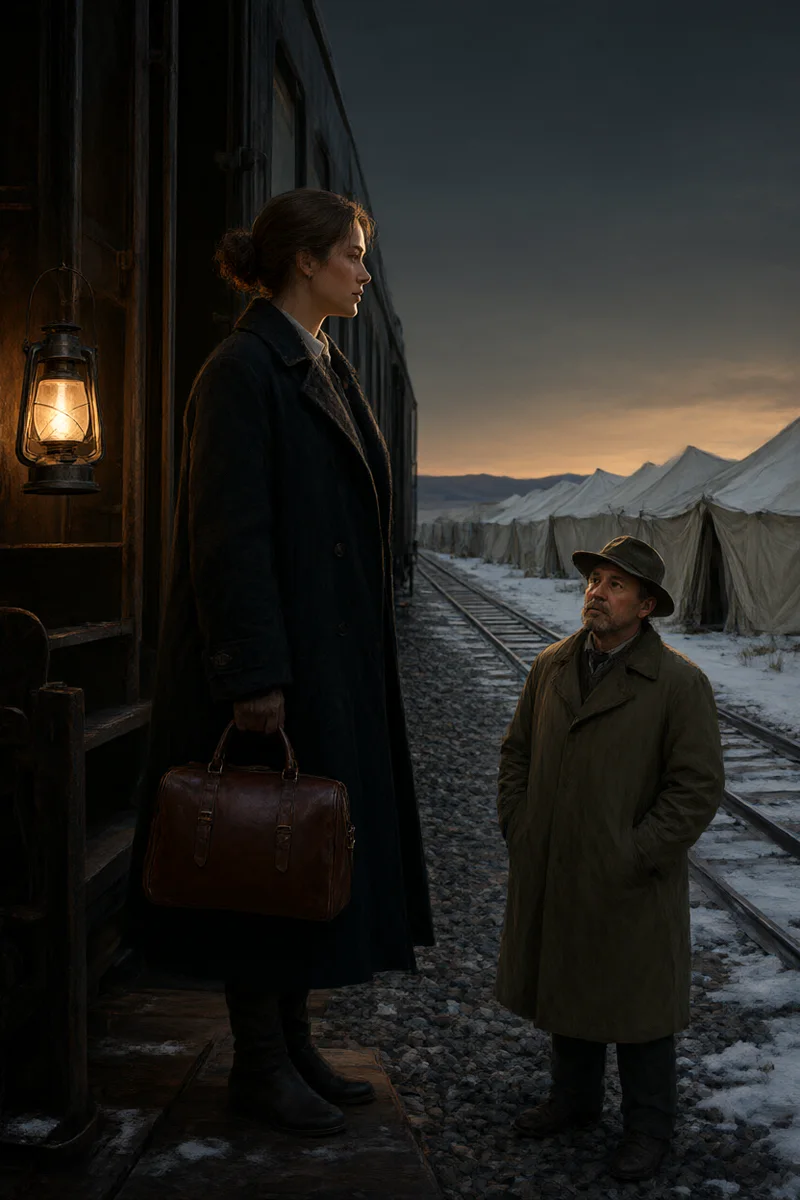
 Surgeon at End of Track
Chapter 4
The Long Way Round
Rafe and Mulcahy cleared the cook tent. They let the fire die on its own, an hour of waiting in the snow two hundred yards off with three hundred men watching, while the stove ticked and cooled. Then Rafe went in alone and carried the thirty sticks out one at a time, in his bare hands, and laid them in a snowbank and walked away.
Honora found she was holding Mulcahy's sleeve. She did not remember taking it.
When Rafe came back, Vane was waiting for him.
“That powder is company property,” the superintendent said. “You'll answer for every stick of it. And you'll answer for every day we lose at Cañon Seco.”
“We won't lose any days at Cañon Seco,” Rafe said. “Because we're not going through it.”
That night he unrolled the profile again in his car, with Honora and Mulcahy and Ignacio, his hand in a sling, crowded around the table. He drew a new line in pencil, bending south around the mesa in a long, lazy curve.
“There's a draw here,” he said. “It's a longer grade. It adds two miles and a half. But it needs no cut. Not a single stick of powder between here and Agua Fría.”
Mulcahy did the arithmetic out loud. Twenty and a half miles in twenty-one days. Track gangs could lay a mile a day on the flat, if every man worked every hour of light and some of the dark.
“It's a gamble,” Rafe said.
“It's a gamble with powder,” said Mulcahy, “or a gamble with sweat. I know which my lads would take.”
They took it. The next morning the drill crews put down their hammers and picked up shovels, and the line bent south.
Honora had not known a railroad could be built like that. The tie gang ran ahead, dropping ties in the snow. The iron men came behind, six to a rail, and the rails came off the cars ringing like bells, and the spikers came behind them, three blows to a spike. They sang while they did it, in Irish and in Spanish. Some days they laid a mile and a quarter.
She treated blisters, frostbite, a broken foot, a man kicked by a mule. She rode the work train out to the head of the line every morning and back every night with Rafe beside her, and by the third week she had stopped pretending to herself that she sat beside him for the view.
On the twenty-seventh Denver wired that a director of the company would come out on Thursday's train to see the last rail laid and to conduct the review himself. Rafe read the flimsy aloud at supper and said that in that case the director could begin with the powder car, lid by lid. Vane, two tables off, went on cutting his meat.
On the night of the twenty-eighth of December, with five miles still to go, she was walking back to her car when she heard a sound on the siding. A soft clank. Then a long, slow creak of iron on iron.
The powder car was moving.
Someone had uncoupled it from the train and let off its brake. It had been standing at the top of the siding all month, and now it was rolling, slowly at first and then less slowly, down the long grade toward the main track. Toward the switch. Toward the tents, where three hundred men lay sleeping.
And far behind it, walking away very fast toward his own car with his coat collar up, went a narrow man she knew by his walk.
The End









