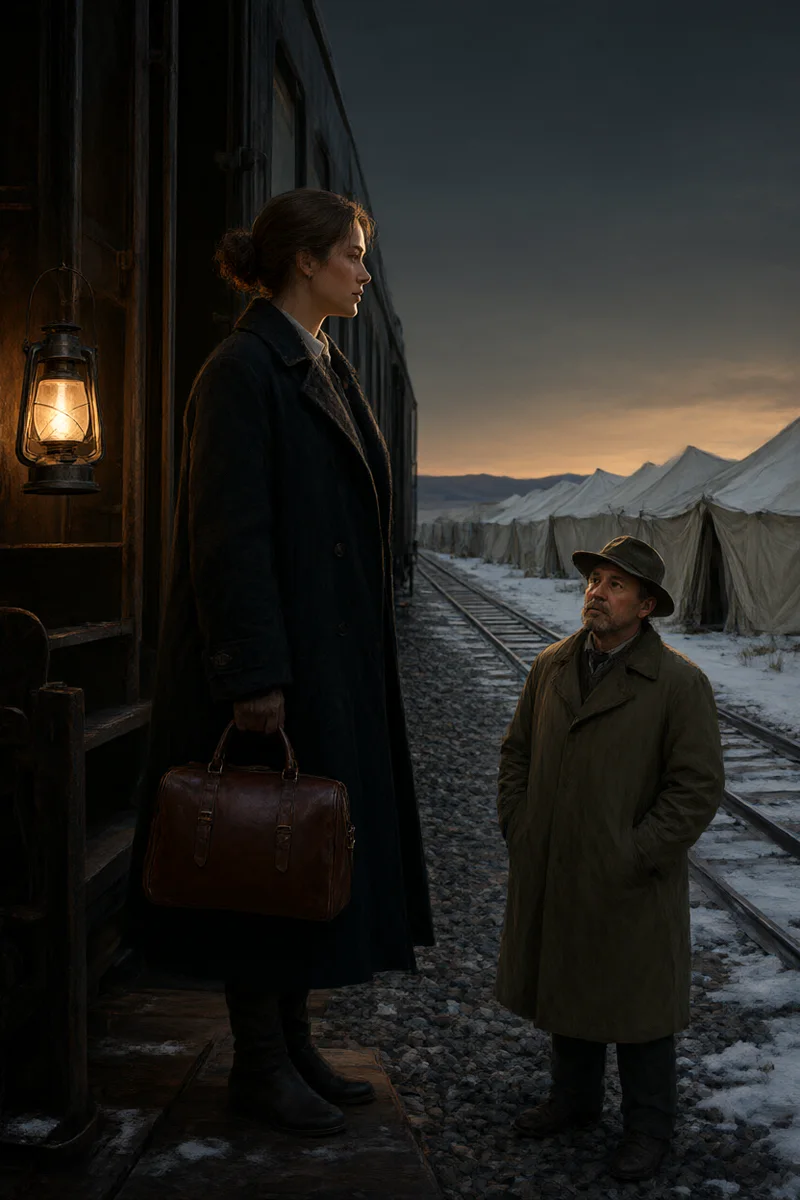
 Surgeon at End of Track
Chapter 3
Thaw
“Why?” she said.
He went to a drawer and took out a bundle of letters, and laid them on the table one by one, like a man showing his cards.
“Seven applicants for the post,” he said. “Two never answered my second letter. One wanted twice the salary and his own cook. One was dismissed from the army for drunkenness, and I know that because I served with him. Two were students who'd never set a bone. And one wrote me four pages in a very neat hand about the treatment of crush injuries, which was the only thing I'd asked about.” He tapped the last letter. “I wrote your name on the requisition myself. Initial only. I'm afraid I let Vane assume.”
“You might have warned me.”
“You'd have come anyway,” he said. “Wouldn't you.”
She thought about that. She thought about the four pages.
“Yes,” she said.
He wired Denver that night, over his own name. He said the surgeon was competent, that she had already saved a man's hand, and that if she went back on Thursday's train, so would the chief engineer. He did not tell her he was going to do it. She found out from the telegraph operator, who had decided by then that he was on her side.
The answer came back on Wednesday. SURGEON TO REMAIN PENDING REVIEW. Vane read it and went into his office car and did not come out for supper.
Ignacio Baca's hand did not go septic. On the fourth day he made a fist, a slow and crooked one. The big red-bearded Irishman, whose name was Mulcahy, brought her a jar of wild plum preserves that he would not say where he had found.
Then the cold came.
It came down off the mountains on the night of the ninth of December, and in the morning the water barrels were solid and the thermometer in Rafe's car read four below. The drill crews at Cañon Seco came back at noon cursing, because the dynamite had frozen in the crates. Frozen powder would not fire. Frozen powder meant no blasting, and no blasting meant no cut.
Honora was walking back from the hospital tent at one o'clock when she smelled it. That same sweet, oily smell, stronger than she had ever known it. It was coming from the cook tent.
She pushed the flap aside.
The cook's big iron range was going full blast. And in the warming oven, laid out in rows like loaves of bread, were thirty sticks of frozen dynamite. Two powder men were feeding the fire. One of them was turning the sticks with a fork.
“Superintendent's orders,” he said, when he saw her face. “Says we lose a day for every hour they're froze.”
Honora had read about this in the medical journals. Everyone had. Every winter, somewhere in the mountains, somebody thawed frozen dynamite by a stove, and the papers printed a paragraph about it, and the paragraph was always very short.
She very carefully did not run.
“Put down the fork,” she said. “Don't touch the oven door. Walk out of this tent with me, now, both of you, and don't stop walking.”
The End









