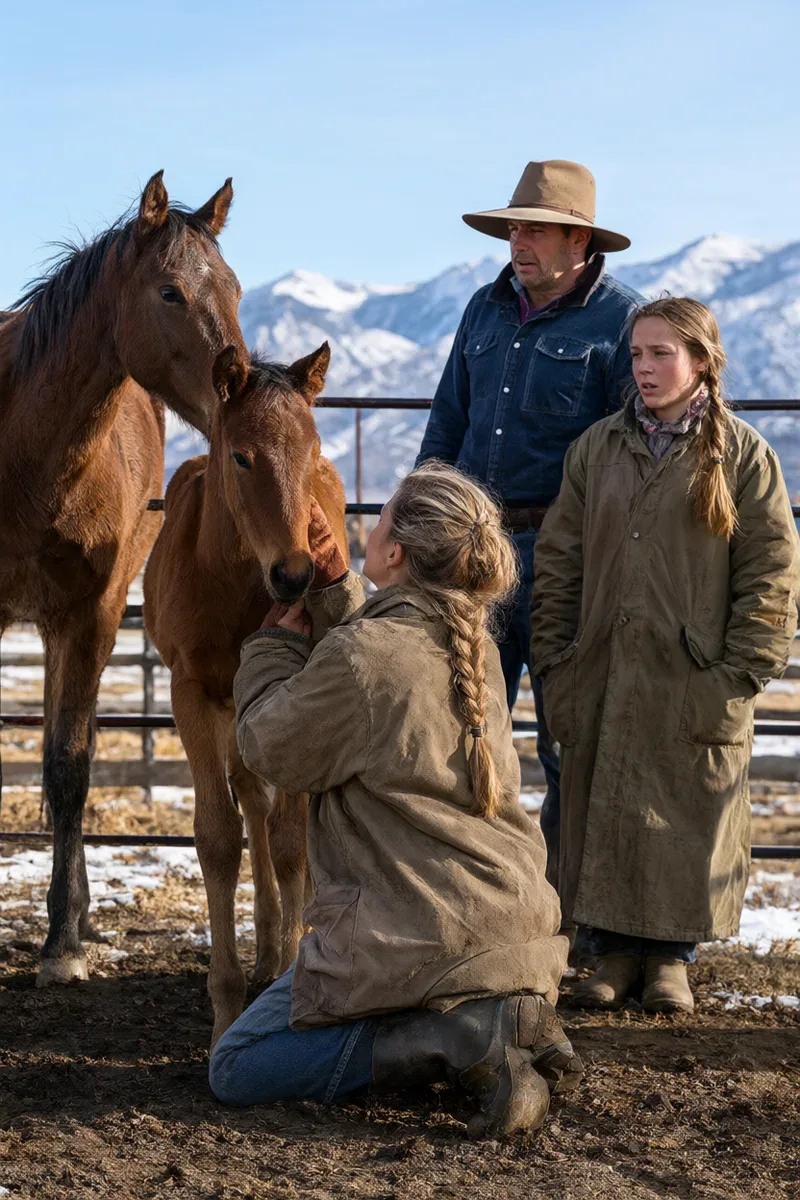
 Sixmile Bench
Chapter 9
Red Bag
Wyeth put the radio on the kitchen table and showed Wrenley the button.
"Channel four is Opaline Treadway. Channel nine is the sheriff's dispatch. You hold it down, you say our name, you say men at the gate. Then you lock the door and get in the pantry and you don't open for anybody but me or Isobel." "Or a policeman," Wrenley said. "Only if he says the password," Wyeth said.
"What's the password?"
He thought. "Brown crayon." She almost laughed. Then she pressed the button.
In the barn, Tinder Road was flat on her side in the straw, groaning, and a red velvet bulge had come out under her tail where there should have been a white sac. Isobel knelt behind her with a scalpel from her kit. "Hold her head down," she said. "If she gets up, I lose him."
Wyeth put his knee on the mare's neck. Isobel cut. Fluid poured into the straw. She reached in to the elbow, found two front feet and a nose, and pulled with the mare's push, and pulled again. "Come on," she said through her teeth. "Come on, come on."
Outside, engines. Headlights swept the barn's south window and stopped. "Wyeth," Isobel said. "I know." He did not take his knee off the mare. "Finish."
The foal came in a slithering rush, long legs folded like a card table, and lay in the straw not breathing. Isobel tore the membrane from its face, cleared its nose, rubbed its ribs, and blew a short breath into one nostril with her hand clamped over the other. Nothing. She did it again. The foal coughed.
Isobel put her forehead against its wet neck for one second. Then she looked up at the barn door.
Wyeth took the rifle from above the tack room door. He did not load it in front of her; it had been loaded since noon. He went to the big door and rolled it open a foot.
Two men stood in the yard in the snow. One was Baskett, without the fleece. The other was bigger, in a canvas coat, and he held a long syringe low by his leg the way some men hold a cigarette.
"Mr. Almquist," Baskett called. "We're just here for the horse. Nobody else needs to be in this."
"She just foaled," Wyeth said. "You're about four minutes late." "Then it's a bigger trailer," Baskett said.
"Your trailer's not coming up my lane." Wyeth nodded past them. Their white pickup and the SUV sat behind his cattle guard, nose down in a drift where the lane dipped by the stock tank. He plowed that dip every winter. Tonight he hadn't. "You're stuck. And there's no signal for a quarter mile, so you can't call anybody to tell you what to do next."
The big man took one step forward. Wyeth lifted the rifle, aimed at nobody, and held it where everybody could understand it.
"Sheriff's on his way with the county plow," he said. "I'd put that needle in your pocket, cap on, before he gets here. He's going to want to know what's in it."
They stood like that in the falling snow for twenty-two minutes. Behind him in the barn he could hear Isobel talking to the mare, and the foal's first wet whinny, high and outraged.
At eleven fifty-eight orange lights came over the rise. The plow first, then Plumley's Tahoe, then a second one Wyeth didn't know.
Plumley got out, looked at the two men, looked at the syringe the big one had dropped in the snow, and looked at Wyeth.
"Wrenley said a password at me," Plumley said. "Over the radio. Wouldn't let up till I said it back." "Did you?" Wyeth asked.
"I'm not going to repeat it in front of these men." He pulled out his cuffs. "Gentlemen. Let's talk about pie."
The End