 She Thought I Couldn’t Hear Her Insults Under the Table
Chapter 3
The Secret Language of the Elite
Over the course of the next twelve months, Sunday dinner at the Whitmore estate became a recurring masterclass in passive-aggressive gymnastics.
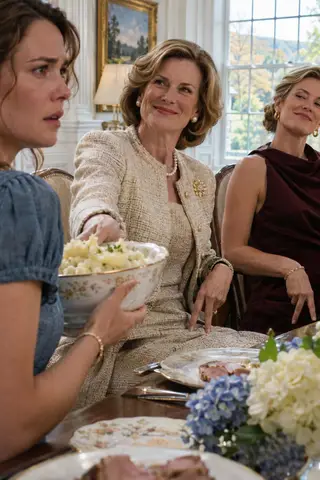
Every other week, I sat at that polished mahogany table while Barbara and her daughters used the shadows beneath the edge of the dining room as a cover for their venom. Because Daniel sat across from me, blissfully cutting his roast beef or debating local school board politics with his father, he remained entirely insulated from the reality of what was happening inches from his plate.
They perfected the art of the dual narrative. With their voices, they asked me about my art lesson plans, praised my handmade ceramic mugs, or inquired politely about my weekend gardening. With their hands, they tore me apart piece by piece.
Look at her hair. She clearly cut it herself with kitchen scissors, Melissa would sign while smiling warmly and asking for the gravy.
Daniel could have had Senator Vance’s daughter. Instead, he brought home a charity case from a public school, Lauren would add, her fingers darting low while she complimented my sweater.
And Barbara—matriarch of the household, pillar of local charity boards, and queen of polite society—was the most ruthless of all.
The breaking point nearly came on a freezing Sunday in late November. I had spent all of Saturday afternoon baking a traditional apple pie from scratch, peeling crisp Cortland apples picked from an orchard down the road, and weaving a delicate lattice crust across the top. When I carried it into the dining room, Barbara’s eyes lit up with practiced maternal warmth.
"Nora, darling, you shouldn't have gone to all this trouble!" she exclaimed, clapping her hands together.
Then, beneath the rim of the table, her fingers moved with cold precision.
Probably bought it frozen at the local co-op and threw some flour on the box to trick us.
I stopped dead in my tracks, the heavy ceramic dish warm against my palms. I wanted to drop it. I wanted to watch the sticky, bubbling apple filling splatter across their pristine Persian rug. But I forced my lips into a polite smile, set the pie in the center of the table, and took my seat.
Yet, as cruel as they were to me, there was something else happening at that table that began to bother me on a much deeper, more fundamental level.
They never actually spoke to Evelyn.
For all their boasts about knowing sign language, the Whitmore women treated Evelyn’s deafness not as a language, but as an inconvenience. Throughout entire meals, they would sign vague instructions or dismissive pleasantries around her, but whenever the elderly woman tried to interject, tried to share a thought or ask a question about the family, Barbara would shut her down with a single, brutal flick of her wrist.
Later, Mother.
Not now, Evelyn.
Always later. Always dismissed. Always pushed to the absolute periphery of a family that had built its entire social standing on the illusion of grace and hospitality.
I knew that look in Evelyn’s eyes. It was the same hollow, defeated expression I had seen on my own parents’ faces decades ago, back when ignorant cashiers shouted at them or bank tellers rolled their eyes at a written note. It was the look of a person rendered invisible by people who were too arrogant to listen.
And I knew, with every fiber of my being, that I couldn't let it continue much longer. The question wasn't if I was going to push back.
The question was how.
The End









