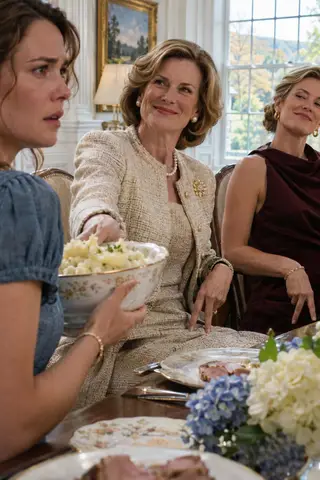
 She Thought I Couldn’t Hear Her Insults Under the Table
Chapter 2
The Art Teacher and the Orthodontist's Son
To understand why I didn't just walk out that door and never look back, you have to understand Daniel.
In a world full of polished veneers and calculated social climbing, Daniel was an anomaly. While his sisters spent their weekends attending charity galas and debating which country club had the best tennis courts, Daniel spent his Saturdays knee-deep in mud, helping a high-school sophomore rebuild a science-fair project after the boy’s little brother accidentally smashed it to pieces. He taught chemistry with an infectious, chaotic energy that left his classroom smelling faintly of vinegar and burnt sugar, and he laughed at terrible puns before he even finished telling them.
We had met a year and a half earlier at a statewide educators' conference in Montpelier. I had been sitting in the back row of a crowded workshop on tactile art therapy, juggling a stack of oversized presentation boards, when Daniel rushed in late, tripped over a loose extension cord, and sent his lukewarm coffee directly across the corner of my portfolio.
He had looked so genuinely horrified, stammering apologies while frantically trying to mop up the mess with a tiny packet of hotel tissues, that I couldn't help but laugh. We ended up spending the entire lunch break sitting on a stone bench outside, sharing a dry turkey sandwich and talking about everything from the challenges of rural public school funding to our mutual love of old paperback sci-fi novels.
When he proposed a year later, it wasn’t at some exclusive five-star restaurant or under the flash of paparazzi bulbs. It was beside a freezing, windswept lake in northern Vermont as the sun dipped below the tree line. He had been so nervous about dropping the ring in the snow that he had hidden it inside the thick wool lining of his work glove, pulling it out with frozen, shaking fingers.
I said yes before he even finished the question.
Marrying Daniel felt like coming home. My parents would have adored him. Dad, with his quick wit and expressive eyebrows that could tell an entire comedic routine without a single utterance, would have challenged Daniel to endless games of cribbage at our old kitchen table. Mom, whose gentle wisdom and fierce protectiveness had shaped every fiber of my being, would have wrapped him in one of her heavy woolen quilts and fed him homemade apple pie until he couldn't move.
They had both passed away—Dad first, when I was twenty-six, and Mom fourteen months later, a quiet fading away after forty years of an inseparable, beautiful silence. By the time I met Daniel, grief had stopped being a jagged blade and had settled into a quiet, enduring presence in my heart.
Daniel knew all of this. He knew my parents had been deaf, knew ASL was my native language, and knew I still caught myself visualizing conversations in signs when I was tired. But somewhere along the way, in the casual cadence of our relationship, he had omitted one crucial detail: he had never told his family just how fluent I actually was.
When he first mentioned that his grandmother, Evelyn, had lost her hearing after a severe childhood illness, my heart had soared.
"My mother and sisters use sign language with her," Daniel had explained as we drove up toward their estate for that fateful first dinner, looking slightly apologetic. "Though I never really picked it up beyond the absolute basics. I thought it would be wonderful if you surprised her. She doesn't get many visitors who can really talk to her."
That had been the plan. That was why my heart had broken a little bit when we walked into that dining room and I saw Evelyn sitting neglected and isolated at the edge of the space, treated more like a piece of antique furniture than a living, breathing human being.
Barbara patted her shoulder as she walked past, tossing off a quick, dismissive sign—Later, Mother—without even breaking her stride. Lauren adjusted Evelyn’s napkin with the mechanical detachment of a nurse managing a hospital ward.
And then came the potatoes. And the insults.
As Daniel drove us home that night, the headlights of our ten-year-old Subaru cutting through the dark Vermont pines, he turned to me with an eager, boyish smile.
"So," he asked, keeping his eyes on the winding road. "Did you surprise Grandma with your signing? Did she love it?"
For a heartbeat, the words caught in my throat. I looked at his profile, illuminated by the pale amber glow of the dashboard. I loved him fiercely. But those women were his mother and his sisters. I needed to know whether what I had witnessed was a momentary lapse in judgment or something rotten to its very core.
"I decided to wait," I said carefully, keeping my voice neutral. "I wanted to get my bearings first."
Daniel reached across the console and gave my hand a reassuring squeeze. "That's fair," he murmured. "She can be a bit overwhelming. But she’ll love you once she gets to know you."
I told myself I would give them time. One dinner became two. Two became six months. And six months bled silently into a year of calculated cruelty hidden right beneath Daniel's trusting eyes.
The End









