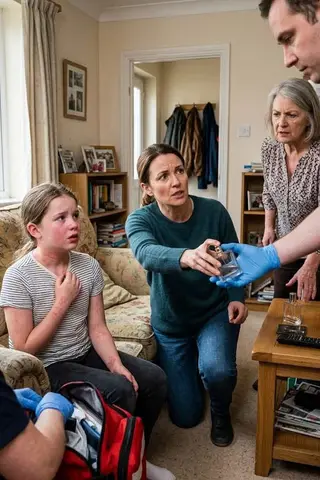
 She Claimed My Daughter Was "Faking" It
Chapter 9
Healing Scars and Severed Ties
Maya came home on a crisp Saturday morning.
The Pediatric Intensive Care Unit discharged her with clean lungs, a supply of preventative inhalers, and three brand-new autoinjectors that Mark and I placed in customized, bright-red magnetic cases around the kitchen and in her school backpack.
When our car pulled into the driveway of our two-story craftsman house in Oakridge, the world felt fundamentally different. The trees along the curb were shedding vibrant canopies of red, gold, and amber. The neighborhood was quiet, peaceful, and entirely devoid of the tension that had suffocated our home for years.
Maya jumped out of the back seat, holding her favorite stuffed rabbit tightly against her chest. She took a deep, exaggerated breath of the cool October air, her chest rising and falling easily.
"Mom," she said, looking up at me with wide, bright eyes. "The air doesn't hurt anymore."
I had to bite my lower lip to keep from breaking down in the middle of the lawn. "No, baby. It doesn't hurt anymore. And it never will again."
Mark carried her luggage inside while Maya ran straight to the backyard to check on her tire swing.
Inside the house, I walked into the kitchen and stopped dead.
On the kitchen island, sitting right where I had left it on that terrifying evening, was a half-filled glass of water and the cutting board where I had been preparing dinner before the nightmare began. Beside it lay a stack of mail that had accumulated over the past week.
Among the utility bills and catalogs was a thick, heavy cream envelope made of imported linen paper.
The handwriting on the front was unmistakable: ornate, looping, arrogant cursive written in dark purple ink. Evelyn’s handwriting.
My stomach knotted instinctively, but the feeling lasted for only a split second. It was replaced by a cold, clinical curiosity. The postmark indicated it had been mailed from the county detention center before her bail hearing, sent through her private courier service before the judge’s restraining order had been officially filed with the postal registry.
I picked up a kitchen knife, slit the top cleanly, and pulled out the single sheet of embossed paper.
Sarah, the letter read.
You have succeeded in turning our private family affairs into a vulgar public spectacle. The name Montgomery has been dragged through the local rags by ambulance chasers and sensationalists. I hope you are proud of the destruction you have wrought.
I am writing this to give you one final opportunity to salvage your inheritance and your position in this family. You will contact the District Attorney on Monday morning. You will state that you were in an agitated, hysterical mental state and that you mistakenly attributed the child’s asthma flare-up to my personal effects. You will state that the perfume was spilled accidentally by the dog.
If you do this, I will cover Maya’s medical expenses and reinstate your portion of the family trust upon my passing. If you do not, I will ensure that every asset, every property, and every family heirloom is placed in an irrevocable trust for the Historic Preservation Society. You will be left with nothing. Choose wisely.
Your Mother, Evelyn.
I stared at the paper. There was no inquiry about Maya’s recovery. No question about whether the child was alive or dead. No apology for the trauma inflicted. Just a transactional, cold-blooded threat designed to buy perjury with the promise of dead money.
"What is that?"
Mark walked into the kitchen, wiping his hands on a dishtowel.
Without a word, I handed him the letter.
He read it slowly, his jaw muscles clenching tighter with every line. When he reached the bottom, he didn't shout. He didn't curse. He simply looked up at me with an eyebrow raised. "Should I call Detective Patricia?"
"No," I said, a faint, victorious smile touching my lips. "I want Elena Ramos to have the original. This is a direct violation of witness tampering. It’s an open-and-shut evidentiary gift."
I opened the top drawer of the desk, pulled out a clean ziplock bag, and dropped Evelyn’s final ultimatum inside without touching the paper with my bare fingers.
She had thought her money was an invincible shield. She had spent a lifetime believing that everyone had a price, that every moral line could be erased with a checkbook, and that her family would always bow to the altar of her wealth.
She was wrong.
That afternoon, I walked through every room in our house with a trash bag.
I threw out the expensive crystal vases Evelyn had gifted us for our wedding. I took down the pretentious, gilded landscape paintings she had insisted we hang in the foyer to "give the home some class." I gathered every piece of expensive, hollow clutter she had used to mark her territory inside our sanctuary, and I piled it all into cardboard boxes for the local charity donation center.
When the house was stripped clean of her influence, the rooms felt larger, brighter, and infinitely warmer. The air was light. The phantom scent of synthetic jasmine that had haunted the corners of my mind for days completely dissipated, replaced by the smell of woodsmoke drifting from the neighbor's chimney and the fresh pumpkin bread Mark was baking in the oven.
Maya came in from the garden, her cheeks rosy from the wind, her hands dusted with dry leaves.
"Can I help with the bread, Mama?" she asked.
I knelt down, brushing a leaf from her brown curls, looking into the clear, vibrant eyes of my child. "You sure can, sweetie. Go wash up."
As she ran toward the sink, singing a silly playground song under her breath, I felt a deep, unshakeable sense of finality settle into my heart. We had cut the rot out of the family tree. It had been painful, terrifying, and brutal, but the branch was finally healthy.
We were free.
The End









