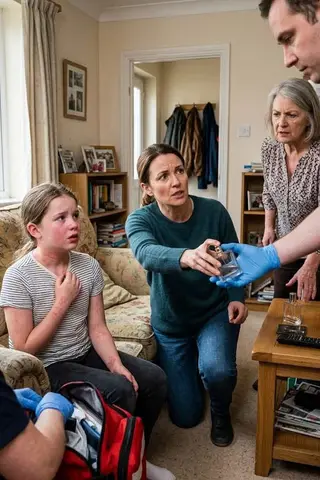
 She Claimed My Daughter Was "Faking" It
Chapter 1
The Weight of a Breath
The ambulance smelled like harsh antiseptic, wet rain, and the faint, sickening undertone of synthetic jasmine clinging to Maya’s cardigan. The paramedic, a man whose badge read Miller, moved with deliberate, frantic efficiency. His thick hands worked over Maya’s tiny chest, cutting away the cotton fabric of her sweater with trauma shears. The blade crunched through the fibers, and as the cloth peeled back, a fresh wave of the cloying scent drifted into the small cabin.
"Vitals are tanking. Heart rate one-forty, oxygen saturation dropping below eighty-six," Miller yelled over the engine roar to the driver. He plunged an epinephrine autoinjector into Maya’s outer thigh. The mechanical click sounded loud, terrifyingly final.
Maya gasped, her small back arching against the gurney. A ragged, whistling sound scraped through her vocal cords. She was only seven years old, but in that moment, her face looked aged by agony. Her lips were swollen into purplish cushions, her eyelids puffy and cracked, covered in angry red hives that crawled down her jawline like fire ants.
"Hold my hand, baby," I whispered. My own voice sounded stranger than fiction, distant and hollow, echoing through the rushing roar of blood in my ears. "Look at Mama. Keep your eyes right here on my face."
Her tiny fingers gripped mine with surprising, desperate strength. Her knuckles were stark white, trembling uncontrollably. She couldn't speak, but her brown eyes—wide, wet, and filled with a primal betrayal—pleaded for answers I couldn't bear to articulate. Why did Grandma do this to me? That was the question trapped behind those suffocating airways.
Outside, the siren wailed, bouncing off the suburban storefronts and streetlights as the evening settled into gray twilight. In the corner of the rig, sealed inside a clear plastic evidence bag, sat the vintage cut-glass perfume bottle. It looked heavy, ornamental, and harmless. But it was a weapon. It contained a discontinued, hyper-concentrated botanical blend that my mother, Evelyn, had treasured for thirty years. It was rich with pure oakmoss extract and heavy benzyl salicylate—the exact allergens Maya’s pediatric immunologist had formally documented on official hospital letterhead two years ago.
Evelyn had read that letter. She had held the paper in her manicured hands, clicked her tongue, and called the specialist an "alarmist graduate of a diploma mill."
"She’s just sensitive because you coddle her, Sarah," Evelyn’s voice rang in my memory, cold and dismissive. "Children today are allergic to hard work and discipline. In my day, a little cologne built character."
Character. My daughter was suffocating for the sake of an arrogant woman’s cosmetic pride.
"Pushing another five milligrams of diphenhydramine IV," Miller announced, flicking the syringe. "Hang in there, little girl. You're fighting good."
The ambulance lurched as it took the corner toward St. Jude’s Memorial. Maya's eyes fluttered, rolling upward toward the ceiling lights.
"Maya! Stay with me!" I leaned over the cot, pressing my forehead against her burning cheek. The heat radiating off her skin was terrifying. "Do not let go, Maya. Breathe. Just fight for one more breath."
Her tiny pulse beat against my fingertips, irregular and fluttering like a trapped moth. Every mile felt like an eternity, an agonized stretch of seconds where life hung by a frayed thread.
When the rig finally skidded to a halt at the emergency bay, the rear doors flew open with a violent metallic bang. A rush of cold autumn air swept inside, followed by a flurry of navy-blue scrubs and brisk, authoritative voices.
"Seven-year-old female, acute anaphylactic shock secondary to direct dermal and inhalation exposure," Miller rattled off as the gurney was unlatched and wheeled down the ramp at a dead run. "Epi given twice. Still stridorous."
I ran beside them, my sneakers squeaking against the wet asphalt of the bay, refusing to let go of Maya's clammy hand until the swinging double doors of Trauma Room 2 slammed shut between us.
A nurse with kind eyes stopped me, her hands firm against my shoulders. "You have to wait here, honey. Let them work. They know what to do."
I collapsed onto the hard plastic chairs in the corridor. My hands were shaking so violently I couldn't press the unlock button on my phone. When I looked down, my sleeves carried the scent of the jasmine. It made me gag. It made me want to rip the skin right off my arms.
Down the hallway, the main sliding doors whooshed open.
Footsteps approached. The measured, steady, unmistakable click of designer low-heels on linoleum.
I lifted my head.
Evelyn walked in. She was wearing her pristine camel-hair coat, her platinum hair perfectly coiffed, carrying her leather handbag tucked securely beneath her elbow. There was no sweat on her brow, no panic in her eyes, no tears staining her powdered cheeks. She looked like a woman who had arrived mildly irritated by an unexpected delay at the theater.
She stopped two paces away, looking down at me with an expression that bordered on exasperation.
"Well?" Evelyn asked, adjusting her scarf. "Did they stop the nonsense yet?"
The world seemed to stop spinning. The hum of the fluorescent lights, the distant beeping of monitors, the quiet chatter of nurses—all of it faded into a sharp, deafening silence. I stood up slowly, feeling every muscle in my body coil like a steel spring.
"Nonsense?" I asked, my voice barely a hiss.
"You called an entire squad of sirens to the house, Sarah. The neighbors were out on their porches. Do you have any idea how humiliating that was?" Evelyn sighed, checking her watch. "I told you, she just needed a cool glass of milk and some fresh air. You always overcomplicate things."
I looked at the woman who had raised me, searching for a single flicker of maternal warmth, an ounce of guilt, or even a shred of fear for her grandchild.
There was nothing. Just cold, impenetrable narcissism.
"She is in that room dying, Evelyn," I said, every syllable dripping with icy clarity. "And you sprayed that bottle right onto her chest."
"I merely touched her collar to make her smell presentable for dinner," Evelyn snapped, her defensive mask hardening. "If she is sick, it’s because her immune system is weak. Don't you dare look at me like that. I am your mother."
"You are not a mother," I whispered. "You are a monster."
The End









