 Peppermints in Chair Nine
Chapter 3
Thursday
I wanted to be angry with him for asking our daughter to keep a secret, and I was, a little. But it wasn't the kind of secret people usually make children keep. It was the kind you keep about someone's birthday present.
I didn't call him. I didn't know what I would say. Instead, the next Thursday, I took the afternoon off work and drove to the cancer center and walked up to the infusion floor as if I had an appointment.
Rochelle saw me at the desk and raised her eyebrows, and then followed my eyes and understood. She didn't say a word. She only nodded toward the far end, by the window.
Chair nine.
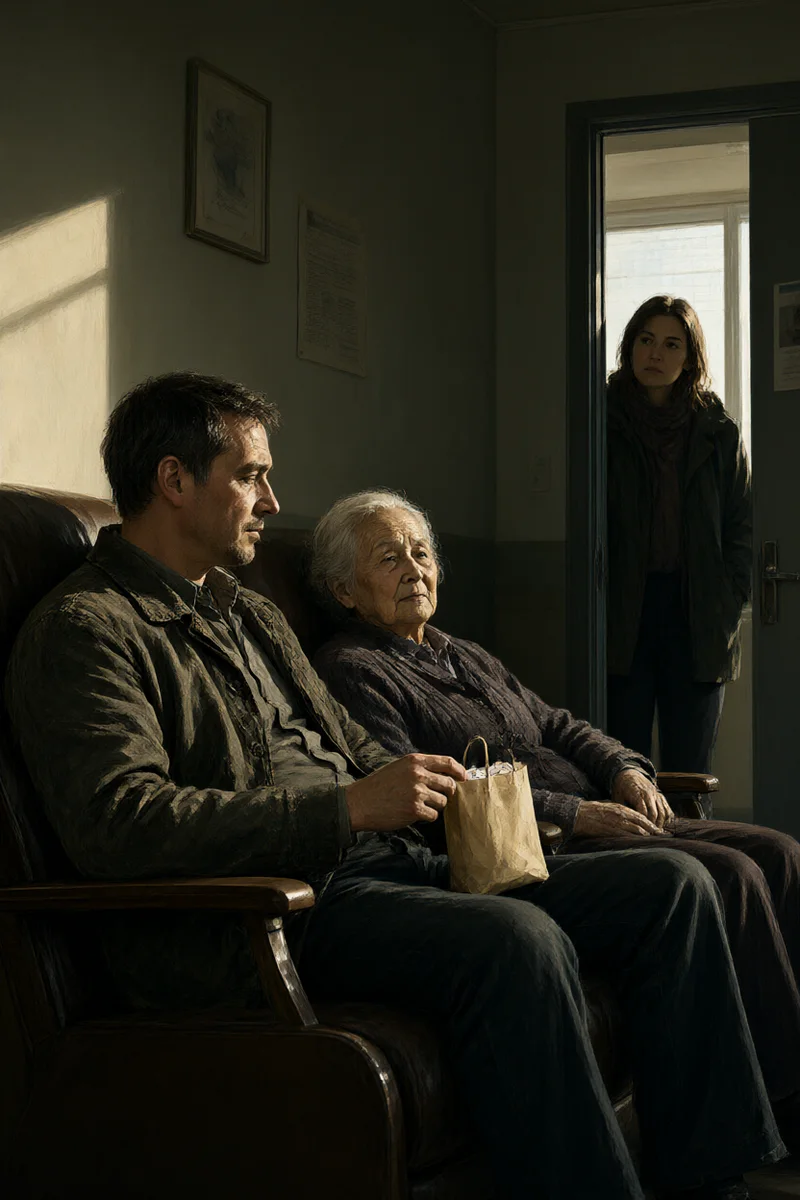
Dolores was in it, with her scarf off and her head bare and a warm blanket over her knees, her line running into her arm. Sully was in the plastic visitor's chair beside her. His coat was off and hung on the back. He had the cards fanned in one hand and the white paper bag in the other, and as I watched, she said something sharp and he laughed, a real laugh, the one I hadn't heard in two years, and held out the bag so she could take a peppermint.
He wasn't looking at the line. He wasn't not looking at it, either. It was just there, part of the room, like the window.
I stood in the doorway long enough for Dolores to see me over his shoulder. She didn't give me away. She just took another peppermint and laid down a card and said, “Gin.”
I waited for him in the parking garage, by the van. He came down at five, pushing Dolores in a wheelchair, and saw me, and stopped dead with his hands on the handles.
“She told you,” he said.
“Maisie did. Dolores just recognised me.” I folded my arms against the cold. “Why didn't you tell me?”
He got Dolores into the van first, carefully, buckling the seatbelt he'd fixed. Then he shut the door and came and stood in front of me with his hands in his pockets.
“Because I'm not doing it to get you back,” he said. “I want you to hear that. I started seeing a counsellor in March, through the union. She asked me what happened in the infusion room that first day, and I said I didn't know, and she kept asking until I did.” He looked at the concrete. “My mother. I was twelve. They sat me in the hall outside her room at County for a whole summer, and I could hear everything, and nobody ever told me I could come in. And then she was gone. I walked into that room with you and I was twelve years old in the hall again, and I ran.”
I hadn't known his mother died like that. In nineteen years, he'd only ever said she'd been sick.
“So I'm learning to sit in the room,” Sully said. “For whoever needs it. In case anyone ever needs me to again.” He looked at me. “Including you. But not only you. Otherwise it's just another way of running.”
I didn't know what to say. I said I had to go.
Three weeks later, my own follow-up scan came back with a line in it that the radiologist called indeterminate. A small shadow near the old site. Dr. Anand wanted a biopsy, soon.
The appointment card said Thursday, at nine a.m.
The End









