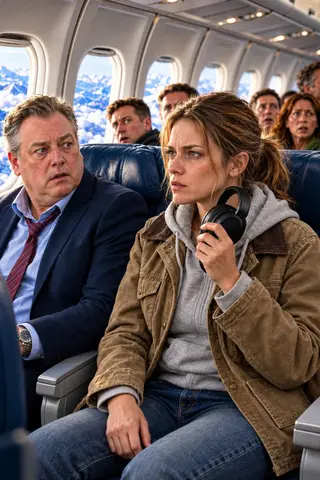
 Passenger Realizes Why Flight Attendants Are Crying
Chapter 4
The Voice on Frequency 121.5
At Seattle Center Air Traffic Control, Sector 4, the radar scope was a chaotic painting of angry green and violent red sweeps. The afternoon shift was already enduring a nightmare scenario: a massive, multi-cell squall line had swept down from the Canadian border, forcing dozens of commercial flights to alter their vectors, creating a cascading web of traffic bottlenecks over the rugged spine of the Cascade Mountains.
Senior Air Traffic Controller Marcus Vance leaned over his primary radar console, rubbing his tired eyes. His headset hissed with the overlapping, frantic chatter of pilots requesting deviations around towering cumulonimbus clouds.
Then, the emergency frequency—121.5 MHz—burst to life with a static-laced transmission that froze the blood of every controller in the room.
“Seattle Center, Seattle Center... this is Cascade Airlines Flight 442. Mayday, Mayday, Mayday.”
Marcus froze, his hand hovering over his keyboard. He immediately slammed his headset selector to the emergency channel, his voice dropping instantly into the crisp, authoritative tone reserved for aviation catastrophes.
“Cascade 442, Seattle Center, I read your Mayday. Go ahead with your emergency nature and intentions.”
The voice that came back wasn't the calm, practiced cadence of a commercial airline captain. It was taut, strained, and breathless.
“Center, this is Marcus, chief flight attendant, relaying from the flight deck. Our captain is unconscious with severe head trauma. Our first officer has a fractured arm and cannot fly the aircraft safely. We are currently being flown by a non-rated civilian... correction, a United States Navy fighter pilot who just stepped up from the passenger cabin.”
A dead, echoing silence fell over the entire Seattle Center radar room. For three full seconds, every controller stopped what they were doing and stared open-mouthed at Marcus Vance.
Marcus gripped his microphone so tightly his knuckles turned white. He looked at his supervisor, who was already sprinting over to plug in a secondary headset.
“Cascade 442, say again your last?” Marcus transmitted, his voice cracking slightly. “Did you say a fighter pilot is currently flying your commercial airliner?”
The radio crackled with static, and then a new voice broke through—deep, gravelly, and entirely devoid of panic. It was a voice that sounded like it belonged to a man who regularly landed jets on floating pieces of steel in the middle of a hurricane.
“Seattle Center, this is Lieutenant Commander Aaron Rucker, USN. Call sign currently irrelevant. I am sitting in the left seat of Flight 442. Captain is down, First Officer Lewis is conscious but incapacitated in the right seat. I have zero hours in a Boeing 767, but I know how to keep a heavy bird in the air. I need an immediate, unobstructed vector straight into Sea-Tac, emergency medical services standing by on the tarmac, and a pilot-to-pilot relay on this frequency to talk me through the avionics, approach plates, and landing configuration. Do you copy?”
Marcus Vance stared at his radar screen, watching the amber dot of Flight 442 bouncing erratically through the red storm cells. He swallowed hard, feeling the immense weight of history resting on his headset microphone.
“Copy that, Commander Rucker,” Marcus said, his voice ringing with absolute professionalism. “We have your transponder locked. You are currently twenty-eight miles east-southeast of Sea-Tac, maintaining twenty-four thousand feet, ground speed four hundred and twenty knots. Every piece of traffic in a fifty-mile radius has just been cleared out of your airspace. You own the sky, Commander. Let’s bring you home.”
Across the radar room, the supervisor was already on a dedicated secure landline to the McChord Air Force Base liaison and the Boeing flight test engineering department in Renton. Within sixty seconds, they had managed to patch in a retired Boeing 767 chief instructor pilot—Captain Howard Sterling—directly into Aaron’s headset frequency to act as his personal, real-time flight instructor.
The static clicked, and a calm, weathered older voice filled Aaron’s left ear.
“Commander Rucker? This is Howard Sterling. I’ve got thousands of hours in the 767. I’m looking at your exact instrument telemetry right now on our simulators in Renton. You’re doing a hell of a job keeping her level. Now, let’s get you configured for descent. Are you ready to talk numbers?”
Aaron glanced across the flight deck at Nate Lewis, who nodded weakly in agreement, before keying his control yoke mic.
“Talk to me, Howard,” Aaron said, his eyes scanning the blinding array of dials and digital readouts. “Tell me how to land this flying apartment building.”
The End









