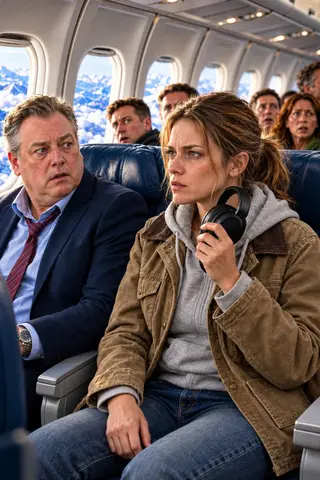
 Passenger Realizes Why Flight Attendants Are Crying
Chapter 1
The Descent into Chaos
The cabin air of Cascade Airlines Flight 442 was stale, scented with cheap coffee and the distinct metallic tang of recirculated oxygen. Outside, the midday sky over the Midwest had turned an bruised, violent purple. Inside, two hundred and nine passengers were blissfully unaware that they were flying directly into a meteorological nightmare.
Lieutenant Commander Aaron Rucker sat in seat 8B, his long legs cramped against the back of the seat in front of him. He was exhausted. A thirty-six-hour rotation aboard a naval facility in Texas had left his bones aching, and his mind was already drifting toward the connecting flight in Seattle that would take him home to Anchorage. Next to him, a retired schoolteacher named Helen had spent the first forty-five minutes of the flight recounting the intricate details of her grandchildren’s latest school play. Aaron had listened with the practiced patience of a man trained to endure grueling debriefings. When she finally paused to sip from her small plastic water bottle, Aaron let his baseball cap drop an inch lower over his eyes, crossed his arms over his navy-blue jacket, and let sleep pull him under.
It didn't last.
The jolt didn't feel like normal turbulence. Normal turbulence was a rhythmic bouncing, a gentle roll that made the wings flex like a bird's feathers in a headwind. This was an instantaneous, brutal drop that felt as though the floor had literally vanished beneath the aircraft.
Aaron’s eyes flew open instantly. His instincts, honed by thousands of hours in high-performance military jets, bypassed sleep-inertia in a millisecond. His right shoulder slammed hard against the locked seat belt, bruising muscle against bone.
Across the cabin, chaos erupted with terrifying speed. A collective gasp of pure terror tore from two hundred throats, instantly swallowed by the screech of metal, the rattling of overhead compartments vomiting loose luggage, and the sickening sound of a heavy beverage cart breaking free of its galley locks. It smashed violently into the aisle, spilling ice and crushed cans in a chaotic wave. A woman three rows back screamed, a sharp, piercing sound that cut through the background roar of straining engines.
Aaron didn't scream. He didn't flinch. His eyes locked onto the small, oval window beside Helen. Outside, the wingtips were flexing violently, shedding sheets of rain that plastered against the glass like iron filings. The aircraft rolled—hard to the left. The horizon tilted at an unnatural, frightening angle. For a fraction of a second, the nose dropped further, and Aaron felt that sickening weightlessness in his stomach that told him the aircraft was descending far too fast.
Then, the automatic stabilization systems kicked in. The nose came up. The wings leveled. But it wasn't clean. It wasn't the smooth, computerized response of a healthy commercial airliner. The aircraft shuddered violently, shaking from nose to tail as if it were fighting its own skeleton. It rolled slightly back to the right, overcorrected, dipped its nose again, and then dragged itself back onto a semblance of an even keel.
Aaron frowned deeply, his jaw tightening. His mind was already calculating vectors, airspeeds, and aerodynamic stress. Turbulence didn't make an aircraft fight itself like a bucking bronco. That erratic, stuttering recovery meant one thing: the controls were being fought, or worse, the autopilot was malfunctioning and the human inputs were frantic, ragged, and desperate.
He glanced down at his tactical watch. 1:42 PM.
He waited for the captain's voice. Usually, within thirty seconds of severe turbulence, a calm, measured voice would echo through the cabin: “Folks, we’ve just hit a bit of rough air, please return to your seats and fasten your seatbelts.”
One minute passed.
Then two.
Then five.
The silence from the flight deck was deafening. It was a vacuum where reassurance should have lived, and it filled the cabin with a suffocating dread. The flight attendants had stopped serving drinks long ago. Now, they were scurrying up and down the aisles, their faces rigidly composed, yet their eyes darted around with unmistakable panic. They were whispering urgently into their handheld cabin phones, their knuckles white as they gripped the seatbacks to steady themselves against the lingering, unstable roll of the aircraft.
Helen turned toward Aaron, her hands trembling as she clutched her purse. Her face had gone completely pale, stripped of all its cheerful warmth. “Aaron… why hasn't the captain said anything? What is going on?”
Aaron didn't answer right away. He was watching the chief flight attendant, a tall man named Marcus, who was sprinting toward the front galley with a first-aid kit clutched tightly to his chest.
“Something happened up front,” Aaron said, his voice terrifyingly quiet, devoid of panic yet heavy with absolute certainty.
Helen swallowed hard, her eyes widening behind her bifocals. “What do you mean? Like an engine fire? Like mechanical failure?”
“I think somebody's hurt,” Aaron replied, his gaze fixed on the reinforced door at the front of the cabin—the door that led to the flight deck, a door that suddenly looked miles away.
Before Helen could speak, the cabin speakers hissed and crackled to life. The voice wasn't the smooth baritone of the captain. It was a high-pitched, tense female voice belonging to the chief flight attendant.
“Ladies and gentlemen, if there is a doctor or nurse on board, please press your call button immediately.”
The words hung in the air like a physical weight. Helen grabbed Aaron’s sleeve, her fingers digging through his jacket fabric. “A doctor? Because of turbulence? People don't need doctors for turbulence, Aaron!”
Aaron didn't look at her. His eyes were locked on the flight deck door. His military training screamed at him that a medical emergency in the cabin was bad, but a medical emergency that required a doctor while the aircraft was handling erratically meant the worst possible scenario had unfolded.
Ten agonizing minutes crawled by. The aircraft continued its unnatural, jerky dance through the clouds, losing altitude in a slow, insidious spiral that made Aaron’s inner ear ring. No doctor stood up. No call lights flashed.
Then, the speakers crackled again.
“If there is a qualified airline pilot traveling as a passenger, please identify yourself to a member of the cabin crew immediately.”
Aaron sat up straight, his shoulders squaring automatically.
Helen turned to him, her voice a desperate whisper. “Aren't you a pilot? Weren't you just talking about flying?”
“I fly military aircraft, Helen,” Aaron said, his eyes dark and focused. “Fast jets. F/A-18s.”
“That's still flying! Planes have wings, controls, engines—go up there!”
“It's not the same kind,” Aaron countered, shaking his head. “A commercial heavy is a different beast entirely. Different systems, different redundancies, different weight. If there's an airline pilot aboard who flies Boeing aircraft, they need that person first. They know the switches.”
He waited. He scanned the faces of the passengers around him, wondering if some retired airline captain was sitting a few rows back, hesitant to step forward. But nobody moved. The flight attendants were moving faster now, rushing down the aisles, bending low, whispering urgent questions into rows of passengers, their eyes scanning faces with mounting desperation. Time was running out, and the aircraft gave another sickening lurch as it clipped a pocket of severe shear wind.
Then, the third announcement came.
This time, the flight attendant's voice didn't just tremble—it cracked, betraying a raw, naked terror that pierced the very soul of everyone on board.
“Is there a fighter pilot on board? Any military pilot who has flown jets? Please... we need you immediately.”
Helen looked directly into Aaron’s eyes, her expression pleading. “Well?”
Aaron closed his eyes for one single second. He thought of his career, his training, his aircraft, and the hundreds of carrier landings he had executed in the pitch-black dead of night over raging seas. He opened his eyes, reached his hand up, and firmly pressed the call button.
The End









