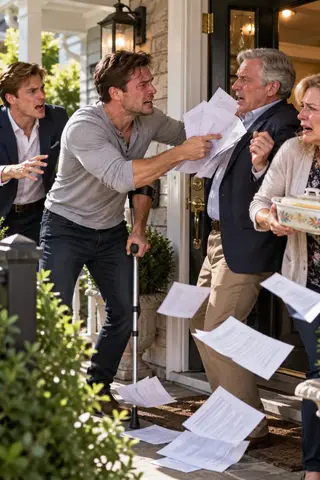
 Parents Abandoned My 7 & 5-Year-Old Children Outside While I Was Under Anesthesia For Spinal Surgery
Chapter 7
The Reckoning at the Doorstep
Three weeks passed in profound, uninterrupted peace.
Without the toxic static of my parents’ demands, our household found a new, harmonious rhythm. My back continued to heal under physical therapy, allowing me to lift Harper into my arms without wincing and toss a baseball lightly with Wyatt in the backyard. Chloe’s advertising campaign in Seattle had been a massive commercial success, landing her a promotion to Vice President of Marketing, and we celebrated with a quiet, beautiful dinner at home—just the four of us, exactly where we belonged.
We had successfully severed the diseased branches of our family tree, and the rest of the garden was finally blooming.
Then, on a crisp Saturday afternoon, the illusion of total immunity was gently tested.
I was out on the front lawn raking autumn leaves into neat piles while Wyatt chased a soccer ball across the grass. A familiar, slate-gray SUV pulled slowly to the curb and parked right in front of our driveway.
My heart rate didn't even spike. I didn't feel panic, or anger, or dread. I simply stopped raking, leaned lightly on the handle of the rake, and watched.
The passenger door opened, and my father, Richard, stepped out. He looked older than his years—his shoulders slumped beneath a worn wool coat, his hair uncombed, the arrogant, easygoing posture completely replaced by the heavy, defeated shuffle of a beaten man.
He didn't march up the driveway like my mother had weeks ago. He stood hesitantly by the front bumper, looking across the lawn toward me as if approaching a volatile construction site with uncalibrated safety equipment.
I didn't invite him in. I didn't walk over to greet him. I just stood my ground, waiting to see what load he was carrying.
Richard took a slow, tentative step up the driveway, clearing his throat nervously. "Harrison."
"Richard," I replied, my voice completely neutral.
He flinched slightly at the use of his first name instead of 'Dad,' but he didn't correct me. He looked down at his worn leather shoes for a long moment before looking back up.
"The bank issued the formal foreclosure notice on the house this morning," he said, his voice cracked and hollow. "The 4th Street building is gone. The commercial buyers walked away when the deed fell through, and the second mortgages... well, the adjustable rates reset yesterday. We can't make the payments, Harrison."
I listened without interrupting. No rush of adrenaline. No sudden urge to offer a solution.
"Preston’s loft lease was terminated this morning," Richard continued, his voice dropping to a near-whisper. "He packed his bags and moved into some cheap motel downtown. He... he blamed us for ruining his business opportunity. He told us we were useless, and then he blocked our numbers."
A grim, tragic irony washed over me. For twenty-six years, my parents had sacrificed everything—their retirement, their peace of mind, their relationship with their eldest son, and the safety of their grandchildren—to protect and elevate Preston. And the very second the money ran out, the golden boy discarded them like empty soda cans.
"I'm sorry to hear that," I said, and for the first time in my life, I actually meant it. Not out of affection, but out of sheer, unadulterated pity.
"Your mother... your mother hasn't stopped crying for three days," Richard added, his voice breaking as a tear finally slipped down his weathered cheek. "She realizes what she did. She knows about the kids, about the porch... she knows we messed up, Harrison. Beyond repair."
"Yes," I agreed quietly. "You did."
He looked at me with hollow, pleading eyes, the last desperate embers of a lifetime of entitlement flickering in his gaze. "Is there... is there any way the guarantor clause—is there anything you can do to help us save the house, Harrison? Just the house. We have nowhere else to go."
I looked at my father—the man who had missed my championship baseball game for a pair of basketball shoes, who had arrived late to my graduation, who had left my five-year-old daughter crying on a concrete porch while he paid for a luxury suit.
I didn't feel anger. I felt the profound, crystal-clear clarity of an engineer inspecting a collapsed structure that could never be rebuilt on a rotten slab.
"No, Richard," I said softly, my voice firm and immovable. "There is nothing I can do. The load-bearing limits were exceeded years ago. You built your house on sand, and you spent your whole life refusing to reinforce it."
Richard closed his eyes, his head bowing slowly as the final weight of reality settled onto his shoulders. He didn't argue. He didn't call me ungrateful or dramatic. He simply turned around, walked slowly back to the passenger seat of the SUV, and climbed inside.
The gray vehicle pulled away from the curb, driving off down the suburban street, disappearing into the afternoon shadows.
I turned back around, dropped the rake into the grass, and watched Wyatt kick his soccer ball straight into the center of the net.
The foundation of our new life was solid, level, and entirely secure. And nothing would ever crack it again.
The End









