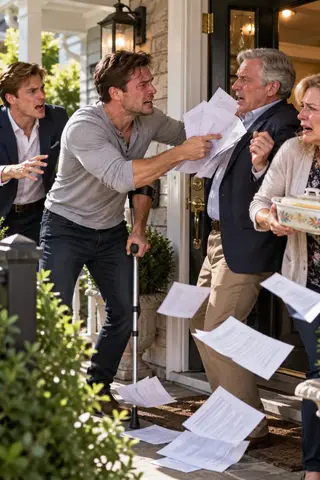
 Parents Abandoned My 7 & 5-Year-Old Children Outside While I Was Under Anesthesia For Spinal Surgery
Chapter 1
The Cold Concrete and the Burning Spine
The sterile, chemical smell of the hospital recovery room was the first thing that registered. The second was the agony. It felt as though someone had taken a blowtorch to my lower lumbar, fusing bone and titanium with white-hot precision. My legs were heavy, numb blocks of ice, utterly detached from my commands. I blinked against the harsh fluorescent glare, my throat dry as sandpaper, my chest tight with the residual effects of general anesthesia.
And then, I saw the screen of my phone glowing relentlessly on the metal bedside table.
Fourteen missed calls. All from Martha Gable, our sixty-eight-year-old neighbor across the street.
Panic surged through my veins, sharp and adrenaline-fueled, threatening to tear right through the pain meds. My thumb trembled violently as I unlocked the screen. The latest notification was a text message: Harrison, your kids are on my porch. Your parents left two hours ago. Please call me the second you read this.
My breath hitched. My son, Wyatt, was seven. My daughter, Harper, was only five.
Just hours earlier, I had kissed their foreheads, trusted my aging parents, Richard and Brenda, to watch them for six short hours while I underwent major spinal fusion surgery, and driven myself to the hospital because my wife, Chloe, was trapped in Seattle presenting the biggest marketing campaign of her corporate life.
Now, my children had been abandoned.
I hit call, my hand shaking so hard I nearly dropped the phone. Martha picked up on the first ring.
"Harrison? Oh, thank God," Martha’s voice shook, tight with a mixture of relief and suppressed fury. "They’re safe now. They’re sitting in my kitchen eating peanut butter sandwiches."
"Martha... what happened?" I whispered, my voice cracking, tears stinging the corners of my eyes despite my best efforts.
"I was out back watering my hydrangeas," Martha explained, her cadence clipped and tense. "I saw your parents’ SUV back out of your driveway around eleven this morning. I figured they were taking Wyatt and Harper to the park or getting ice cream. It was a bit odd that nobody waved, but I didn't think much of it. Then, about an hour ago, I heard wailing. Not just crying, Harrison—terrified sobbing."
My heart hammered against my ribs. "Go on."
"I dropped the hose and ran to the fence," Martha continued, anger bleeding clearly into her tone. "Harper was curled up on your front porch concrete steps, crying her eyes out. Wyatt was right beside her, holding her little hand, patting her back, and telling her that Daddy and Mommy would come back soon, trying to be so brave. The front door was locked tight. There wasn't an adult within a mile radius. They had been out there in the heat for hours, Harrison. Alone."
A cold, heavy numbness settled over me, eclipsing even the post-surgical trauma. My mind raced back to the morning of the surgery. I had prepared a thick blue manila folder—emergency contacts, insurance cards, pediatrician info, allergy alerts, and Martha’s direct phone number. I had laid it all out on the kitchen counter in plain sight. My parents had acknowledged it. My mother had flashed that warm, practiced, martyr-like smile of hers and promised board games, homemade chocolate chip cookies, and absolute safety.
Instead, they had vanished.
"Martha, thank you," I choked out, a dark, unfamiliar rage beginning to curdle in my gut. "Thank you for saving my kids. I'm coming home."
"Harrison, you just had spinal surgery! You can't even stand up yet—"
"Watch me," I muttered, and dropped the call.
My name is Harrison. I am thirty-two years old, and I am a structural engineer. My entire professional life is built around understanding pressure, calculating load-bearing limits, studying stress points, and figuring out precisely how much weight a foundation can carry before it catastrophically fails. For thirty-two years, I had applied those exact principles to every bridge, high-rise, and commercial warehouse I designed.
Yet, for my entire life, I had completely failed to apply that exact same logic to my own family.
In the family I grew up in, I was never a person; I was a utility. If a pipe burst in my parents' basement, they called me. If heavy furniture needed moving, if a holiday dinner table needed extending into the garage, if there was complex tax paperwork nobody wanted to decipher, I was the designated fixer. Useful was my assigned role, carved into me through years of quiet compliance.
My younger brother, Preston, had a completely different job description. He was the protected prince. At twenty-six, Preston called himself a serial entrepreneur, but in reality, every single one of his business ventures began with our parents funding a reckless scheme and ended with them frantically bailing him out of debt.
The disparity had been glaringly obvious since we were children. The family calendar bent entirely around whatever whim Preston possessed at any given moment. My academic achievements, my athletic victories, and my quiet independence were treated as background noise—things that could always be acknowledged later, if there was ever any spare time.
My parents had interpreted my self-reliance not as a virtue, but as proof that I required zero emotional investment. Meanwhile, Preston's perpetual, manufactured helplessness became absolute proof that he deserved every ounce of their attention, money, and devotion. That toxic dynamic followed us straight into adulthood. Every crisis Preston orchestrated became an urgent, all-hands-on-deck emergency. Every responsibility I carried quietly—building a career, buying a modest home, marrying Chloe without asking them for a dime—was treated as evidence that I could easily carry one more burden.
I had spent my entire childhood telling myself it didn't hurt. At sixteen, I pitched a perfect game in our high school baseball championship, throwing the final strike to win the pennant. When the crowd erupted, I looked toward the bleachers for my parents, expecting to see them cheering. Their seats were entirely empty. Later, I discovered Preston had thrown a violent temper tantrum because he desperately wanted a pair of limited-edition basketball shoes. Instead of watching their eldest son's biggest athletic milestone, my parents had driven him two hours to a specialty boutique in the city and missed the game entirely.
When I graduated from university with top honors, they arrived an hour late because Preston had overslept and Mom flatly refused to leave the house without him. When Chloe and I got married, we paid for everything ourselves—six hundred dollars for a simple, beautiful backyard barbecue with close friends. Mom complained about the humidity for two solid hours and insisted they leave before dinner was even served because Preston was "bored and wanted to go see a movie."
One month later, my parents took out a second mortgage on their suburban home to buy Preston a brand-new luxury sports car for his twenty-first birthday.
Eventually, I learned the ultimate defense mechanism: I stopped asking them for anything. I built an emotional fortress of absolute independence. If I expected nothing from them, they could never truly disappoint me.
Until today. Until my back gave out, and I had no other choice.
I pressed the call button on my phone again, dialing my father’s number. It rang twice before he answered. In the background, soft classical music played, accompanied by the distinct, cheerful clinking of crystal wine glasses. My father sounded relaxed, airy, completely unbothered.
"Harrison? Are you out of surgery already? Your mother is busy right now—"
"Where are my children?" My voice was low, flat, and dangerously controlled.
There was a brief pause on the other end, followed by an exaggerated, heavy sigh, as if I were a mildly annoying salesman interrupting his afternoon relaxation. "Oh, relax, Harrison. Why are you always so high-strung? They’re fine."
"They are sitting at our neighbor's house because you and Mom abandoned them locked outside in the afternoon heat," I hissed, every vertebra in my spine screaming in protest as I tried to sit up. "Where the hell are you?"
Dad sighed again, dripping with condescension. "Your brother needed his suit fitted for tonight. It's a custom Italian cut, Harrison. Preston has a massive networking gala this evening, and he can't look cheap in front of investors. We had to drive into the city to put the deposit on our credit card. It couldn't wait."
I stared blankly at the sterile white hospital ceiling, the absurdity of his words washing over me in cold waves. "You left my seven-year-old son and five-year-old daughter locked outside alone... for a suit fitting?"
"They were only gone for a couple of hours! Stop being so damn dramatic," Dad snapped back, his tone turning defensive and irritated. "You engineers always overcomplicate everything. They survived, didn't they? Now stop bothering us, we're in the middle of a very important consultation."
My spine felt like it was still burning in the furnace, but inside my chest, something fundamental and permanent snapped. All the years of accommodating, of swallowing my resentment, of pretending I didn't care—it all dissolved into absolute clarity.
"Do not ever," I whispered, every syllable razor-sharp, "contact my children again."
Before he could sputter a response, I ended the call.
The nursing staff tried to argue with me, warning me about internal bleeding, suture integrity, and post-op protocol. I didn't care. I signed the AMA (Against Medical Advice) discharge papers with a hand that refused to stop shaking, paid out of pocket for a private medical transport car service, and had them drive me straight home.
When the car pulled up to our house, I leaned heavily on a black metal cane, my teeth gritted against the agonizing pull of every step.
Martha was still in my kitchen. Wyatt looked up as I limped through the back door. My brave seven-year-old had a smudge of peanut butter on his cheek and dark, worried circles under his eyes, but the moment he saw me, he tried to straighten up and put on a brave face.
That heroic little expression nearly broke me entirely.
I dropped the cane, ignored the tearing sensation in my lower back, and dropped carefully to my knees on the linoleum floor, pulling both Wyatt and Harper into my arms and burying my face in their hair.
"I'm so sorry," I choked out, tears finally breaking free. "I am so, so sorry."
Wyatt patted my shoulder, his small voice trembling. "It's okay, Dad. I took care of her. I remembered what you told me about Martha's house."
"No," I whispered fiercely, holding them tighter. "You should never, ever have had to."
That night, after the kids were finally asleep in their beds, exhausted from the emotional trauma of the day, I sat alone at the kitchen table under the dim glow of a single overhead light. My back throbbed with a relentless, punishing rhythm, but I felt nothing.
I unlocked my phone, opened Instagram, and navigated to Preston’s public profile page.
There it was, posted less than an hour ago.
A heavily filtered, high-contrast photograph taken inside an exclusive, ultra-luxury downtown tailoring salon. Preston stood proudly in front of a massive gilt-framed mirror, striking a pose in a bespoke, midnight-blue wool suit, grinning like a king. Slumped comfortably on a velvet Chesterfield couch right behind him were my mother and father, both holding crystal flutes filled with sparkling wine, looking utterly radiant and proud.
The caption, written in Preston’s obnoxious, self-absorbed style, read: Mom and Dad funding the $1,000 look for the new empire. Big things coming!
I checked the timestamp on the post.
1:00 p.m.
At precisely one o'clock that afternoon—while my five-year-old daughter was sobbing in terror on a scorching concrete porch and my seven-year-old son was desperately trying to act like a grown-up to protect her—my parents had been clinking champagne glasses in a luxury boutique, paying for a suit so my brother could play businessman.
I saved the photograph directly to my camera roll. It was the ultimate piece of irrefutable evidence.
Then, I looked down at the thick blue manila folder I had meticulously prepared that morning to keep my children safe. It had started as a simple emergency reference guide for babysitters.
Now, sitting in the quiet kitchen, I realized what that folder was truly destined to become. It was going to become a dossier.
For the very first time in thirty-two years, I was not going to call my parents to argue, to plead, or to ask them to understand the gravity of what they had done. I was simply going to lock the door, shut the gate, and permanently revoke every single ounce of access they had ever enjoyed to my life, my home, and my children.
The foundation was cracked, structurally unsound, and completely rotten at the base. It was time for a total demolition.
The End









