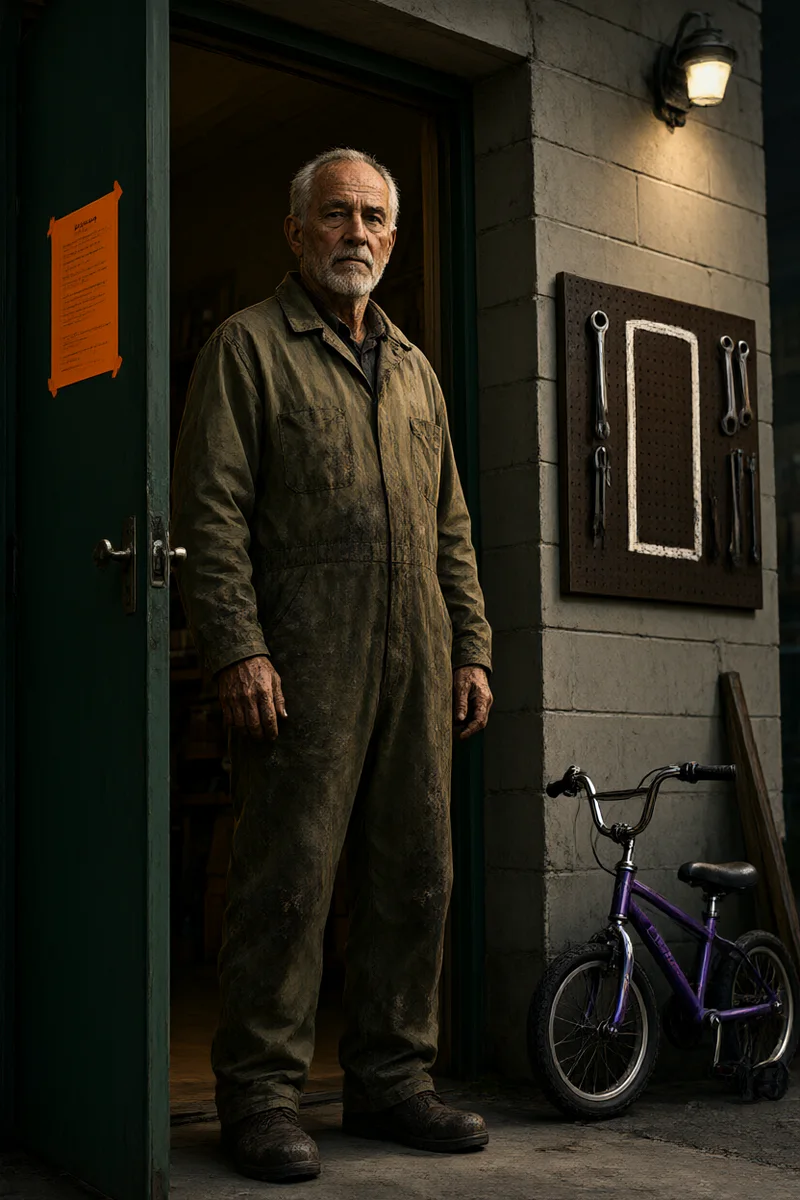
 Owes One Hour
Chapter 4
Line Two
“I can't lift the order,” Renata Alvarez said. “I wrote it, and I'd write it again. That truss is going to come down on a child. And I can't sign off the repair, because my name's in your book. Somebody else from the office will do the final.”
“Then what use are you?”
“I can hold a ladder. I've got an hour.” She gave him a sheet of paper. “That's every item the next inspector will look at. I'm allowed to hand that to anybody.”
Stan went to the door.
The alley was full from the corner to the Okoros' fence. There were sixty people at least, most of them in their thirties and forties, in work gloves and old shoes. Nobody had brought a casserole. A woman in a rain jacket had a roll of drawings under her arm. A man had a generator in a wheelbarrow.
“Priscilla Tan,” said the woman with the drawings. “Two thousand and three, bent derailleur hanger. I'm a structural engineer now. These are stamped. I measured through your window on Thursday, I hope that's all right.”
“It's not.” “Well. I owe you an hour.”
A licensed electrician owed him three. A bus driver owed him one and said he could carry things. They had not come to save his garage for him. They had come to pay him what the book said, which was different, and he could find no way to refuse it.
The demolition man turned up at eight, took one look down the alley, and backed his truck out again. So Stan ran it the way he had always run it. He stood in the middle of the floor and pointed.
It took four Saturdays. Dale's crew lifted out the old trusses and the bed rail came down with them, and Stan would not let anyone throw it away. The new ones went up white and smelling of pine. People came for their hour and stayed for five. Imani kept the ledger on a clipboard and made every one of them sign beside their own line.
On the third Saturday a man who sold insurance could not get a nut started on a hanger bolt, overhead, with his arms full.
“Give it here,” Stan said, from habit.
He got the nut to the end of the bolt. He could not get it to bite. It chattered against the thread, and slipped, and rang on the concrete. The sound was small, but the garage went quiet. A dozen people stood about looking at their boots.
Stan stared at his own hand as if it belonged to an apprentice.
Dale Purvis bent and picked up the nut. He spun it on with two fingers, and he did not look at Stan while he did it.
“Hold the light for me, would you,” he said. “I can't see a thing up here.”
It was broad day and the bay door was open. Stan took the trouble lamp off its hook and held it up, and after a minute the talk started again around him.
The second inspector came on the twenty-seventh day. He was a young man named Corbett. He spent an hour on a stepladder with Priscilla's drawings, and signed the first line of the order as cured.
Stan was peeling a corner of the tape when Renata put her hand flat on the notice.
“Not yet. Nobody's read you line two, have they?” She said it kindly. “You wouldn't let the girl finish. The roof was never the real problem, Mr. Wojcik. You've been running a repair shop for the public in a private garage for forty years. I can't make that legal by pretending I didn't see it.”
“So it comes down anyway.”
“There's one way I know to cure it.” She looked round at the new trusses, and at him. “You're going to hate it.”
The End









