 Owes One Hour
Chapter 2
The Empty Outline
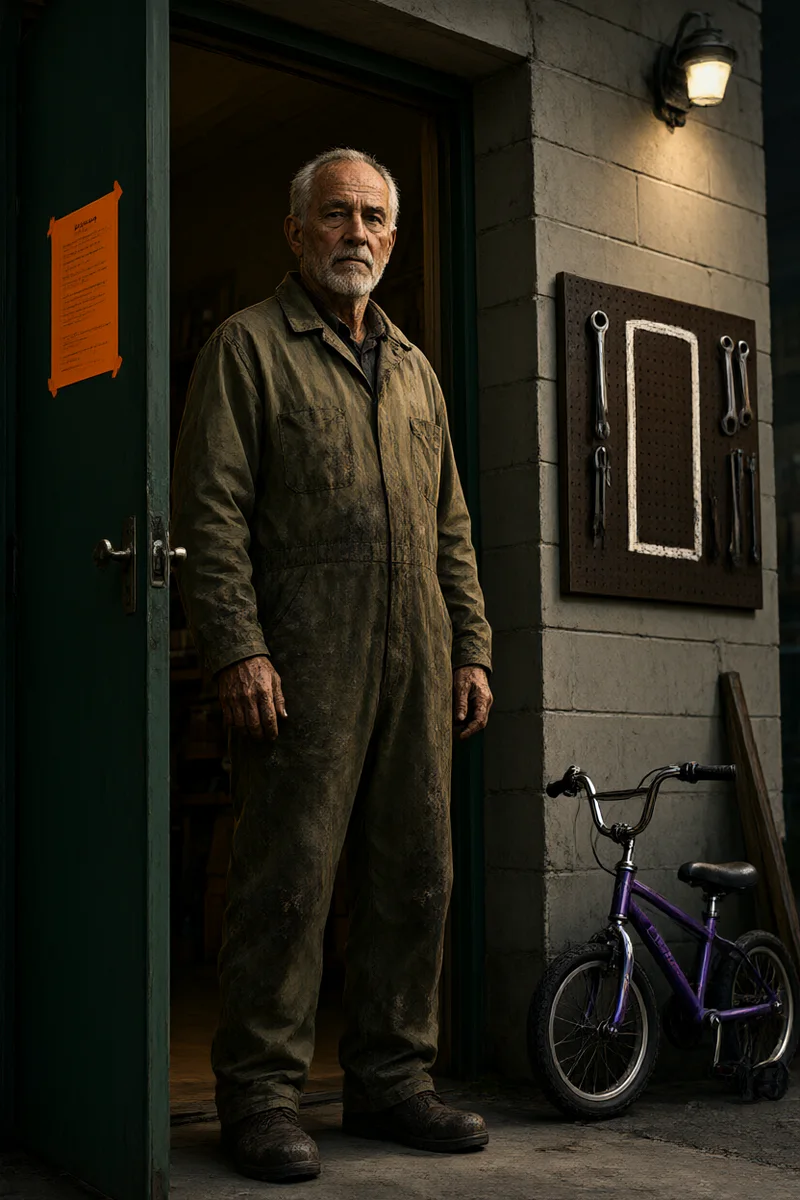
Every tool on Stan's pegboard hung inside its own outline, painted in white enamel by his father, so that a man could see at a glance what was missing.
One outline had been empty since 1993. It was the shape of a nine-sixteenths combination wrench. Stan had bought two replacements over the years, and kept both in a drawer.
The boy's name was Dale Purvis. He was eleven that summer, a skinny kid who lived over the laundromat and turned up most days whether his bike was broken or not. He had good hands. Then one August afternoon the wrench was gone and so was he, and the line Stan had written for him in the ledger got a stroke through it and one word in capitals.
Stan had told that story to thirty-odd years of children as a warning. Now he walked three houses down in his slippers and knocked on the Okoros' door with the side of his fist.
Folake Okoro opened it in hospital scrubs. Past her, at the kitchen table, sat Imani and a laptop and the black composition book.
“She was going to bring it back before you woke up,” Folake said. “I've told her what I think of the method.”
“I photographed every page,” Imani said. She did not look sorry. “Mum typed while I read them out. There's one thousand four hundred and twelve lines, Mr. Wojcik. Some people are in there nine times.”
“That book's private.” “It's on a nail. It's got my name in it four times.”
“What have you done with it?”
Folake turned the laptop round. It was the neighbourhood's message board, the one where people complained about parking. Somebody had put up a photograph of the orange notice and, under it, the first page of the ledger. There were two hundred and six replies. Stan did not read them.
“Those hours aren't yours to call in.”
“You were never going to call them,” Imani said. “You were going to let them knock it down and not tell anybody. You already got a price. I saw it in the drawer.”
“It's forty-eight thousand dollars and I'm seventy-seven. It was my father's garage, and I'll say when it's finished.” He picked the ledger up off the table. “Forty years is plenty. I'm tired.”
“You're not tired,” Imani said. “It's your hands.”
The kitchen was quiet. The fridge hummed.
“You haven't done a cable since last summer. You say your thumbs are busy and I do it. I did Marcus's whole derailleur.” Her chin had started to wobble, and she got it under control. “I didn't tell anyone. I didn't put that in. I wouldn't.”
Stan stood there with the book against his chest. He could feel it shaking a little, which was his fault and not the book's.
“Mind your own tyres,” he said, and went home.
He telephoned a demolition outfit that afternoon. The man said he could come and look on Saturday, early.
On Saturday at seven somebody knocked on the steel of the bay door, three flat raps. Stan put down his coffee and ran the door up, ready to talk price.
It was not the demolition man. This one was in his forties, grey at the temples, in steel-toed boots and a canvas jacket with a company name stitched on the chest. He had a hard hat under one arm.
In his other hand, held out flat, the way you would offer something to a horse, was a nine-sixteenths wrench.
The End









