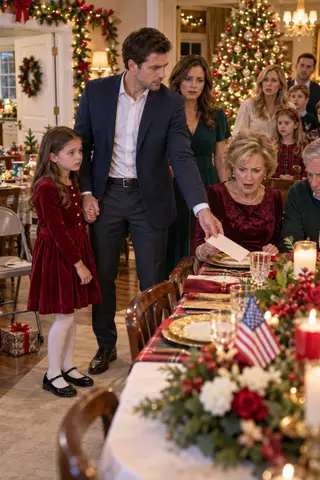
 My Mother Put My Adopted Daughter by the Trash Can on Christmas
Chapter 4
The Poison in the Bloodline
To understand why Eleanor Vance would subject a nine-year-old child to deliberate public humiliation, you had to understand the sickness that ran through her veins: the obsession with aristocratic pedigree.
Eleanor was the daughter of an old Virginia tobacco clan that had lost its acreage in the 1960s but clung desperately to the social register. When I was growing up, appearance wasn't just important; it was the only religion practiced in our household. Grades, athletic trophies, the cut of our suits at Sunday service—everything was measured by how it reflected upon Eleanor.
My rebellion had started early. While Chloe conformed, attending the right debutante balls and marrying Brad—a man whose sole qualification was a recognizable Virginia surname and a grandfather who had once been a federal judge—I walked away. I studied architectural engineering at Georgia Tech, working construction sites during the summer heat while my peers sailed in Nantucket.
When I met Nah, Eleanor was horrified. Nah wasn't from the country club circuit. Her family were hardworking Vietnamese-American immigrants who owned a small chain of dry cleaners in Northern Virginia. They were people of deep faith, quiet dignity, and immense generosity—everything my mother despised because it couldn't be bought in an antique boutique.
And then there was Leah.
When Leah’s biological father, Mark, died in that catastrophic offshore rig blowout in the Gulf of Mexico, I had spent two weeks in the hospital waiting room with Nah. Mark had been my brother in every way that counted. On his deathbed, his body burned and failing, he looked at me and whispered three words: "Keep them safe."
I didn't marry Nah out of obligation. I fell deeply, completely in love with her grace, her resilience, and her fierce maternal devotion. And Leah became my heart. When she was four, she developed a severe pneumonia that kept her in pediatric ICU for ten days. I slept in an upright plastic chair beside her oxygen tent, holding her tiny hand, praying to any God that would listen to take my life instead of hers.
When she pulled through, I legally adopted her.
I remember bringing the adoption decree to my parents' house six years ago, proud, radiant, ready to celebrate.
My father had mumbled congratulations and poured another glass of bourbon. But Eleanor had looked at the certified court document with pure disdain, as if I had handed her a used tissue.
"Well, Graham," she had remarked with an icy smile, smoothing her silk blouse, "it’s very noble of you to do charity work for your friend’s unfortunate situation. But you must be practical. A child from that background... with that blood... you can't truly expect the family estate to pass down to someone who isn't a Vance. Chloe’s children are Robert’s true heirs. That is simply nature."
"Leah is my legal heir, Mom," I had told her back then, my voice shaking with restrained rage. "She is a Vance. She carries my name, and she will inherit everything I build."
From that afternoon forward, Eleanor waged a covert war of passive-aggressive erasure against my daughter.
When Leah was five, Eleanor gave Mason and Piper custom silver monogrammed bracelets for Easter; Leah received an open box of generic sidewalk chalk.
When Leah was seven, my parents hosted a massive fiftieth-anniversary gala at the Commonwealth Club. When the photographer gathered the grandchildren for the formal family portrait, Eleanor loudly told the room, "Oh, Leah darling, why don't you run over to the dessert table and grab a cookie? This photo is just for the direct descendants."
Nah had taken Leah home that night, and I had spent two hours screaming at my parents in their study. My father had begged me not to make a scene, pleading that his heart couldn't take the stress. Eleanor had wept manufactured tears, claiming she "simply slipped up" and didn't mean anything by it.
I had foolishly given them another chance. I believed that as Leah grew older, her sweet, undeniably brilliant nature would melt Eleanor’s frozen pride. Leah was an honor roll student, played the violin, and never forgot a birthday. For Eleanor's 68th birthday, Leah spent an entire month saving her allowance to buy Eleanor an antique brass sewing kit because she heard Eleanor mention her old one had broken.
Eleanor had opened the gift, made a face of faint disgust, and set it aside without a word of thanks. Ten minutes later, I found the sewing kit in the mudroom recycling bin.
I fished it out, put it in my pocket, and promised myself that the next slight would be the absolute last.
The Christmas Eve folding chair by the trash can wasn't a mistake. It wasn't an oversight.
It was Eleanor's deliberate, final statement. She wanted to prove to the entire family, and to Leah herself, that no matter how much money I made, no matter how much I succeeded, my adopted daughter would always sit by the garbage in her house.
She thought her status as "the mother" made her immune to consequences.
She was about to discover that a father’s love for his chosen daughter can tear down an entire dynasty in thirty days flat.
The End









