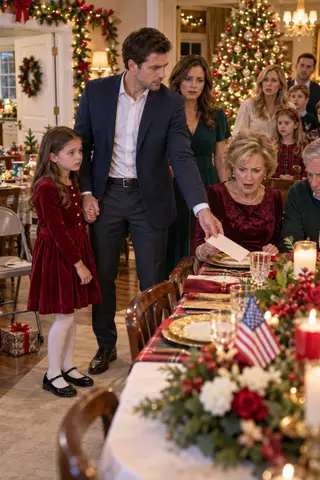
 My Mother Put My Adopted Daughter by the Trash Can on Christmas
Chapter 2
The Paperwork of Reckoning
The scream my mother had unleashed on Christmas Eve wasn't because of broken feelings or ruined holiday traditions. It was the scream of financial ruin.
To the outside world—to the country club committee, the ladies' auxiliary board at St. Luke’s Episcopal, and the local Virginia preservation society—Eleanor Vance was the matriarch of old-money elegance. She wore cashmere twinsets, drove an emerald-green Mercedes, and spent hours curating an Instagram profile depicting an immaculate Southern dynasty.
The ugly truth, which only three people in the state knew until tonight, was that Eleanor and Robert Vance were dead broke.
Seven years ago, my father’s commercial contracting firm had quietly collapsed beneath a mountain of bad debts, embezzled subcontractor funds, and ill-fated real estate speculation in Florida. They were six days away from a public, humiliating sheriff's foreclosure on the five-bedroom Georgian brick estate on Oak Ridge Lane—the very house they hosted Christmas dinner in every year.
My father had sat in my office in downtown Richmond, weeping into his hands, begging me to save the family name. Chloe, who had married a perpetually unemployed "venture consultant" named Brad, had two toddlers at the time and lived in a carriage house on the property, entirely reliant on our parents' credit lines.
I was thirty-two then. My architectural and commercial development firm had just secured two massive multi-state logistics contracts, netting me more liquidity than my father had made in his entire four-decade career.
I agreed to save them, but on two very specific legal terms.
First, I didn't loan them money. I bought the Oak Ridge Lane estate outright through my private holding company, Vance Heritage Assets LLC. I cleared the $780,000 delinquent balance, absorbed the property taxes, paid off Robert's personal signature loans, and allowed my parents to live in the home under a zero-dollar lifetime tenancy lease.
The second condition was simple: mutual respect. The lease included a strict behavioral clause regarding family conduct and family assets. Furthermore, I covered Chloe’s children’s elite private academy tuition through a discretionary educational trust funded solely by my dividends.
They kept their illusion. Their friends thought Robert had simply "transitioned into private wealth management." Eleanor kept throwing her lavish seasonal galas on my dime.
Then came Leah.
When I met Nah, she was raising three-year-old Leah on her own. Leah's biological father, an offshore pipeline welder and my former college roommate, had died in an industrial explosion before she took her first breath. Nah was working twelve-hour shifts at the hospital, pouring every drop of love and energy into that bright-eyed toddler.
The moment I held Leah, the moment she wrapped her tiny fingers around my thumb and called me "Dada," my world shifted on its axis. When Nah and I married, adopting Leah wasn't a question—it was the single easiest, proudest decision of my entire existence. The ink on the legal adoption decree had dried six years ago. She carried my name, my health insurance, and my heart.
My mother, however, viewed Leah as an existential threat to the "bloodline."
At family gatherings, Eleanor made sure Leah’s differences were felt in a thousand subtle, poisonous cuts. When Chloe’s biological children, Mason and Piper, were given heirloom silver spoons for their birthdays, Leah was handed a generic, five-dollar coloring book from a discount bin. In family portraits, the photographer was quietly instructed by Eleanor to place Leah "slightly to the outer edge," so she could be conveniently cropped out for the annual holiday card sent to the alumni association.
I had warned my mother repeatedly. "Treat my daughter equally, Mom, or we stop coming."
Eleanor would always offer a dismissive, Southern-sweet wave of her hand. "Oh, Graham, don't be so terribly sensitive! You know boys and girls need different things. You can't expect me to treat a child from the outside exactly the same as blood right away. It takes time."
"She's been my daughter for six years, Mom," I had countered during Thanksgiving dinner two months earlier, after Eleanor deliberately forgot to set a chair for Leah at the dessert table. "This is your final warning. If you disrespect her again, we are done."
Eleanor hadn't believed me. She assumed I was the same dutiful son who had handed over nearly a million dollars to protect her social standing. She believed her social leverage and maternal authority made her untouchable.
So she set the folding chair beside the trash can on Christmas Eve.
She deliberately left off Leah's name tag. She gave her a paper napkin while Chloe's kids ate off hand-painted porcelain. She thought she was establishing dominance, putting the "outsider" in her proper place in front of the entire extended family.
What she didn't realize was that the envelope I dropped between her plates didn't contain a Christmas card or a reconciliation letter.
It contained two legal instruments.
Document One: A formal, thirty-day notice of termination of the tenancy agreement for 142 Oak Ridge Lane, citing incurable breaches of the domestic occupancy covenant. Vance Heritage Assets LLC was placing the property on the open market effective February 1st.
Document Two: A formal revocation of the discretionary educational trust funding Mason and Piper’s $24,000-a-year private school tuition, along with the immediate cancellation of the platinum corporate credit cards Eleanor and Chloe used for their monthly country club dues.
The party was officially over.
The End









