 My Husband Had a Medical Emergency
Chapter 1
The First Thread Unravels
The silence in the hallway near the vending machines was thick enough to choke on. My phone felt heavy against my ear, the plastic casing warming from the heat of my palm. Across the line, Claire’s breathing was shallow, hesitant, the telltale sign of someone caught between family loyalty and the sheer terror of being found out.
"She's his wife," Claire had said.
Those four words didn't just shatter my world; they suspended it. Gravity felt optional for a terrifying, floating second before it slammed back down with the force of a hydraulic press.
"What did you just say?" My voice didn't shake. That was the curse of being a cardiac step-down nurse. When code blue alarms sound, you don't panic; you calculate. But this wasn't a crashing patient in bed four. This was my life, flatlining in real-time.
"Maris, please," Claire whispered, her voice cracking. "Let Declan explain. There's a context—"
"Context?" I let out a dry, humorless laugh that bounced off the stainless-steel panels of the soda machine. "My husband of nine years, a man I share a mortgage, a dog, and a bank account with, is listed as married to a woman I've never heard of. What context bridges that canyon, Claire? Is it cultural? Is it an administrative typo at the courthouse? Because last I checked, bigamy isn't a clerical error."
"It's not what you think," she pleaded, though everyone who uses that phrase always uses it right before confirming your absolute worst nightmares. "He didn't... he wasn't trying to live a double life, Maris. It's complicated."
"Everything is complicated when you're lying, Claire. Put me on speaker with whatever reality you're living in, because mine just ended."
"I can't talk about this over the phone. Where are you?"
"Emergency department. Room 312. Come down here and tell me to my face, or I walk back into that room, pull the telemetry leads off his chest myself, and ask him why his emergency contact shares his last name in a registry I was never invited to."
The line went silent for a beat. Then, a sharp intake of breath. "I'm leaving my house now. Don't blow up until I get there, Maris. Please."
The line clicked dead.
I stood there, staring at a poster warning against the dangers of high-sodium snacks, feeling the hum of the fluorescent lights vibrate behind my eyes. Eleven years in healthcare. I had watched patients take their final breaths. I had delivered devastating news to families who walked through those sliding glass doors expecting a routine check-up and leaving with an empty house. I knew grief. I knew trauma responses—the denial, the bargaining, the cold, analytical numbness.
Right now, I was cycling through all of them in thirty seconds.
I turned on my heel and walked back toward Room 312. My hospital badge, dangling from my pocket, clipped against my hip with a familiar rhythm. Irony was a cruel roommate; I spent my days piecing broken hearts back together while my own was currently being shredded in a municipal paperwork filing cabinet.
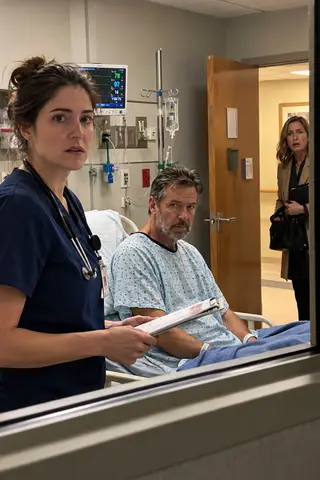
When I pushed the door open, Declan was sitting up straighter. A nurse was adjusting his IV drip, checking the rate of the saline. She looked up and gave me a polite, professional smile—the kind reserved for family members who look like they might throw up or pass out.
"His vitals are stabilizing," the nurse said, her voice bright and cheerful in that infuriating way hospital staff manage when everything is falling apart. "Doctor says we're just waiting on the final labs to clear, but he's looking much better."
"Thank you," I said, my voice eerily calm.
The nurse slipped out, leaving the heavy scent of antiseptic and clinical detachment in her wake. Declan looked at me, his eyes searching my face, hunting for the explosion. He knew. The second I walked out of the room to call his sister, the math had added up in his head.
"Maris," he started, his voice rough.
"Don't," I said, raising a single finger. I pulled the plastic chair closer to the bed, sat down, and folded my hands neatly in my lap. "We are going to wait for your sister to get here. Because apparently, my husband needs a supporting cast and a conference call to explain his own life choices."
"Claire is coming?" He flinched, the color draining slightly from his face, leaving him looking pasty under the sickly yellow lights of the ER ceiling.
"She's on her way," I replied smoothly. "And you are going to stay right there, with those leads on your chest, because if your heart rate spikes again, at least we're in the right building."
The minutes stretched like taffy. Every beep of the cardiac monitor felt like a countdown to an execution. Declan tried to speak twice more, but I met him with a wall of absolute, terrifying silence—the kind of silence you learn to use when a patient is combative and delirious. You don't argue with delirium; you wait it out, protect the airway, and let the diagnostics speak for themselves.
Thirty-four minutes later, the door flew open. Claire stood there, breathless, her hair windblown, clutching her purse like a shield. She looked at me, then at Declan, and the color drained entirely from her face.
"Well," I said, standing up to meet them both in the center of the room. "The quorum is here. Let's begin."
The End









