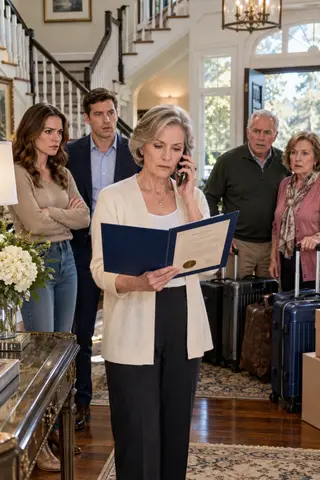
 My Daughter-In-Law Brought Her Parents’ Suitcases to My Door
Chapter 7
The Quiet After the Storm
The legal battle that followed over the next six months was fierce, but it was decisive.
Kendall had built her entire life on bluffing. She believed that normal, decent people would always choose compromise over embarrassment. She had relied on Carter’s guilt, my desire for peace, and our shared love for the children to force everyone into submission.
But when you strip away the bluffs from a bully, there is very little substance underneath.
During the forensic audit, Carter’s legal team discovered that Kendall had siphoned over ninety thousand dollars from their children’s college funds over three years, funneling the cash into her father’s failed shell corporations to stave off creditors. That single discovery destroyed any remaining leverage she had.
Faced with potential criminal charges for grand larceny and fraud, Kendall signed a comprehensive settlement agreement.
Carter was awarded primary physical custody of Harper and Miles. Kendall was granted supervised visitation every other weekend, contingent upon psychiatric evaluation and complete financial transparency. The joint marital home—a modest suburban place in West Ashley—was sold to pay off the legitimate marital debts, while the liabilities tied to Douglas’s schemes were assigned entirely to Kendall and her family.
Douglas and Rita finally left Charleston. They moved into a cramped, one-bedroom subsidized senior apartment outside Columbia, living on Douglas’s minimal monthly social security check. The grand illusions of historic downtown living, hot tubs on historic verandas, and corner suites on Meeting Street had evaporated into the reality of their own poor choices.
Kendall moved into a small rental duplex across the county line. The designer clothes and expensive salon visits disappeared, replaced by the grim daily reality of working forty hours a week as a mid-level insurance coordinator just to pay her legal fees.
Through it all, 44 Meeting Street stood unchanged.
The heart-pine floors remained unscratched. The quiet upstairs study remained filled with Warren’s architectural sketches and my design portfolios. But the air inside the home felt different. The tension that had hovered over the house for years—the constant waiting for the next demand, the next subtle violation of boundaries—had vanished entirely.
One rainy afternoon in April, Carter came over while the children were at school.
We sat in the kitchen, just as we had six months earlier. But this time, Carter didn't avoid my eyes. He poured the tea himself.
“I’m sorry, Mom,” he said quietly, setting the porcelain pot down. “For all the years I asked you to bend so I didn't have to stand up.”
I reached across the island and took his hand. His skin was warm, his grip steady.
“You stood up when it mattered most, Carter,” I told him. “A mother doesn't need her son to be perfect. She just needs him to be a man her grandchildren can look up to.”
A small, genuine smile touched his lips. “They love you, you know. Harper made something for you at school yesterday. She said it’s for Sunday dinner.”
My heart swelled. “Sunday dinner is at five sharp. Don't be late.”
The End









