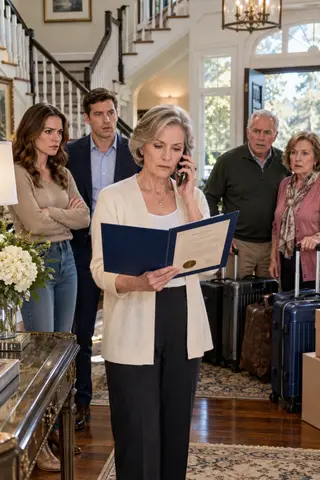
 My Daughter-In-Law Brought Her Parents’ Suitcases to My Door
Chapter 1
The Document on the Console
The grandfather clock in the foyer struck ten, its measured chimes echoing off the twelve-foot ceilings. Beside it, the silence was suffocating. Douglas’s hand lingered in midair, frozen an inch above his leather suitcase. Rita’s self-satisfied smirk had collapsed into a slack, confused stare. Kendall looked between me and her husband, her sharp jaw jutting forward in defiance, while Carter stood completely immobilized, the color draining from his cheeks until he looked like a ghost standing in his childhood hallway.
“What did you change, Mom?” Carter asked again, his voice cracking like dry kindling.
I did not flinch. I kept my fingers firmly on the crisp, cream-colored parchment bearing the gold raised seal of the Charleston County Probate Court.
“I didn’t change my love for you, Carter,” I said, keeping my voice as smooth and steady as polished river stone. “But I changed the illusion that this house is an open trust for anyone who feels entitled to take it.”
I turned the paper around and laid it flat on the mahogany console table. Across the top, in bold, formal calligraphy, were the words: The Warren & Donna Vance Historic Preservation and Family Trust.
Kendall stepped forward, her expensive leather boots clicking sharply on the heart-pine floor Warren and I had spent months stripping and oiling thirty years ago. Her eyes scanned the legal clauses, searching for a loophole, a weakness, or anything she could tear apart with her usual condescension.
“What is this nonsense?” Kendall scoffed, trying to inject her trademark authority back into her voice. “Donna, you’re playing childish games. Carter is your only son. He’s your legal heir. You can’t just rewrite South Carolina inheritance law on a whim because you’re having a tantrum about guest rooms.”
“Read clause four, Kendall,” I said softly.
Douglas leaned over his daughter’s shoulder, his breath smelling faintly of peppermint and cheap arrogance. His brow furrowed as he muttered the words out loud: “The residential property located at 44 Meeting Street shall immediately transfer into an irrevocable historic preservation trust upon any formal transfer of deed, managed solely by an independent fiduciary board. No direct family member shall possess unilateral rights of occupancy, sale, liquidation, or sublease without unanimous board approval.”
Douglas blinked, turning a blotchy red. “Wait a minute. What does that mean?”
“It means,” I replied, looking directly into Douglas’s bewildered eyes, “that Carter does not own this house. Carter will never own this house. He holds a non-transferable life interest that permits him to live in the carriage house behind the garden—and only after my passing. He cannot invite tenants. He cannot sell a single brick. And he certainly cannot use my home as a private retirement village for people who treat me like a nuisance in my own living room.”
Kendall’s hands curled into tight fists. “You spiteful old woman. You gave away Carter’s birthright just to spite my parents?”
“No,” I replied. “Warren and I set up this structure five years ago, after his first diagnosis. We built this home with sweat, sacrifice, and mutual respect. We swore it would never become leverage. But the document beneath that one is the one you really need to worry about.”
I pulled out the second sheet from the blue folder. It wasn't an estate document. It was a formal Notice of Trespass, prepared forty-eight hours ago by my attorney, signed by a magistrate, and accompanied by a copy of the emergency call log.
“Ten minutes ago,” I said, tapping my screen, “I called the Charleston Police Department. I informed them that unauthorized individuals had breached my locks using a stolen key and refused to vacate private property. They are already turning onto Meeting Street.”
The End









