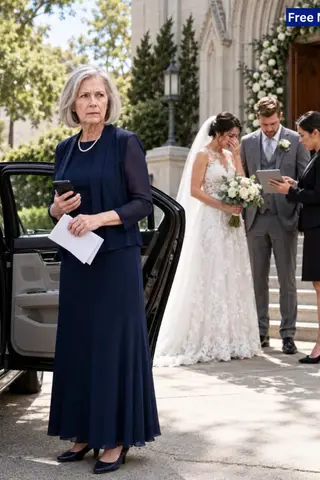
 My Daughter Banned Me From Her $200,000 Wedding, So I Canceled The Reception Before She Reached The Altar
Chapter 8
The Price of Pride
By the middle of summer, the sweltering Charleston heat had settled over the peninsula like a wet wool blanket.
Clara’s world had shrunk to a radius of four city blocks. After Evan abandoned her, the high-society friends who had posed for selfies with her on the church steps deleted her from their feeds. When people in Charleston whispered about the “Runaway Reception,” they didn't speak of Evan’s cowardice; they laughed at the girl who had tried to play the debutante on her mother’s laundromat money and ended up with mud on her hem.
With no college trust allowance, no access to my accounts, and no resume beyond summer internships Evan’s father had fabricated, Clara was forced to face the raw arithmetic of survival.
She moved into a cramped, windowless studio apartment above a dry-goods warehouse on the north side of town—a neighborhood she had once turned her nose up at when driving past in Evan’s convertible. Her landlord, an unsentimental man named Mr. Henderson, cared nothing for her polished diction or her sorority pedigree. Rent was six hundred and fifty dollars on the first of every month, cash or cashier's check, without exception.
To pay it, she took a job as an hourly hostess at a bustling seafood restaurant near the market.
Her days were spent on her feet, smiling at tourists who snapped their fingers to get her attention, wiping down grease-streaked menus, and dodging the condescending stares of former college classmates who occasionally walked in for Sunday brunch. Her feet swelled inside cheap flat shoes. Her back ached by the end of every eight-hour shift.
One evening in late July, while cleaning a bathroom stall after a dinner rush, she found herself staring at the industrial disinfectant spray and the stack of paper towels in her hands. The pungent, chemical scent of bleach filled her lungs.
She dropped the sponge into the plastic bucket, leaned her forehead against the stainless-steel stall divider, and wept until her chest burned.
For the first time in her life, she didn't weep because she had been caught, or because she had been embarrassed. She wept because she finally understood.
Every hot iron she had watched me wield; every winter morning I had walked out into the freezing pre-dawn drizzle while she slept under warm quilts; every calloused finger and burned wrist that she had looked at with disgust—it hadn't been a lack of ambition. It had been an act of total, terrifying devotion.
And she had thrown it into the dirt for a boy who wouldn't even pay for her taxi home.
Nora visited her once, bringing a bag of groceries that Clara accepted with downcast eyes and trembling hands.
“Does she ask about me?” Clara whispered, sitting on the edge of her second-hand mattress.
“She knows what you’re doing,” Nora said honestly. “She knows where you work. But she doesn't ask. Aunt Marian is traveling right now. She’s in Bar Harbor, Maine, looking at lighthouses.”
Clara swallowed hard, pulling her knees up to her chest. “I don't expect her to give me money, Nora. I swear to God, I don't. I just… I don't know how to live with what I said to her.”
“Then don't live with it,” Nora said gently, setting a loaf of bread on the counter. “Change it. But don't expect it to be easy. You spent twenty-six years taking her for granted, Clara. You can’t fix that with a greeting card.”
The End









