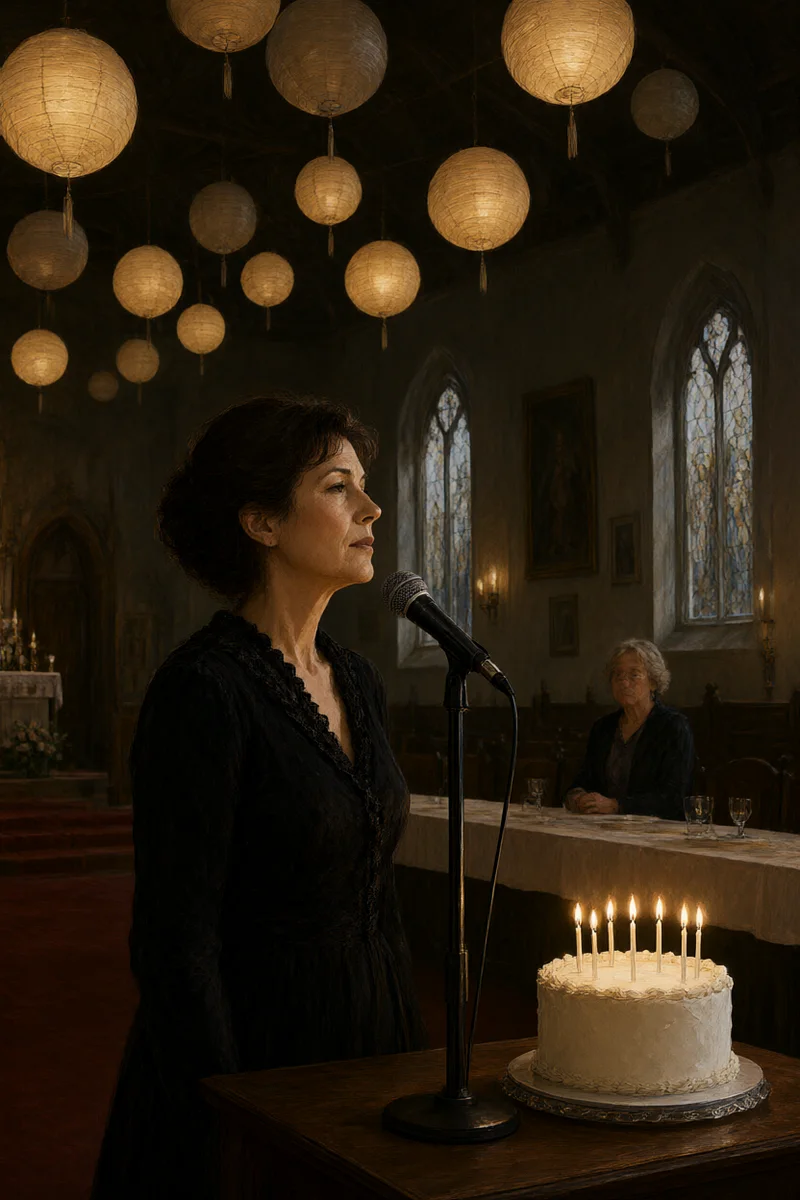
 The Seventieth Toast
Chapter 3
The Winter You Were Born
Maeve's kitchen at nine the next morning looked like the morning after a wedding: foil trays of leftover meatballs, a third of the cardamom cake under a dish towel, the lilacs already dropping their tiny flowers on the counter.
Her mother was sitting at the table in her bathrobe with the memory book open in front of her. By the look of the coffee pot, she had been sitting there a long time.
“You read it,” Agnes said.
“Four times.” Maeve did not look up. “You were right. I counted too.”
Agnes sat down across from her. “Rolf said to ask you about the winter I was born.”
Her mother closed the book. She smoothed the cover with the flat of her hand, as if pressing out a wrinkle that wasn't there.
“January of seventy-nine,” she said. “Forty below for nine days. You came three weeks early, in the middle of it. And something happened to me after. They'd call it something else now. Then they called it a breakdown and sent me to the state hospital in Fergus, and I was there until the end of May.”
Agnes said nothing. Outside, a plow went by and the windows shook.
“I don't remember most of it. I remember I thought you weren't mine. I thought there'd been a switch at the hospital. I said so, to anyone who'd listen.” Maeve's voice did not change. “Your grandmother moved into this house the week I went in. She fed you and bathed you and walked the floor with you. For five months you were hers.”
“Nobody ever told me.”
“Your father decided that. It was what people did. We'd never speak of it and it would be as if it hadn't happened.” Maeve looked at her finally. “I came home on the first of June. Your grandmother put you in my arms in that doorway, right there, and you screamed. You screamed and you twisted and you reached for her over my shoulder with both hands. And you went on reaching for her, Agnes. For about three years.”
“I was a baby.”
“I know that. I knew it then. It didn't help.” She turned her cup in its saucer. “Then Rolf came. Uneventful, eight pounds. They put him on my chest and he stopped crying, and I felt it. Whatever I was supposed to have felt for you. I'm not proud of what I did with it. I'm telling you what happened.”
Agnes found that she was holding the edge of the table. She made herself let go.
“So you decided I was Grandma's.”
“I decided you didn't need me. You never seemed to. You were the most capable child I ever saw. You tied your own shoes at three.” Something crossed her mother's face that might have been a smile. “I was afraid of you. Isn't that a stupid thing. Afraid of a little girl who could tie her shoes.”
They sat with that. The furnace came on with a thump.
When Agnes got up to leave, her mother stopped her at the door. She was holding three index cards, creased, damp at one corner.
“These were on the floor of the hall,” Maeve said. “Under the microphone stand. They must have fallen out of your pocket.”
Agnes reached for them, and her mother held on a moment longer.
“I read them,” Maeve said. “It's a lovely toast. You thank the pastor and the caterers and the altar guild. You thank Oskar for the card he made me.” She let the cards go. “You might want to read them again, honey. See who's not in it.”
The End









