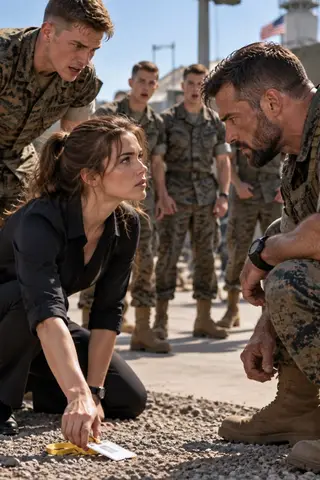
 Marine Brother Stomps on Sister's Guest Pass to Humiliate Her
Chapter 3
Shadows from the Past
The drive back from Camp Pendleton to my modest, nondescript apartment in San Diego was a quiet masterclass in paranoia. Even though I had successfully maintained my cover in front of my parents and my thoroughly traumatized brother, I knew that Gunnery Sergeant Rourke’s sudden recognition of Fury Ten meant my operational security had sprung a leak. In our world, secrets don't stay buried forever; they just wait for the right catalyst to unearth them.
My apartment was deliberately sparse. No family photos on the walls, no military memorabilia on the shelves, no outward signs of a life lived in the razor-thin margin between classified black ops and high-stakes intelligence analysis. To my neighbors, I was Eleanor Hayes, a mild-mannered remote logistics consultant for a federal contractor who spent too much time staring at glowing computer monitors and drinking black coffee.
I tossed my keys onto the entryway table, walked straight to the small, secure desk in the corner of my living room, and booted up an encrypted terminal completely isolated from commercial internet service providers.
The screen flared to life, casting a cold blue glow across my face. I bypassed three layers of biometric security and entered a secure decryption key that hadn't been activated in over fourteen months. The system blinked, spun, and finally opened a restricted, dark-mode interface: DOD-DIAS // SPECIAL OPERATIONS ARCHIVE // RESTRICTED ACCESS.
My file popped up on the screen.
NAME: HAYES, ELEANOR M.
CALL SIGN: FURY-10
STATUS: OFF-GRID / INACTIVE (CLASSIFIED REASSIGNMENT)
LAST KNOWN DEPLOYMENT: OPERATION BLACK RIDGE (AUG 14)
I scrolled down to the incident reports. The official narrative was clean, sterile, and entirely fictitious: Logistics transport downed during routine supply run; all personnel presumed KIA due to hostile kinetic action. It was the standard paperwork ghost story invented by Washington bureaucrats to sweep a catastrophic intelligence failure under the rug and protect the agency from congressional oversight.
They had written me off as dead because it was convenient. I had played along because fading into civilian life was the only way to escape the grinding meat grinder of black-ops warfare without ending up in a shallow, unmarked grave in an unmapped sector of the globe.
Suddenly, a sharp, rhythmic ping echoed from the terminal.
Incoming Secure Transmission.
Source: PENTAGON-HQ // COMMAND OPERATIONS.
Priority: IMMEDIATE / FLASH.
My eyebrows arched. Nobody from my old directorate had pinged this dead-drop channel in over a year. Either someone in Washington had noticed my digital footprint flickering back to life when Rourke recognized me at Pendleton, or something catastrophic had just broken loose in the field.
I typed in my authorization passcode and opened the encrypted data packet.
A video file began streaming onto the screen. The video was grainy, shot through a thermal imaging lens mounted on an overhead drone circling a desolate, wind-swept desert compound somewhere in the Middle East. At the bottom of the screen, text scrolled rapidly: LIVE FEED // SECTOR 7 // HOSTILE TAKEOVER.
The feed showed a heavily armed insurgent cell breaching a black-site intelligence relay station—a high-value communications node that housed active decryption keys for half of our regional surveillance network. The local security garrison had been entirely neutralized within the first three minutes. The insurgents were systematically downloading core intelligence data onto portable hard drives, preparing to strip the facility bare and execute the surviving station analysts.
Then, a text attachment popped up at the bottom of the screen, typed directly by the duty director in Washington:
Ellie. We know you're active. Rourke triggered an automated security alert when he blew his cover at Pendleton and reported your status. We don't have time to vet a new extraction team. Sector 7 is about to go dark, and the decryption keys will compromise every active sleeper cell in the theater. We need Fury Ten back in the chair, right now.
I stared at the screen, the cold blue light reflecting in my eyes. Six years of peace, six years of pretending to be a boring desk jockey, six years of keeping my head down to protect the people who couldn't handle the truth about who I was.
I looked over at my jacket hanging on the hook by the door—the cheap civilian jacket I had worn to Family Day. Then I looked back down at the terminal, where glowing red lines of tactical data were ticking down toward total system compromise.
"Printer toner," I muttered to myself with a grim, humorless smile. "Looks like the printer just jammed."
I reached out, clicked the response icon on the secure terminal, and typed a single, definitive word back to Washington:
Executing.
The End









