 Kicked Out on Christmas Morning with a Trash Bag, She Returned 4 Hours Later with the Sheriff and Evicted Her Entire Family!
Chapter 6
The Smell of Linseed Oil
The silence that settled over Milbrook Road at 1:00 p.m. on Christmas Day was unlike any silence I had ever known. It wasn't the heavy, suffocating quiet of a household walking on eggshells around my mother’s moods, nor was it the sterile emptiness of a cheap motel room. It was an honest, grounding, restorative quiet—the kind of silence that only exists when the wrong things have been swept completely away.
I walked back into the main house, locking the heavy oak front door behind me with the new brass key Arthur had given me. The artificial pine candle my mother had burned for a decade had finally burned down to a greasy puddle of wax on the foyer table, its sickly-sweet chemical stench lingering faintly in the air.
Without hesitation, I picked up the glass jar, carried it to the kitchen trash can, and dropped it in.
I opened every window on the main floor for five minutes, letting the sharp, invigorating winter air sweep through the rooms, flushing out the remnants of artificial cheer, fake smiles, and decades of silent resentment. As the crisp breeze circulated, it carried away the last traces of my family’s presence, leaving behind the clean, neutral scent of old cedar walls, hardwood floors, and winter sunlight.
I didn't bother unpacking my small contractor bag. Instead, I walked into the kitchen, put on a kettle of water, and brewed a simple cup of loose-leaf black tea—the exact brand my grandfather had drunk every single afternoon at 3:00 p.m. sharp.
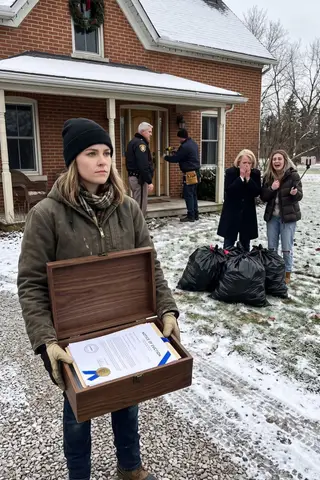
Carrying my mug in one hand and the dark figured walnut box in the other, I walked out through the back kitchen door and stepped off the rear porch.
The sun had climbed to its highest point in the winter sky, casting a pale, golden light across the frozen fields and illuminating the weathered green wooden workshop standing sixty yards behind the main house. The workshop had been built by my grandfather’s own hands in 1968, every beam mortised and tenoned without a single metal nail in the primary frame.
I walked across the frost-covered grass, my heavy boots leaving dark, clear footprints in the white rime. When I reached the heavy double doors of the shop, I pulled the original brass key from the walnut box and slid it into the padlock clasp.
The lock turned with a smooth, satisfying click that I had heard a thousand times during my childhood summers.
I swung the heavy green doors wide open.
The interior of the workshop hit me like a physical embrace. It didn't smell like pine candles or designer perfume; it smelled like history, hard work, and uncompromised integrity. The air was rich with the deep, earthy dust of black walnut and red oak, mixed with the sharp tang of turpentine, metal shavings, and boiled linseed oil.
Rows of vintage hand planes, chisels, marking gauges, and Japanese saws hung neatly on pegboards along the walls, each tool cleaned, oiled, and resting in its designated shadow-line. In the center of the room stood Grandpa Everett’s massive workbench—a six-inch-thick maple butcher block scarred by decades of mallet blows, glue spills, and pencil marks.
I walked over to the bench, set my teacup down, and placed the walnut box right in the center of the maple surface.
I opened the lid and lifted out the brass key, setting it gently beside the wood. Then I reached in and pulled out a small, worn object tucked beneath the legal papers: a single, half-inch firmer chisel with an applewood handle polished smooth by decades of sweaty palms. It was the very first tool my grandfather had ever handed me when I was thirteen years old, telling me to learn how things were made if I wanted them to hold.
I picked up the chisel, ran my thumb over the beveled steel edge, and felt the cool, balanced weight of it in my palm.
My grandfather had spent his entire life teaching me how to measure twice, how to fit joints so tightly that no amount of weather could force them apart, and how to recognize when a structure was built to last. My parents had spent their lives trying to force a bad fit, gluing together a fragile facade of status and cruelty that shattered the moment a real storm rolled in.
They thought they owned the world because they knew how to play a social game. But they had forgotten the golden rule of building: Paper does more than a voice ever will, and the weight will always fall where it belongs.
I set the chisel down, turned on the overhead warm Edison-bulb lamps above the workbench, and smiled into the quiet, walnut-scented air.
I was home. And for the first time in my life, every single joint was locked in place.
The End









