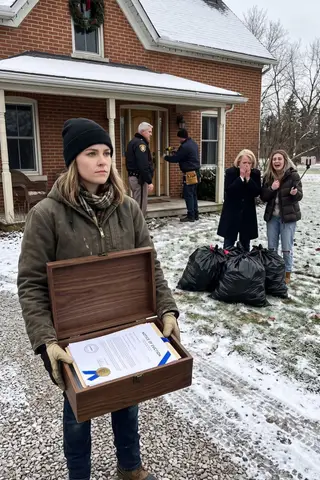
 Kicked Out on Christmas Morning with a Trash Bag, She Returned 4 Hours Later with the Sheriff and Evicted Her Entire Family!
Chapter 1
The Coldest Christmas Morning
The frost on Milbrook Road did not sparkle; it bit. At exactly 7:14 a.m., the front door of the house my grandfather built felt heavier than usual, not because of its solid oak construction, but because of the finality echoing behind it. My mother, Diane Calloway, stood in the hallway wrapped in her favorite gray cashmere sweater, her pearl earrings catching the pale morning light through the sidelights. Those pearls were her armor. Whenever she wore them, it meant a verdict had been reached, sentences had been handed down, and any plea for mercy was deemed an act of insolence.
"That’s the last thing you’re taking out of this house," she said, nodding toward a black contractor bag lying flat against the hardwood floor. My bare feet felt the chill radiating up from the planks.
Behind her, my father, Russell, stood with his arms tightly crossed over his chest. He didn't look at me; instead, his eyes drifted toward the antique barometer hanging on the wall, pretending that an instrument tracking atmospheric pressure was more interesting than his own thirty-two-year-old daughter being cast out into a freezing winter morning. Downstairs, the heavy scent of artificial pine oil mixed with the sugary aroma of cinnamon rolls—a breakfast meant for a family that excluded me.
"You’re thirty-two, Nora," my mother repeated, her voice dripping with the practiced fatigue of a martyr. "This arrangement has gone on long enough, and we’re not spending another year pretending you belong here."
The irony of her words tasted like ash. Eight months earlier, I had packed my modest life into my sedan and driven straight back to Milbrook Road not because I wanted to sponge off my parents, but because my grandfather, Everett Hale, could no longer manage the stairs alone. His hands, once capable of transforming raw timber into heirloom furniture, had begun to tremor with a relentless Parkinson’s-like stiffness. I cooked his meals, drove him to endless specialist appointments, changed his linens when his nights were plagued by cold sweats, and sat beside him in the suffocating silence of 3:00 a.m. when pain stripped him of sleep.
Yet, within weeks of his passing sixty-two days ago, my mother had systematically rewritten history. In her version, I was an unmotivated, unemployed parasite who had leeched off her parents' hospitality.
"Unemployed?" I muttered under my breath.
I worked grueling twelve-hour home health nursing shifts five days a week, funding my own education through a local community college without a single dime of support from the people standing in front of me. But facts were malleable things in the Calloway household, shaped to fit whatever narrative preserved my mother’s immaculate social standing in the community.
"You want me gone today?" I asked, keeping my voice level, though my pulse hammered against my ribs like a trapped bird.
"Immediately," Diane said, flicking a stray lint speck off her sleeve. "Your belongings are packed. Your father put your winter gear in the mudroom, but this bag stays."
A sharp click echoed down the hallway. Paige, my twenty-nine-year-old sister, stepped out from the guest room with her smartphone held vertically in front of her face. Paige had mastered the art of the modern aesthetic: professionally tousled hair, meticulously contoured cheekbones, and a digital footprint dedicated entirely to lifestyle curation. Her accounts were flooded with soft-focus photos, inspirational quotes about "family first," and captions warning followers to "protect your peace from toxic energy."
She tilted the phone slightly, ensuring the live-streaming chat window captured my humiliated expression. "Say goodbye to the haters, guys," she chirped brightly to her followers. "Merry Christmas! Have fun starting over, loser."
Neither of my parents blinked. My mother didn't scold Paige for broadcasting a family eviction; my father didn't shift his gaze. In their eyes, Paige’s casual cruelty was simply smart branding.
Something inside me didn't break; it went entirely, terrifyingly numb. The emotional noise died away, leaving behind a cold, crystalline clarity. I turned my back on them, walked back into the small guest bedroom, ignored the cheap contractor bag, and knelt beside the twin bed. My hand slid into the dark space beneath the nightstand, my fingers brushing against a cool, smooth surface that I had hidden there three days after Grandpa Everett’s funeral.
I pulled out a small box made from dark figured walnut. Its corners were joined with dovetails so exact, so microscopic in their precision, that the seams looked like pencil lines drawn on solid wood. My initials, NC, had been deeply pyro-engraved into the lid by my grandfather’s own hand seven years prior, during an afternoon when the workshop smelled of sanding dust and boiled linseed oil.
"Don’t open it until you have to," he had whispered, handing it to me in the dim light of his workbench.
For seven years, I had kept that promise. Now, the weight of the box felt heavy—not with wood, but with consequence.
I walked out of the bedroom, carrying the walnut box cradled against my chest like an infant. I bypassed the coat closet, knowing my good winter coats had mysteriously vanished from the hangers weeks ago, and grabbed only an old, paint-stained canvas work jacket hanging by the back door. Paige danced backward down the hallway, keeping her phone locked on my face, narrating a breathless recap of "toxic people finally facing natural consequences" for her digital audience.
When I stepped out onto the front porch, the freezing December wind slapped my cheeks, turning my breath into white plumes. Behind the main house, standing silent and monolithic beneath a pale, bruised winter sky, was the green wooden workshop where Everett Hale had spent sixty years of his life shaping timber into things that outlasted men.
I got into my battered sedan, placed the walnut box gently on the passenger seat, and stared out the frosted windshield. My grandfather had been born in 1941 in the rugged foothills of western North Carolina, one of four brothers who grew up believing a hard day's work was the only inheritance worth having. He had taught himself joinery from water-damaged library books and forged his own chisels when store-bought steel proved too soft.
When I was thirteen, he caught me rushing through the construction of a cedar keepsake box. He had gently stayed my hand, his palm rough and warm like sandpaper, and said, "Nora, never hurry a joint. If you force a bad fit, the wood will always find a way to pop apart when the weather changes. Measure twice, cut once, and let the structure speak for itself."
My family never understood that philosophy. Paige was rewarded for flash, for performance, for the appearance of success. I was praised only when I was useful, labeled "independent" whenever asking for help would have cost them time or money. I remembered the afternoon when I was seventeen, standing in the kitchen while my mother slapped me across the face because she blamed me for a missing box of heirloom photographs—a box I had never touched.
Grandpa Everett had found me sitting on the back steps, pressing a cold bag of frozen peas against my stinging cheek. He handed me a handkerchief and said, "Don’t waste your breath trying to win a shouting match with someone who changes the rules of the game while you're playing. Paper does more than a voice ever will. Remember that, sweet girl."
Those words vibrated in my chest as I turned the ignition. My fingers brushed against the glove compartment. Inside lay a heavy ivory business card my grandfather had slipped into my coat pocket during his final week in hospice care.
Arthur Vance, Attorney at Law. On the back, written in shaky, sprawling block letters, was a direct mobile number.
It was 7:35 a.m. on Christmas morning. I pulled out of the driveway, gravel crunching beneath my tires, and dialed the number without hesitation. Arthur answered on the third ring, his voice gruff with sleep but instantly alert when I gave him my name.
"Nora?" he said, the holiday casualness evaporating from his tone. "Where are you?"
"They locked me out, Arthur. I have the walnut box."
There was a sharp intake of breath on the other end of the line. "Don't go anywhere. Come straight to my office downtown. I’ll meet you there in twenty minutes."
The End









