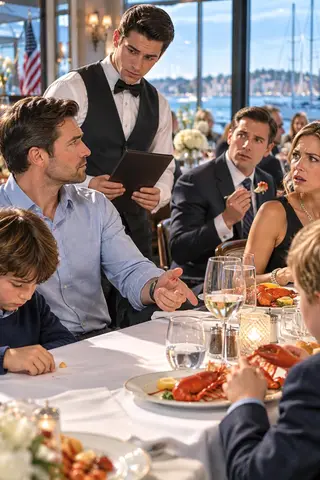
 “He’s Used To Going Without,” My Sister-in-Law Smirked Leaving My Son Hungry
Chapter 2
The Paper Trail
Monday morning at eight o’clock, the city was choked with grey autumn fog. I dropped Caleb off at his private academy—a school Naomi had scoffed at because "it lacked the social pedigree of St. Jude’s," where her twins attended. She didn't realize St. Jude’s was currently facing a structural deficit and that Caleb’s school had an endowment larger than most small liberal arts colleges. Caleb hopped out of the truck with his sketch pad tucked neatly into his backpack, looking back once to wave. He smiled. It was small, but it was real.
"Have a great day, son," I said.
"See you at three, Dad."
As soon as his red jacket disappeared through the heavy oak doors of the academy, the warmth faded from my face. I engaged the hands-free console in the truck and placed a direct call.
It picked up on the second ring.
"Marcus," Arthur Vance’s gravelly voice came through the speakers. Arthur was seventy-one, a retired commercial banking litigator who now served as the lead executive director for my private asset portfolio. He was one of three people on earth who knew the true valuation of Apex Vantage Systems. "I didn't expect to hear from you until the quarterly review next month."
"Change of plans, Arthur. I need a full forensic audit on Harbor Ridge Development."
A brief pause hovered on the line, accompanied by the rustle of papers. "Gavin's project?"
"Gavin's project."
"I thought you made it clear that family holdings were strictly off-limits for active restructuring. You told me three years ago to let him play out his hand without intervention."
"The rules changed this weekend, Arthur."
Arthur didn't ask questions. In our world, you don't pry into motives; you execute strategy. "Give me two hours. I'll pull the covenants, the escrow milestones, and the debt-service ratios. Do you want the legal exposure or the liquid position?"
"Both," I said cold as ice. "And Arthur? Pull the personal underwriting files on the Riverfront property. The ones signed by Gavin and Naomi Vance personally."
"Understood. I'll have the brief sent to your private server by ten-thirty."
I drove to my downtown office—a discreet, single-story brick building tucked between two historic warehouses. There was no bronze plaque out front, no digital marquee. Just a frosted glass door that read AVS Consulting. Inside, six senior engineers and analysts worked in near silence, monitoring server clusters that serviced high-level financial clients across four continents.
I walked straight to my corner office, hung up my jacket, and pulled up my personal ledger.
Every insult from the past half-decade was logged in my memory, but now I matched them against facts.
Three years ago, at our father’s funeral, Gavin had pulled me aside behind the chapel. While our relatives were still wiping away tears, Gavin had handed me an envelope. Inside was a cashier’s check for twelve thousand dollars. “Take it, Marcus,” he had whispered, patting my shoulder with that pitying, performative grimace. “Dad didn’t leave much liquid cash, and I know your consulting gig is feast or famine. Use this to catch up on Caleb’s health insurance. I don’t want people saying the Vance family can’t take care of its own.”
He had loudly announced to three cousins that evening that he had "handled Marcus's immediate debts."
I had never cashed the check. I still had it framed inside a folder in my desk drawer. That same month, Apex Vantage had posted an eight-hundred-thousand-dollar quarterly dividend.
Then came Thanksgiving dinner last year. Naomi had insisted on catering the event through a five-star French bistro, loudly lamenting the "astronomical per-head cost." When Caleb asked if he could have a second miniature lemon tart, Naomi had stepped in front of the dessert tower, laughing that high-pitched, musical laugh that carried across the entire dining room. “Careful, sweetie! Those are imported from Montreal. Let’s make sure the twins get their fill first. Caleb’s probably more comfortable with grocery-store cookies anyway.”
Caleb had put his hands behind his back, apologized, and sat on the hallway stairs until it was time to go home.
And now, the mountain cabin. The lobster. The "used to going without."
At 10:28 AM, a secure notification popped up in the corner of my primary monitor.
I clicked the link. Arthur’s report was twenty-four pages long, meticulously indexed, and devastatingly precise.
I read through the figures slowly, leaning back in my chair.
It was worse than I thought. Gavin hadn't just leveraged his house; he was drowning.
To maintain the illusion of high-society wealth—the leased Mercedes every two years, the private golf club membership, the ski chalets in Aspen, Naomi’s wardrobe—Gavin had been drawing against a revolving line of credit tied to the construction milestones of the Riverfront project. Under the terms of the mezzanine loan from Blackwood Capital, if construction failed to break ground by November 15th, or if the environmental compliance certificates were flagged for secondary review, the lender held the right to immediately declare the entire principal balance due within thirty days.
The principal balance was $3.8 million.
Gavin’s total liquid reserves across all checking and savings accounts?
Ninety-four thousand dollars.
He was flying a kite in a hurricane, praying the wind wouldn't drop before his firm awarded him the senior partnership. And the date today was October 12th.
The phone on my desk chimed. It was Arthur.
"Did you read section four?" Arthur asked.
"The environmental easement?"
"Exactly," Arthur said, a dry chuckle in his throat. "The southern access corridor for the entire Riverfront development cuts directly across an old industrial spur. Sterling & Croft forgot to verify the parcel title. They assumed it was municipal property granted by the city council under the zoning waiver."
"And who owns that parcel, Arthur?"
"A shell corporation named Osprey Land Holdings," Arthur replied. "Which we acquired during the rail-line liquidation three years ago for approximately two hundred thousand dollars. In short, Marcus... Gavin’s multi-million-dollar development cannot move a single bulldozer onto the site without our express written permission."
I looked out the window at the grey city skyline. Down there, somewhere in a glass tower on 4th Avenue, Gavin was probably sitting in a conference room, wearing a tailored Italian suit, laughing condescendingly about his broke brother who couldn't even afford seafood for his kid.
"Arthur," I said quietly.
"Yes, Marcus?"
"Don't file the stop-work injunction yet."
"What's your play?"
"Let them proceed with the annual charity gala this Saturday," I replied, my voice steady and cold. "The one Gavin organized for the city's legal elite. Let him take the stage. Let him bask in the applause. I want him standing at the very top of his mountain before the ground starts to move."
The End









