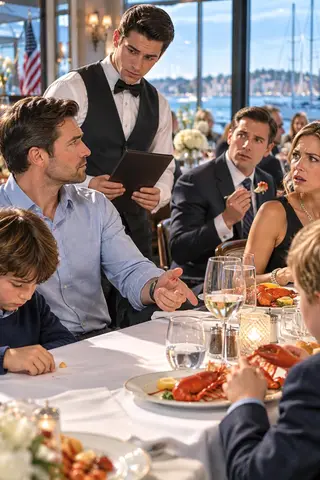
 “He’s Used To Going Without,” My Sister-in-Law Smirked Leaving My Son Hungry
Chapter 1
The Weight of Silence
The quiet hum of the tires against the wet asphalt was the only sound inside the car for forty miles. Caleb sat in the passenger seat, his knees pulled slightly toward his chest, his fingers tracing the worn cardboard spiral of his sketch pad. The sun hadn’t completely cleared the eastern ridge yet; it hung low and blood-red through the tall pines, casting long, sharp shadows across the highway.
Every time I looked at him in the rearview mirror, my chest tightened. He hadn't asked for the radio. He hadn't asked for breakfast. He just sat there, small and still, holding his breath as if taking up space in the car was an inconvenience he might be punished for. That was what Gavin and Naomi had done over four short days. They hadn't just insulted him; they had shrunk him. They had chipped away at a ten-year-old boy until he believed his presence was a burden.
"Dad?" his voice was barely a whisper, thin as parchment.
"Yeah, buddy?"
"Did I do something wrong?"
I pulled the truck onto the gravel shoulder of the highway, shifted into park, and turned off the engine. The silence rushed in, thick and heavy. I unbuckled my seatbelt and turned fully toward him.
"Look at me, Caleb."
He hesitated, keeping his eyes on his sneakers before finally looking up. His lower lip trembled, just once, before he clamped it down.
"You didn't do anything wrong," I said, keeping my voice dead steady. "Not one thing. Do you hear me? Not at dinner, not at the cabin, not during that scavenger hunt. You are kind, you are smart, and you deserve a seat at every single table you walk up to. If someone doesn't give you a chair, it's not because you aren't worthy. It's because they are too small to understand what real family means."
He nodded, but the doubt stayed in his eyes. A child doesn't unlearn rejection in thirty seconds just because his father delivers a speech. Rejection from blood digs deep. It settles into the bones.
I put my hand on his shoulder, gave it a firm squeeze, and pulled back onto the road. My hands didn't shake on the steering wheel, but my jaw ached from clenching it so hard. For years, I had let Gavin play the golden child. I let him park his leased German sports car in Mom and Dad’s driveway right in front of my ten-year-old pickup. I let Naomi drop casual barbs about my "little consulting gigs" while she paraded designer handbags bought on credit. I had stayed silent because our mother had begged me on her deathbed: Keep the peace, Marcus. Gavin needs to look strong. Just keep the family together.
I had honored that promise for six long years. I attended the holiday dinners. I smiled through the condescending toasts. I brought wine that cost more than their mortgage payments, poured it into decanters without showing the label, and let Gavin lecture me on tax brackets.
But the mountain cabin was the line. When Naomi looked at my hungry son and laughed, claiming he was "used to going without," she shattered that deathbed promise. You don't get to starve a child's dignity to feed your own ego.
We arrived home just past noon. Our house sat on three wooded acres on the outskirts of the city—a craftsman home built from cedar and stone. From the street, it looked modest, almost rustic. Inside, it was wired with fiber-optic lines, automated energy grids, and custom mahogany shelving lining my home office. It was comfortable, private, and paid for entirely in cash.
"Go take a shower, Caleb," I told him gently as we walked through the back door. "Then we’re making double-bacon burgers. Real ones. On the brioche buns."
A small spark returned to his eyes. "With the smoked cheddar?"
"Double portion of smoked cheddar."
He hurried upstairs, his steps sounding a little lighter on the hardwood.
I walked into my study, shut the heavy oak door behind me, and sat down at my desk. The room was cool and dim. I didn't turn on the overhead lights. Instead, I opened the bottom drawer of the safe beneath the floorboards, pulled out a black leather notebook, and laid it flat on the mahogany surface.
Beside it, I placed my personal tablet.
For the past seven years, my company, Apex Vantage Systems, had been operating in the deep infrastructure of corporate acquisitions. I didn’t build flashy apps. I didn’t pitch venture capitalists on television. I built enterprise security and automated logistic audits for commercial real estate syndicates and mid-tier investment firms. When a regional bank or a private equity group wanted to know if a borrower was overleveraged or hiding liabilities behind shell corporations, they hired me to peel back the paint.
I knew numbers. I knew contracts. And more importantly, I knew where Gavin’s law firm kept its skeletons.
Gavin wasn't a partner at Sterling & Croft because of his legal genius; he was a junior equity partner because he had promised the senior partners he could secure the land rights for the sprawling Riverfront District revitalization. The entire future of his career was staked on a forty-acre commercial parcel along the waterfront. He had bragged about it during Thanksgiving two years ago, claiming he was about to become the youngest senior managing director in the firm’s history.
I opened my secure browser and pulled up the public filings for the Riverfront parcel.
Underneath the corporate umbrella of "Harbor Ridge Development LLC," there were three tiers of leveraged debt. The primary creditor was a boutique mezzanine lender called Blackwood Capital. Gavin had brokered the deal, guaranteeing the personal debt covenants using his own home as collateral to secure his equity buy-in with Sterling & Croft. He had mortgaged his pride, his home, and his family’s future on the assumption that Blackwood Capital would never call in the balloon payment early.
What Gavin didn't know—what Naomi certainly didn't know as she sneered at my son—was who owned Blackwood Capital.
Two years ago, when the original founders retired to Sarasota, they sold seventy percent of their voting shares to an anonymous Delaware holding trust.
I tapped the screen, opening the ledger for that very trust.
My signature sat on the final resolution page.
I sat back in the leather chair, watching the cursor blink rhythmically in the dim light. I opened the black notebook to the first clean page, picked up my pen, and wrote three words:
Make them remember.
The End









