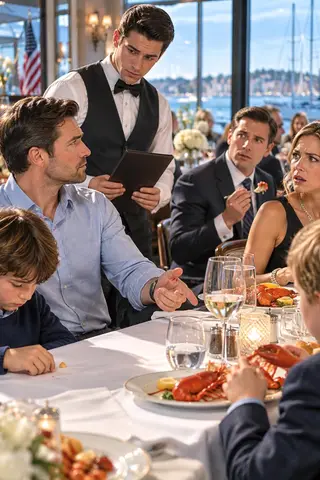
 "He'll Be Fine, He's Used to Going Without": Sister-in-Law Humiliated a 10-Year-Old Boy at a Luxury Restaurant
Chapter 30
The Masterpiece of Peace
One month later, the grand gallery of the San Francisco Modern Art Pavilion held the national debut of the New Horizons Youth Retrospective. The cavernous, minimalist hall of polished concrete and white marble was packed with art patrons, critics, university deans, and philanthropists from across the Pacific rim.
At the center of the main atrium stood a massive, panoramic triptych canvas, stretching twenty feet wide under soft gallery spotlights. The piece had been awarded the highest distinction of the national exhibition: The Presidential Honor for Collaborative Youth Art.
The painting was titled The Harbor at Dawn.
The left panel depicted a storm-ravaged mountain slope, cold and austere, with dead pine branches framing an empty wooden cabin porch wrapped in ice. The right panel depicted a crumbling corporate skyscraper made of dark glass, falling apart into jagged geometric fragments that dissolved into dust.
But the central panel—vast, glowing, and commanding the room—depicted an expansive, sun-drenched coastal headland overlooking a calm, deep-blue ocean. On the bluff stood four figures, silhouetted against the rising sun, standing around a simple, solid oak table laden with fruit, bread, and water. Above them, an eagle soared toward the limitless horizon, its wings catching the pure, unfiltered morning light.
The plaque beneath the painting read:
Created collaboratively by Caleb Vance, Leo Vance, and Julian Vance.
Dedicated to Luke Vance: Who taught us that a seat at the table is not earned by pride, but granted by love.
Crowds gathered three-deep in front of the canvas, murmuring in quiet admiration of the emotional depth and sheer technical mastery of the work. Marcus Vance stood among the attendees, smiling discreetly as he adjusted his lapel pin, while the director of the National Gallery personally presented the awards on stage.
When the ceremony concluded and the applause subsided, Caleb, Julian, and Leo walked down the marble steps together, dressed in simple, elegant navy suits, laughing and celebrating with their classmates and mentors.
I waited for them near the grand glass atrium doors. As they approached, Caleb caught my eye, his face glowing with a calm, effortless confidence that no insult could ever diminish.
"Are you ready to go home, Dad?" Caleb asked, clapping Leo on the back.
I looked at the three of them—whole, brilliant, unified, and utterly untouchable by the malice that had once sought to define them.
"Yes, sons," I answered, a broad, peaceful smile spreading across my face as we walked out into the cool evening air together. "Let's go home. The table is waiting."
The End









