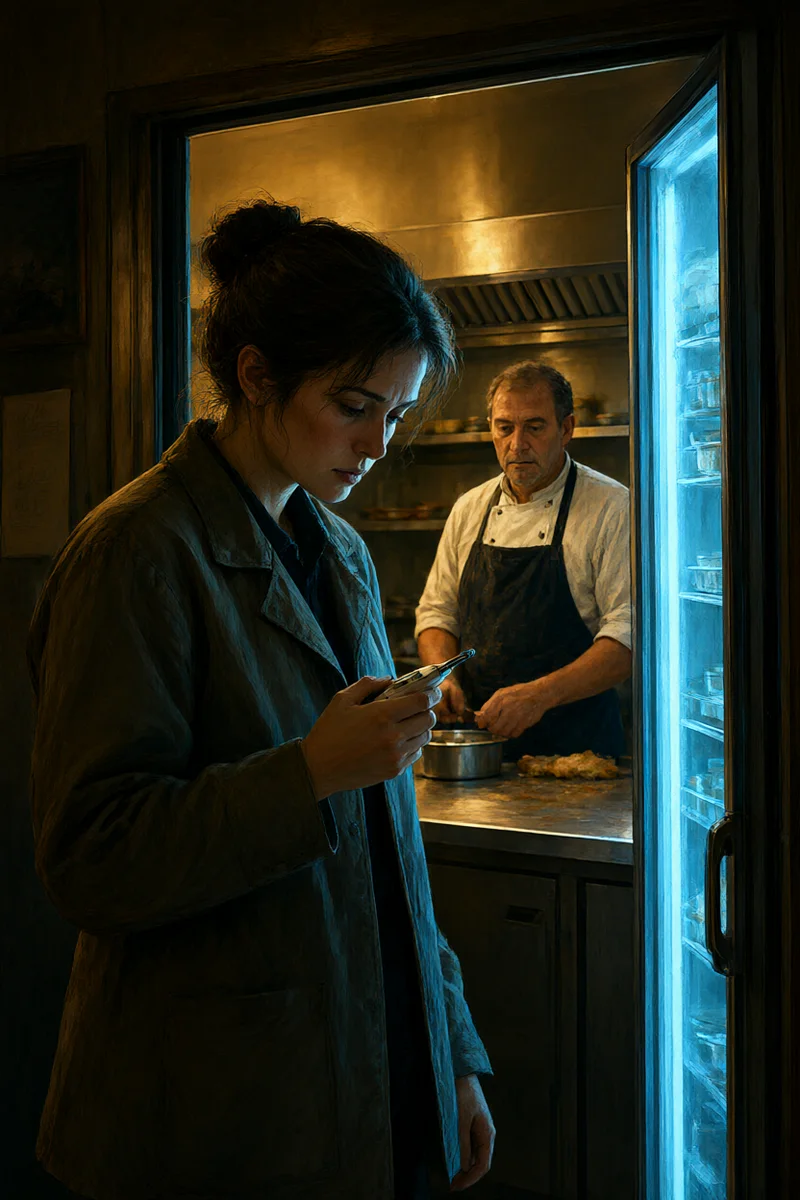
 Back of House
Chapter 5
Thirty-Seven Degrees
The badge sat on the desk between them, face up, and Sabine looked at her own photograph and thought that it was a fair outcome. That was the worst of it. She had written people up for less.
Dorota was reading the file. Outside the glass, the office was pretending not to watch.
There was a knock. Pradeep put his head round the door with an apologetic face. “There's a man in reception who says he needs to make a statement about complaint 4471. He's brought a sort of folder.”
Tibor had shaved, which she noticed and wished she hadn't. He had his phone, his walk-in repair quotes, and a printout of his own call record showing the city's number on Tuesday at nine-oh-six. He laid them out on Dorota's desk next to Sabine's badge like a man setting a table.
“I falsified my logs,” he said. “Then I reported myself and asked for her district, because I knew she wouldn't let it slide. She didn't. She closed me in eighteen minutes. Everything after that was me cooking something I'd already been paid for, in a licensed kitchen, because she wouldn't let me cook it in my sister's. If anyone gets in trouble for Saturday it should be me.”
Dorota looked at him for a long moment, then at Sabine.
“You understand,” she said to Tibor, “that you've just admitted falsifying records to the city in writing.”
“Yes.”
“That's a separate fine.”
“I assumed.”
Dorota made a short noise that might have been a laugh in a different building. She pushed the badge back across the desk to Sabine with one finger.
“Written reprimand for the form. You fill it in today, you declare the prior relationship, and you never inspect that address again. Pradeep does his reinspection.” She turned back to her screen. “And next time you break the rules, Marsh, check where the cameras are.”
The new compressor cost eleven thousand four hundred dollars installed. The rehearsal-dinner money went into November's rent, so the compressor came out of Juno, who said this was the very last time, and from the sale of the Japanese knife set Tibor had been given by his first head chef at nineteen. Sabine found out about the knives later. She did not offer to pay, because she understood that it mattered he hadn't asked.
Pradeep reinspected on a Thursday. The walk-in held thirty-seven. The log on the nail had two weeks of real numbers in it, thirty-seven and thirty-eight and once a thirty-nine after a delivery, each with initials and a time. He passed it in twenty minutes and took the red notice down himself.
Sabine came that Saturday at nine, which was when the second seating ended and the counter emptied.
She sat at the end, seat fourteen, by the pass. She had brought an envelope that had been in the bottom of a suitcase for nine years and she put it on the counter: fourteen supplier receipts from one October afternoon, the fish man, the dairy, the produce company, the linens, and a sheet of lined paper with Hector the dishwasher's signature on it for two weeks' wages, paid in full.
Tibor looked through them without saying anything. When he got to Hector's signature he stopped for a while.
“I thought you'd kept some,” he said finally. “For the bus. For somewhere to live.”
“I had forty dollars of my own.”
He put the envelope under the counter, carefully, beside the till. Then he went into the kitchen and came back with a small plate: one piece of short rib, dark and glossed, a little too much orange in the sauce.
Behind him, on its nail inside the cooler door, the clipboard had a new line in his square capitals. Sat 9:04 p.m. 37°. And beside it, in the initials column, two sets: T.B. and, waiting for her, a blank.
The End









