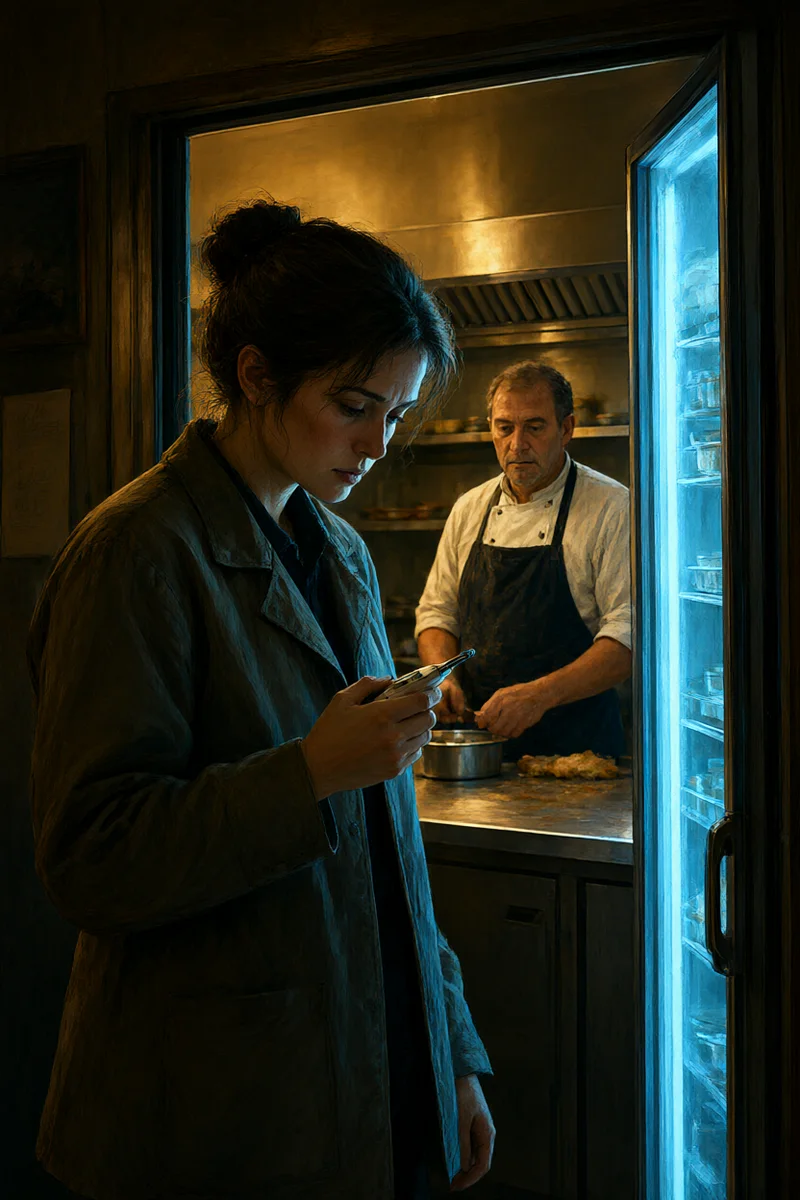
 Back of House
Chapter 3
The Church Hall
Juno's house was a narrow brick semi on Gale Road, and at seven on Friday evening every window on the ground floor was steamed.
Sabine stood on the step for a minute in her own coat, not the city one. If she knocked she was a private citizen visiting an old friend. If she saw forty portions of short rib braising in a domestic oven and walked away, she was an inspector who had witnessed an unlicensed food operation and not reported it. She could feel the difference in her shoulders.
Juno let her in and pointed down the hall with her chin.
Tibor was in the kitchen with two stock pots going on a four-burner stove built for a family. There were sheet trays on the dining table and on the chairs. He was salting something and did not look up.
“You can't do this,” she said.
“I'm aware.”
“If anyone at that dinner gets so much as a stomach ache, it isn't a fine. It's your name in the paper and no licence for five years.”
“Then I'll make sure nobody gets a stomach ache.” He tasted, frowned, added vinegar. “Unless you've come to close Juno's kitchen too. I'll get you the form.”
She looked at the trays, the borrowed pans, the rice cooker on top of the washing machine. It was the same kitchen-table logic that had nearly taken this house once already. He had not learned a thing. Or he had learned one thing, and the thing was to keep going no matter what was on fire.
“Saint Brigid's,” she said.
He looked up for the first time.
“The church hall on Mercer. They have a licensed commercial kitchen; they do the funeral lunches and the food bank. Two convection ovens, a blast chiller, walk-in that holds thirty-six. I inspected it in August.” She was talking too fast. “Father Okonjo rents it to caterers by the night. He'll want a hundred dollars and for you to mop.”
“Why are you telling me this?”
She didn't have an answer that she wanted to say out loud. “Because I don't want to read about you.”
Father Okonjo wanted a hundred and twenty dollars, and for them to mop, and for the radio to stay on the classical station because it was his radio. By ten o'clock everything had been carried over in Juno's hatchback in four trips. By eleven, Sabine had her sleeves pushed up and was trimming beef at the next station without anyone having asked her to.
It came back the way a language comes back. He reached left and she had already moved. She said behind and he'd already turned. At one in the morning he passed her a spoon of the braising liquid without a word and she said “more orange,” and he added orange.
“You never said why,” he said, somewhere around two. He was washing the big pot; she was drying. “The note said, I've paid everyone. Don't follow me. That was it. Nine years on two lines.”
“If I'd told you to your face, you'd have talked me out of it. You'd have been very reasonable and very sure, and I'd have let you, and we'd have lost Juno's house in the spring instead.” She dried the same lid for too long. “I didn't trust myself in a room with you. That's the honest version.”
He was quiet. The radio played something with a cello in it.
His order book lay open on the steel beside the sink, the week's list in square capitals, most of it struck through. At half past two she lifted it clear of the suds and read the page, the way anyone reads what is in their hand.
Tues 9:00 — call city re: walk-in. Ask for district 4.
Complaint 4471 had come in on Tuesday at nine-oh-six. Sabine was district 4.
The End









