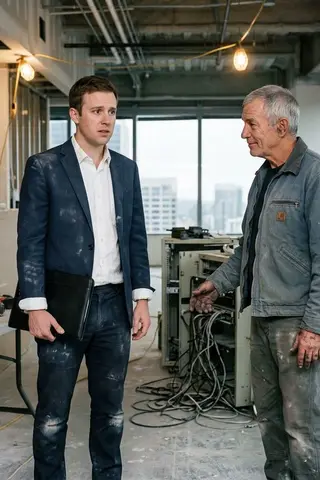
 He Got Off on the Wrong Floor for a Job Interview
Chapter 2
The First Week in the Trenches
The next morning, I didn’t wear the navy suit. I didn’t button up the thirty-four-dollar white shirt, which was now permanently scarred with grease stains across the chest. Instead, I pulled on a comfortable pair of dark jeans, a worn flannel shirt, and a pair of sturdy sneakers.
When I walked through the security gates of the Hayes Systems Group tower, the receptionist didn't blink twice. My badge was waiting for me at the front desk, already printed and programmed with full level-two facilities access.
My new desk was tucked away in a bustling corner of the third-floor hardware bullpens. It looked like it had been abandoned in a hurry. The previous occupant had left behind a chipped coffee mug stained with rings of dark sludge, three expired peppermint candies stuck to the blotter, and a towering, intimidating stack of neglected work orders that stretched back nearly a month.
Before I even had time to sit down and figure out my email login, a sharp voice cut through the hum of the office.
“Are you the new transfer?”
I looked up to see a sharp-eyed woman with silver-streaked hair pulled back into a tight bun standing over my desk. She dropped an even heavier stack of green paper work orders directly onto my keyboard with a resounding thud.
“Two weeks of backlog,” Rachel Moore, the facilities operations supervisor, announced briskly. “The previous guy couldn't handle the ticket volume and transferred to marketing. Don't let the queue get above fifty, or we’ll hear about it from upper management.”
That was my glamorous beginning in the corporate world.
There was no honeymoon phase, no gentle onboarding process, and no introduction to the team. Just a relentless avalanche of technical failures. Broken conference-room projectors that refused to sync with executive laptops. Unstable office Wi-Fi networks that dropped packets every time the microwave in the breakroom ran. Faulty badge readers that locked employees out in the rain.
And, memorably, a high-tech sensor faucet in the executive washroom that the facilities team had somehow decided was an “IT routing problem.”
I tackled them one by one. I crawled under conference tables with a flashlight and a crimping tool, traced blown fuses in electrical closets, and rewrote corrupted network firmware while employees glared at me from behind glass walls. I didn't complain. Every ticket I closed meant another step away from the financial precipice waiting for me back at our small Seattle apartment.
By Friday afternoon, the backlog queue had dropped from two hundred tickets down to twelve. My hands were calloused, my back ached from hunching over terminal blocks, but when I clocked out, I felt a deep, steady satisfaction I hadn't felt in years.
That was when Walter began pulling me into the company’s real problems.
It started quietly on a Tuesday afternoon. Walter appeared beside my desk without warning, motioning for me to grab my laptop. He led me down into the sub-basement levels, where a massive, multi-floor data center conversion project was severely falling behind schedule. Millions of dollars of hardware sat unconfigured, and the project managers were pointing fingers in every direction while deadlines burned away.
Walter would sit cross-legged on the unfinished concrete floor, spreading sprawling architectural wiring diagrams across his knees, looking less like a billionaire chairman and more like a master mechanic diagnosing a stubborn engine.
“Look at this throughput bottleneck, Ethan,” he would say, pointing a thick finger at a schematic. “The software team says the network fabric can't handle the traffic load. What do you see?”
Sometimes, we disagreed fiercely. I would argue that the bottleneck wasn't bandwidth at all, but poorly optimized packet routing in the legacy firmware. He would push back, testing my logic, forcing me to defend my technical assertions with hard data rather than assumptions.
More often than not, we arrived at the exact same conclusion from opposite directions. Working with Walter wasn't like reporting to a boss; it was like being apprenticed to a master craftsman who demanded absolute precision and rewarded ingenuity.
But not everyone in the building was thrilled by my rapid integration into the inner circle.
The End









