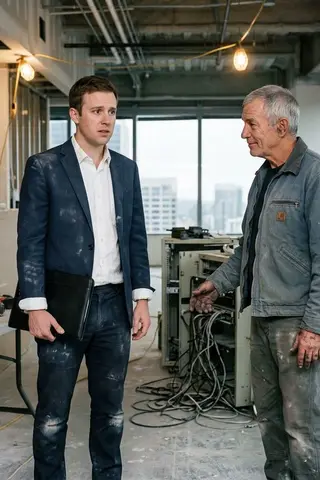
 He Got Off on the Wrong Floor for a Job Interview
Chapter 1
The Wrong Floor and the Broken Machine
The light rail hummed beneath my feet as I stared out the window, watching the gray Seattle rain smear against the glass like a watercolor painting. Thirty-one years old, nearly a decade of technical experience under my belt, and yet my stomach felt like a knotted mess of frayed wires. Four months of unemployment had a way of shrinking your world until it consisted entirely of two things: the balance in your checking account and the price tag on prescription medications.
That morning, my mother had silently pressed two warm boiled eggs into the pocket of my only navy suit.
“Eat them on the way,” she had said, her voice thin with a worry she tried desperately to hide.
“I’ll grab breakfast downtown,” I replied, trying to sound more confident than I felt.
“With what money?”
That single question had ended the argument. We were living on a tightrope, counting grocery money down to the cent, balancing every trip to the pharmacy against the utility bills. A former coworker had thrown me a lifeline by referring me for a server operations position at a major tech company. I had spent days organizing years of projects into a black folder, printing two pristine résumés, and shelling out thirty-four dollars for a brand-new white shirt. It felt like a small fortune, but I needed to look the part.
The address led me to a towering glass corporate monolith north of downtown. The text message from my friend was specific: Sixteenth floor.
When the elevator doors chimed and slid open, I didn’t step into a sleek corporate lobby with polished marble and smiling receptionists. I stepped into a construction zone. Dust hung thick in the air, catching the amber glow of temporary work lights strung from exposed concrete ceilings. Stacks of drywall leaned against bare studs, and the sound of distant hammers echoed through the skeletal framework. There was no software company anywhere in sight.
I pulled out my phone and checked the floor indicator beside the elevator shaft.
Sixteen.
Panic prickled the back of my neck. I dialed the friend who had referred me, but the call went straight to voicemail. I tried again, tapping my foot against the concrete subfloor, surrounded by the quiet chaos of a renovation that had clearly gone off schedule.
Before I could figure out my next move, a rough voice cut through the dust-heavy air.
“You know how to fix things?”
I blinked, turning around to find an older man standing by a stack of lumber. He wore a faded, paint-splattered work jacket, and his hands were stained with grease and carbon dust. He looked like a veteran technician who had spent decades elbows-deep in cooling fans and circuit boards.
I looked down at my brand-new white shirt, my clean navy suit, and my pristine black folder. Then I looked back at him.
“A little,” I said.
He didn’t waste time with small talk. He turned and gestured for me to follow him deeper into the unfinished labyrinth, leading me past rows of plastic-wrapped furniture toward a cluster of old, heavy server racks. Their side panels had been stripped away, and a chaotic nest of tangled black cables spilled out onto the floor like exposed entrails.
“This one hasn’t worked all morning,” the old man said, crossing his grease-stained arms. “The whole bank is dead, and the crew thinks we need to rip out the motherboard. But I think it’s something else.”
Every logical voice in my head told me to turn around. My interview was supposed to be starting soon. I was wearing an expensive new shirt that I couldn't afford to ruin, and I had no business playing handyman in a construction zone.
Instead, I set my résumé folder down on a dusty folding table. I slipped off my suit jacket, draped it carefully over a plastic crate, and meticulously rolled up my sleeves. Kneeling down on the gritty concrete floor, I slid into the narrow gap behind the server rack, feeling the familiar, comforting hum of residual power against my fingertips.
What started as a polite favor quickly devoured the clock. Ten minutes melted into thirty, and thirty minutes stretched past an hour. My initial frustration with the misplaced interview dissolved entirely, replaced by that stubborn, familiar itch of a technical puzzle waiting to be solved.
The power supply was drawing clean current. The controller boards were responding to basic ping tests. But somewhere deep within the legacy architecture, the data packets were hitting a dead wall.
The stranger pulled up an overturned bucket, sat down a few feet away, and watched me work in silence. After a while, he tossed a small Phillips-head screwdriver across the floor toward my knee.
“What’s your name?” he asked.
“Ethan Carter,” I muttered, eyes locked on a diagnostic screen reflecting off the glass of a chassis.
“I’m Walter,” he said simply.
Two hours slipped away like water through my fingers. The stress of unemployment, the crushing weight of my mother’s medical bills, and the anxiety of the missed interview all vanished, compressed into a single objective: make the machine talk.
Near the very bottom of the rack, tucked behind a thick bundle of redundant power lines, I found it. A hairline fracture in a specialized fiber-optic connector. Years of heat, vibration, and dust had done their work, oxidizing the pins until the data link was completely severed.
Walter dug through an old metal toolbox sitting on a nearby cart and produced a pristine replacement connector. Working with steady, practiced precision, I unclipped the damaged hardware, slotted in the new component, and secured two loose grounding fittings.
“Cross your fingers,” I murmured.
I hit the master power switch. For a second, the rack remained dead silent. Then, a sharp click echoed from the interior chassis. Cooling fans whirred to life, roaring up to full RPM before settling into a steady, rhythmic hum.
Lines of green startup text cascaded down the monitor screen like a digital waterfall. The error lights blinked out one by one, replaced by a solid, reassuring green indicator.
A login prompt blinked cleanly on the monitor.
“There you go,” I exhaled, wiping a smudge of dust from my forehead with the back of my wrist, completely unaware that I had just smeared black grease right across my brand-new white shirt.
Walter leaned forward, peering at the screen with sharp, appraising eyes. Before he could speak, my phone began vibrating violently in my pocket.
I pulled it out to see my friend’s name flashing on the screen. I swiped and answered, but before I could speak, my friend’s voice came through the receiver, dripping with horror and disbelief.
“Ethan! Oh god, man, where are you? They moved corporate offices last month! I completely forgot to send you the new address across town!”
I slowly lowered my phone from my ear and looked up at the wall clock hanging above the construction site. Nearly three hours past my scheduled interview time. The prestigious software firm, the hiring manager, the carefully rehearsed answers—they were all happening across the city in a building I wasn't even in.
When I clicked the phone off, Walter was standing right beside me, looking down at my ruined shirt, my dirt-stained knees, and then back at the humming server rack.
“What happened?” Walter asked, his voice low and gravelly.
“The company moved,” I said numbly. “I missed my interview.”
“Pretty much,” I sighed, staring at the floor.
Walter looked me over once more, taking in every detail of my exhaustion. “What position were you interviewing for?”
“Hardware maintenance and server operations.”
Walter nodded slowly, a faint, knowing smile touching the corners of his mouth. He reached into the pocket of his faded work jacket and pulled out a slightly bent, cream-colored business card, holding it out to me between two grease-stained fingers.
I took it and looked down.
Walter Hayes.
Chairman.
Hayes Systems Group.
My breath caught in my throat. I looked up from the card to the vast, open expanse of the construction floor around us. This entire building—every floor, every server, every brick—belonged to him.
“Come work for me tomorrow,” Walter said, turning back toward the elevator bank. “You didn't just tell me you could fix things. You already showed me.”
The End









