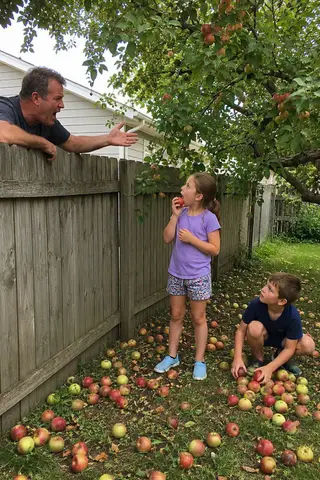
 He Called My 6-Year-Old Daughter a Thief Over His Fallen Apples
Chapter 5
The Certified Letter
For forty-eight hours after the surveyors left, Dale’s house was completely dark.
The blinds remained closed. His lawn mower didn't run. His garage door stayed shut. The bright pink stakes and neon nylon string remained stretched across the green lawn, bisecting what Dale had always assumed was his private kingdom.
On Thursday morning, the United States Postal Service carrier walked up Dale's front walkway carrying a thick manila envelope that required a signature. Through our kitchen window, I saw Dale open the front door in his bathrobe, squint suspiciously at the green certified mail slip, sign the electronic pad, and retreat inside with the envelope.
The letter inside did not come from Rob or me. It came from Vance, Sterling & Holbrook, Attorneys at Law—specifically from Arthur Vance, a veteran real estate litigator who happened to be Rob’s longtime college roommate.
The letter was twelve pages long, printed on heavy bond paper, and written in the kind of bone-chilling, airtight legal terminology that keeps corporate executives awake at night.
Rob had given me a copy to read the evening before.
The notice formally notified Dale Henderson of three major legal realities:
First, the survey confirmed that Dale was actively encroaching upon our deeded parcel with approximately eighty linear feet of wood fencing, an underground irrigation line, and a brick retaining border. The letter demanded the full removal and relocation of the encroaching fence within thirty calendar days, at Dale’s sole expense.
Second, the letter addressed the Honeycrisp apple tree. Because the trunk straddled the boundary line, under state jurisprudence, the tree was legally classified as a "boundary tree" held in common tenancy by both landowners. Neither neighbor had the right to harm, harvest, or prune the tree without mutual written consent.
Third—and this was the masterstroke Rob and Arthur had spent hours crafting—the letter addressed liability.
Because Dale had formally claimed exclusive ownership of the fruit and refused to allow reasonable maintenance, while simultaneously allowing the root system to crack the underground stormwater discharge pipe serving our foundation (which Rob had documented with a miniature pipe camera over the weekend), Dale was notified of an active private nuisance claim.
The letter gave Dale two choices:
Option A: He could sign a mutual maintenance and easement agreement, reimburse us for the pipe repair ($2,400), hire a licensed, insured tree service to prune the canopy evenly back to the boundary line, and pay for the relocation of his encroaching fence to the true property line.
Option B: We would file an emergency petition for quiet title and nuisance abatement in the County Circuit Court, seeking an order to compel the complete removal of the encroaching tree, full restoration of our property, twenty years of back-rent for the occupied land, and legal fees.
Around two in the afternoon, Dale finally emerged from his house.
He didn't have his visor on. His hair was disheveled, his face pale, and he held the certified letter in one trembling hand. He marched down his driveway and headed straight for our front door.
I was in the living room helping Leo with his second-grade spelling words when the heavy brass knocker pounded against our front door.
Bang! Bang! Bang!
"Miller!" Dale’s voice muffled through the wood. "Open this damn door! You can't do this! You know damn well this fence was here before you bought the place! Open the door!"
Leo froze, dropping his yellow pencil onto the carpet. His eyes grew wide with fear, his little shoulders instantly tensing up.
"Mommy?" he whispered.
I put my finger to my lips, knelt down, and kissed Leo's cheek. "Stay right here, baby. Don't move."
I walked into the entryway just as Rob came down the hallway from his home office. Rob looked completely unbothered. He didn't open the door. Instead, he pulled out his smartphone, tapped the screen twice to bring up the front porch camera feed, and activated the two-way intercom speaker.
"Dale," Rob’s voice projected clearly through the exterior speaker above the doorbell. "You are trespassing on my front porch. All communication regarding the boundary dispute must go through my legal counsel, Arthur Vance, whose phone number is on the letterhead in your hand."
"Stop talking through this stupid gadget and face me like a man, Rob!" Dale bellowed, leaning directly toward the camera lens. "You think you can steal four feet of my yard? You think you can touch my father's tree? I have adverse possession! I’ve maintained that strip of grass for twenty years! You don't own that dirt anymore!"
Rob pressed the microphone button again.
"Dale, adverse possession in this state requires twenty years of continuous, open, notorious, and hostile possession, accompanied by the payment of all municipal property taxes on the contested parcel. You haven't paid taxes on that four-foot strip—I have. The county tax records confirm it. You have twenty-nine days remaining to respond through counsel. If you do not leave my porch in sixty seconds, I will contact the police for criminal trespass."
Dale stood there, breathing heavily through his nose, his knuckles white around the papers. He looked up at the black dome of the security camera, realized he was being recorded in full high-definition video, spat on our welcome mat, and stormed off down the driveway.
Leo came creeping around the corner of the hallway. "Is he gone?"
Rob knelt down, opened his arms, and pulled Leo into a tight hug. "He’s gone, buddy. And he’s not going to bother you ever again."
The End









