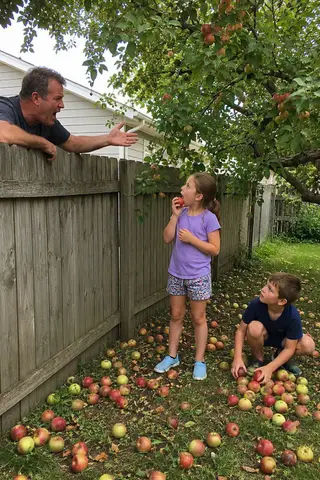
 He Called My 6-Year-Old Daughter a Thief Over His Fallen Apples
Chapter 3
The Code Inspector's Knock
Dale didn't wait until Monday.
By Tuesday afternoon at two o’clock, a white Ford Escape with the green emblem of the City Department of Neighborhood Services and Code Compliance pulled up to our curb.
A tall woman in a crisp khaki uniform with an official badge pinned to her pocket stepped out of the vehicle. She carried a thick black binder and a digital camera with a long telephoto lens. Her name tag read Officer Bradley.
I was working at the dining table on my laptop when the doorbell chimed. My stomach dropped. Even when you know you haven't done anything wrong, the sight of a city inspector standing on your front porch with a clipboard makes your chest tighten.
I opened the door. "Can I help you?"
"Good afternoon, ma'am. Sarah Miller?" Officer Bradley spoke with the tired, mechanical politeness of someone who spends eight hours a day mediating disputes between neighbors over trash cans and overgrown weeds. "We received an urgent priority complaint regarding an unmaintained property, severe odor nuisance, and an uncontrolled insect infestation creating a public health hazard in your rear yard."
Before I could answer, Rob appeared behind me. He had taken half a day off from work, anticipating this exact visit. He was dressed in his work slacks, a button-down shirt, and wore a calm, welcoming smile.
"Officer Bradley, thank you for coming out so quickly," Rob said, extending his hand. "I’m Robert Miller. I believe my neighbor, Mr. Henderson, filed the complaint?"
Officer Bradley hesitated, shaking his hand. "I cannot confirm the identity of the complainant, Mr. Miller. However, the report indicates that several bushels of decaying fruit are creating an environmental nuisance bordering the adjacent property."
"Understood," Rob said politely. "Would you like to step through to the back deck to view the condition of the parcel?"
"Please," she said.
We led her through the kitchen and out onto the deck. The smell hit her immediately. Officer Bradley wrinkled her nose, reached for her camera, and stepped toward the deck railing. Below us, Dale’s overhanging branches were dropping yet another soft, bruised apple into the lawn. The ground was dotted with dark patches of decay, and the yellowjackets were having a field day.
On the other side of the fence, the blinds in Dale’s kitchen window twitched. He was watching us like a hawk, waiting for the citation book to come out.
Officer Bradley opened her binder and clicked her pen. "Mr. Miller, as you can see, Section 14-8 of the Municipal Health and Safety Code requires homeowners to maintain their grounds free of rotting vegetable matter that attracts vermin or stinging insects. This level of decay is definitely in violation. I would have to issue a notice of violation with a seventy-two-hour cure notice, after which daily fines of one hundred and fifty dollars apply."
"I completely understand the statute, Officer," Rob said smoothly. He didn't look worried at all. He reached into his leather work satchel, which was sitting on the patio table, and pulled out a neatly organized, tabbed blue folder.
"Before you write that notice, though, I’d like you to review a few pieces of documentation."
Officer Bradley frowned slightly, but took the folder.
"Tab one," Rob explained, pointing with a pen, "contains municipal precedent from the state appellate division regarding encroaching vegetation and debris liability. Under state law, fallen fruit belongs either to the owner of the tree or to the owner of the land where it falls, depending on local jurisdiction. However, tab two contains an official signed statement and two date-stamped photographs taken ten days ago."
Officer Bradley turned the page. The high-resolution photo showed Dale Henderson standing on his side of the fence, arms crossed, watching seven-year-old Leo and six-year-old Maya carrying armfuls of fallen apples to his waiting grocery bag.
"On that afternoon," Rob continued, "Mr. Henderson formally asserted exclusive legal ownership over every piece of fruit dropped by that tree, explicitly barring my minor children from touching, keeping, or disposing of it under threat of being reported for theft. Tab three is the audio recording transcript where he reiterates to me that the apples are his private agricultural property."
Officer Bradley read the documents, her eyes shifting from the papers to the photo of little Maya crying by the fence. Her expression shifted from bureaucratic detachment to profound irritation—not at us, but at the situation.
"Furthermore," Rob added, stepping beside her at the rail and pointing upward, "take a look at the tree's primary trunk. It sits on Mr. Henderson’s parcel, but over thirty-five percent of the productive canopy extends across the air rights of my property without an easement. If this fruit is his personal property, as he formally claimed to local minors, then he has dumped his private agricultural waste across my boundary line. That falls under Municipal Code Section 22-4: Illegal Dumping and Hazardous Debris Encroachment by an Adjacent Landowner."
Officer Bradley closed the binder with a sharp snap.
She looked across the fence at the twitching blinds in Dale’s kitchen window.
"Mr. Miller," she said slowly, her voice laced with professional irony, "are you telling me that Mr. Henderson called the city to complain about the rotting condition of his own claimed personal property?"
"That is precisely what he did," Rob said. "And as a homeowner, I am currently requesting that the City of Oakridge issue a formal Notice of Abatement to Mr. Dale Henderson to immediately enter my property with my written consent to remove his hazardous property, or face daily fines for unlawful debris encroachment."
Officer Bradley looked back at the fence. The blinds snapped shut.
"Mr. Miller," she said, pulling a different colored carbon-copy slip from her folder, "I believe I need to have a very long conversation with the gentleman next door."
The End









