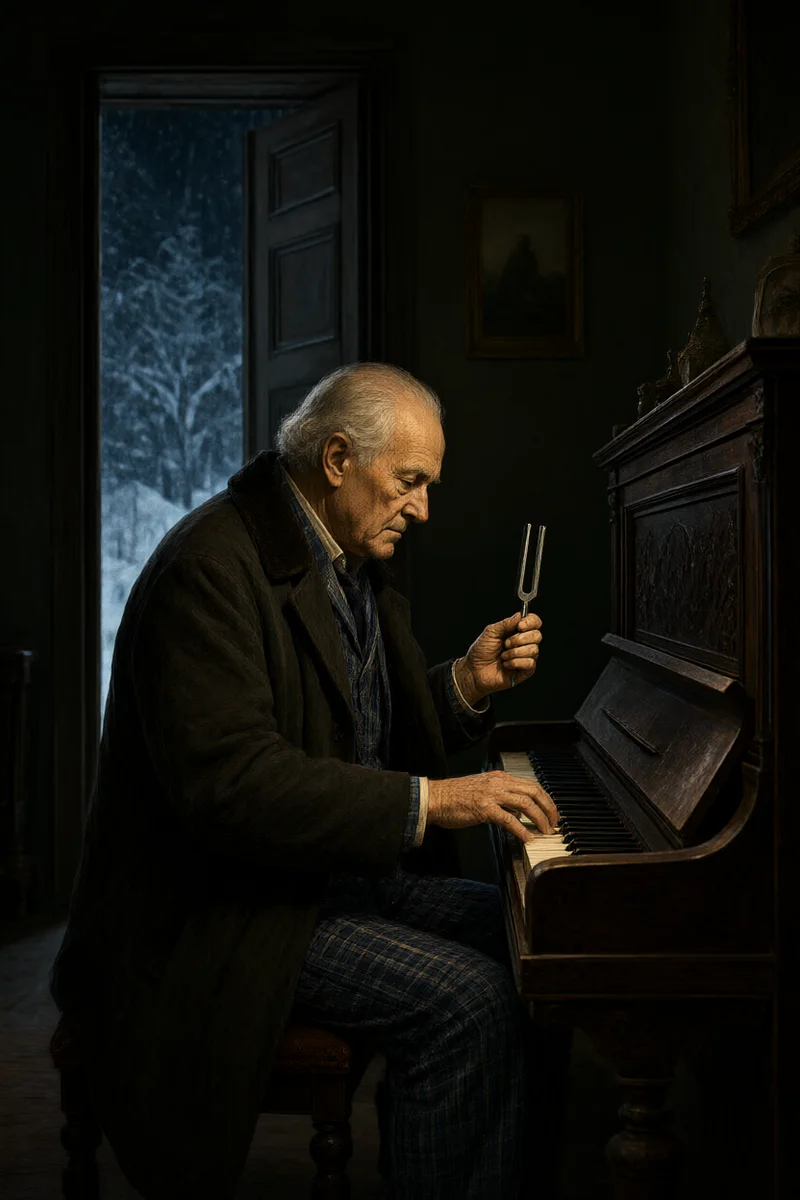
 The Tuning Fork
Chapter 3
The Promise
In the morning their father was clear and bright and slightly embarrassed, the way he always was after a bad night, though he couldn't have said why. He made oatmeal for three. He asked Anson about the twins' soccer and remembered the answers.
Fern had gone home to shower. When she came back at nine, Anson met her on the porch and shut the door behind him.
“Tell me.”
She leaned on the rail. Below them the yard was white and perfect except for last night's tracks, sunk now into soft dents.
“Three weeks ago. I came at six, like always, and he'd been asleep in the chair. I woke him to give him his pills.” She was looking at the snow, not at him. “He didn't know me. He thought I was someone who'd broken in. He grabbed my arm and he held on, and he said, ‘Who are you, what have you done with her.' He kept saying it. What have you done with her. I think he meant me. I think he was trying to protect me from me.”
Anson didn't say anything.
“It lasted maybe a minute. Then he let go and asked why I was crying.” She shrugged. “It's happened once since. Not as bad.”
“Why didn't you tell me?”
“Because you'd do exactly what you did last night. You'd say aides, round the clock, keep him in the house. And when the aide got grabbed, you'd say it was the wrong aide.” Now she looked at him. “Why does it matter so much to you? Really? You've been gone twenty years.”
He was quiet for long enough that a truck went by on Route 9 and its chains rang on the road.
“The last week,” he said finally. “Mom's last week. You'd gone home to sleep for once, and it was just me with her, and she was mostly out of it. But she woke up and took hold of my wrist and she said, ‘Don't let them put him anywhere. Fern will want to do the sensible thing. You won't let her.'” He laughed, without any humor in it. “She said it to me. Not you. I was the one who wasn't there, and she picked me.”
Fern stared at him.
“I've been carrying that for four years,” he said. “I think it's the only thing she ever asked me to do.”
Behind them the screen door creaked. They both turned.
Their father was standing in the doorway in his cardigan, holding a black composition notebook against his chest with both hands. Neither of them knew how long he'd been there.
“Your mother asked me the same thing,” Wendell said mildly. “Forty years ago, when her own mother went into the county home. Never let them put me anywhere, Wendell. I said I'd try. Then four years ago, at the end, she asked me again, and that time I told her no.”
Anson stared at him. “You told her no?”
“I told her I wouldn't make a promise I couldn't keep to a woman who was dying. She was very cross with me. Then she laughed. Then she must have gone and asked you.” He shook his head slowly. “That's your mother. She always did have a second plan.”
He held out the notebook. On the cover, in his careful tuner's capitals, it said DAYBOOK. The doctor had told him to keep one, two years ago, for the bad days, and he had written in it every single night since.
“I may not remember this conversation by supper,” their father said. “So I'll ask you both to read it while I do. Start with the eleventh of November.”
The End









