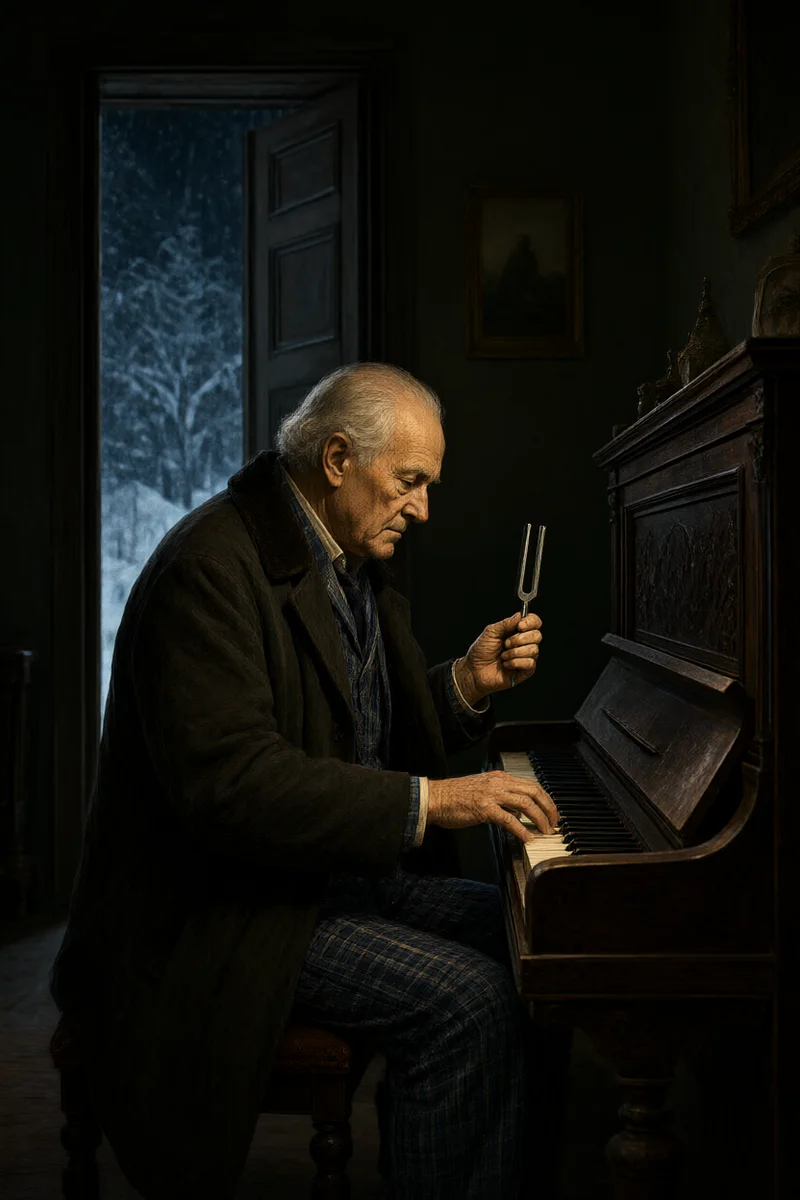
 The Tuning Fork
Chapter 1
The Brochure
Before dinner, their father tuned the piano.
It did not need tuning. Fern had paid a man from Corbray to do it in October, and her father had stood behind the man the entire hour with his arms folded, wincing. But the house was full and noisy and hot, and Wendell Babcock had been a piano tuner for fifty-one years, and when the world got loud, he went and found the A.
Anson stood in the doorway of the front room and watched him. Their father sat very straight on the bench, struck the fork against his knee, held it to the wood, and listened with his head tipped like a bird's. Then he pressed the key. Then he did it again.
“He's good,” Anson said, sounding surprised. “He's fine. Look at him.”
“He's fine at that,” Fern said, and went back to the gravy.
Her brother had flown in from Phoenix the night before with a carry-on bag and a sunburn, and had already told her twice that the house looked great and once that she looked tired. He was forty-seven, four years younger than she was, and he had their mother's quick, bright way of filling a room. He had been home for two Christmases out of the last four. He called every Sunday. He sent money for the gutters.
At dinner Wendell called the twins Ellery and Jude, which was correct, and then called them Ellery and Jude again ten minutes later with exactly the same delight, as if seeing their photograph on Anson's phone for the first time. He told the story about tuning for a famous pianist at the college in 1983 and the pianist asking him to stay for the concert. He told it twice.
Anson laughed both times. Fern watched him laugh the second time and saw the moment it caught in his throat.
After pie, he went to the fridge for cream and came back holding the brochure.
She'd forgotten it was there, under the magnet from the dentist. Thornbury House. Memory Care in a Home Setting. A photograph of an old woman laughing with a nurse in a sunny room with a fern in it, of all things.
“What's this?”
Their father had gone through to the front room to sit by the piano. Fern lowered her voice. “It's a place in Hadley. Twenty minutes. I've been to see it twice.”
“You've been to see it.”
“They have a room in January. I've put his name down.”
Anson set the brochure on the table like it was something that had died. “Fern. Mom made him promise. You were there. She made him promise he'd never let either of them go into a place like this, and he made her promise the same, and he kept his. He kept her here till the end.”
“He had me,” Fern said. “He kept her here because I came every day for nine months.”
“And now you're done, so he goes in a home.” He wasn't shouting. That was worse. “I can pay for aides. I'll pay for someone round the clock. He wants to be in this house with that piano, and you want your weekends back, and I get it, I do, but that's heartless, Fern. That's what it is.”
Fern pulled the cuff of her sweater down over her wrist. The house was eighty degrees. She had been wearing long sleeves since the eleventh of November.
“Go to bed, Anson,” she said. “You're on Eastern time now.”
She went home to her own house at ten. He slept in his old room under the eaves, on the bed with the plaid spread, and woke at ten past two to a sound he could not place, and then to cold.
The front door was standing wide open. Snow was blowing in across the hall rug. And his father's bed was empty.
The End









