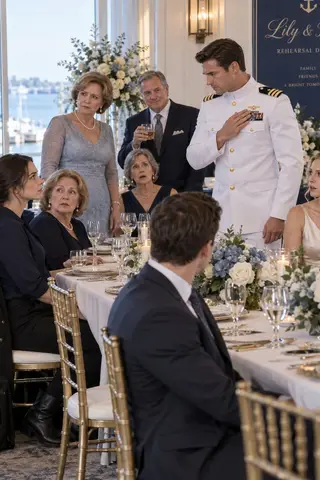
 Family Treats Her Like an Outcast Because of Her "Little Navy Career"
Chapter 8
The Turning Point on the Dance Floor
The applause eventually subsided into the soft, rhythmic hum of a string quartet playing a gentle classical waltz across the polished mahogany floor of the grand ballroom. The tension that had hung over the wedding reception like a heavy, suffocating fog finally evaporated, replaced by an atmosphere of genuine warmth, cautious reconciliation, and undeniable respect.
Lily and Ryan took the floor for their first dance as husband and wife. They moved together with effortless grace, whispering and smiling, entirely lost in their own world. I watched them from my seat at the head table, sipping a sparkling cider, feeling a deep, settling sense of peace wash over my soul.
“Nora?”
I looked up to see my mother standing beside my chair. Gone was the rigid, glittering facade of the perfectionist matriarch. Her shoulders were slightly slumped, her fingers nervously pleating the fabric of her designer dress, and her eyes held a fragile, vulnerable expression I had never seen on her face before.
“Do you... do you have a moment?” Diane asked softly, her voice barely louder than the string quartet. “Just... a few minutes. Outside on the terrace?”
I set my glass down on the table, met her gaze for a steady moment, and then nodded. “Sure, Mom. Let’s step outside.”
We walked through the open French doors onto the sweeping stone terrace overlooking the dark, rolling expanse of the Atlantic Ocean. The cool evening breeze carried the scent of salt water and damp earth, washing away the heavy, suffocating perfume of the ballroom inside. Strings of fairy lights twinkled overhead, casting a soft, golden glow across the stone balustrade.
My mother leaned against the railing, staring out into the dark horizon where the moonlight glittered across the cresting waves. For a long time, neither of us spoke. The silence wasn't awkward; it was heavy with twelve years of unspoken history, unaddressed distance, and buried truths.
“I was terrible to you last night, Nora,” Diane finally whispered, her voice cracking as a fresh tear spilled down her cheek. “And... and for a very long time before that.”
I kept my hands resting calmly on the cold stone railing, looking out at the ocean. “You liked the narrative where I didn't fit in, Mom. It made it easier to explain why I wasn't married with kids in a suburban cul-de-sac like your friends' daughters.”
Diane flinched as if she had been physically struck, but she didn't try to defend herself. She let the truth of my words settle over her without interruption.
“When Alan made those little jokes... when he called you the family glitch... I let him do it,” Diane choked out, her voice trembling. “I laughed along because I thought... I thought I was fixing you. I thought if I made you feel small enough, you’d finally quit that ridiculous Navy career, cut your hair, put on a dress, and come home to live a normal life.”
“The Navy isn't ridiculous, Mom,” I said, turning my head to look her dead in the eye, my voice entirely steady. “It gave me purpose. It gave me a family of people who judge you by your character, your competence, and your willingness to lay down your life for the person standing next to you—not by the brand of your handbag or the price of your watch.”
My mother covered her face with her trembling hands, her shoulders shaking with quiet, miserable sobs. “I was so ashamed, Nora. That’s the awful truth. When you enlisted at eighteen and walked away from the colleges we picked out for you, I felt like you were rejecting me. I took it personally. So I built up this wall where your success didn't count, because if your success counted, then my failure as a mother—my failure to understand my own daughter—was absolute.”
I looked at her for a long, quiet moment. The anger I had carried for over a decade didn't flare up; instead, it simply dissolved into a profound, hollow exhaustion. I realized then that my mother’s cruelty hadn't been born out of malice toward me; it was born out of her own narrow, fragile fear of a world she couldn't control.
“You missed a lot, Mom,” I said quietly, stepping closer and resting a hand gently on her rigid shoulder. “You missed out on knowing a daughter who built something real out of her life. But you don't have to miss the rest of it.”
Diane gasped, her hands dropping away from her face. She looked at me with wide, disbelieving eyes, the tears streaming freely down her cheeks. “You... you can forgive me? After everything I said? After how I treated you at the rehearsal dinner?”
“I forgave you a long time ago, Mom,” I said, offering a faint, gentle smile. “In the military, you learn that holding onto bitterness is like carrying a fifty-pound pack on a forced march. It just slows you down. I travel light now.”
Before my mother could break down entirely, the terrace doors swung open again. Alan stepped outside, looking distinctly uncomfortable, holding two glasses of scotch. When he saw us standing together, he stopped dead in his tracks, looking ready to turn around and retreat back inside.
“Alan,” I called out, my voice stopping him in his tracks.
He froze, swallowed hard, and slowly walked over, holding out one of the crystal glasses toward me with a hand that was visibly shaking.
“Nora,” Alan muttered, clearing his throat awkwardly. He didn't look at my face; he kept his eyes fixed on the stone floor. “I... I just wanted to say... I was an arrogant son of a bitch last night. And for the last twelve years. I didn't know what you had done. I didn't know who you were.”
I looked at the glass of scotch in his outstretched hand, then back up at his face. I didn't take the glass.
“You were right about one thing, Alan,” I said quietly, stepping closer so he had no choice but to meet my gaze.
Alan blinked nervously. “A-about what?”
“Some people just aren't built for social occasions,” I said with a faint, wry smirk. “Some people spend their whole lives hiding behind real estate portfolios because they’re terrified of a world where real courage is actually required. Don't ever mistake my quietness for weakness again.”
Alan swallowed hard, breaking eye contact and nodding rapidly. “Understood, Nora. Crystal clear.”
“Good,” I said, turning back toward the warm, brightly lit ballroom where the music was swelling into a lively celebration. “Now, come on. The band is playing, and I promised my sister I’d dance at least one song before my flight back to base.”
The End









