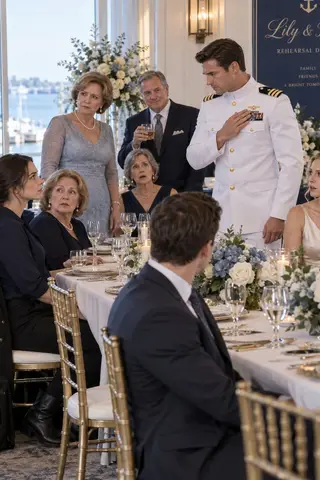
 Family Treats Her Like an Outcast Because of Her "Little Navy Career"
Chapter 1
The Weight of the Uniform
The hum of the private dining room at The Grandview was a symphony of privilege, clinking crystal, and polite, curated laughter. It smelled of expensive white wine, truffled risotto, and the distinct, suffocating aura of people who measured a person’s worth by the brand of their handbag or the pedigree of their title. At the center of it all sat Diane Brooks, my mother, radiating a radiant glow of maternal pride that somehow completely bypassed me.
I stood near the entrance, holding a worn canvas duffel bag that had been through cargo holds, salt spray, and airport security lines across three continents. My boots were caked with dried mud from a naval air station where I’d spent the last twenty-four hours troubleshooting a communications failure that could have grounded an entire squadron. I had driven straight from the base to the venue, skipping a shower, skipping a change of clothes, desperate just to be there for my sister Lily’s rehearsal dinner.
“Nora, seriously? You couldn’t change?” Diane’s voice cut across the ambient chatter, carrying that familiar, public-stage disapproval she reserved exclusively for me.
She didn't get up to hug me. She didn’t ask how my cross-country flight went. Instead, her eyes locked onto my footwear with a look of profound disgust, as if I had dragged a dead animal into a five-star dining room.
I looked down at myself. Dark operational slacks, a simple navy blouse, and standard-issue-adjacent boots. To anyone in my world, it was the uniform of someone who worked for a living. To my mother, it was visual proof that I refused to play the game.
“My flight sat on the runway for almost two hours,” I said, keeping my voice level, though a familiar tightness crept into my chest. “I came straight here from the flight line.”
Mom tilted her head, her perfectly styled silver-blonde hair catching the chandelier light. “You always have an explanation, Nora. Always an excuse for why you can’t look like the rest of the family.”
Behind her, Alan Brooks, my stepfather, swirled a finger of amber bourbon in a heavy crystal glass. A slow, condescending chuckle rumbled in his chest. Alan was a real estate mogul who equated volume with authority and bank accounts with character.
“Some people just aren’t built for social occasions,” Alan drawled, pitching his voice just loud enough for the table to share in the punchline. “Give her a wrench and she’s happy. Put her in a room with civilized people, and she forgets how to comb her hair.”
A few polite chuckles rippled through the immediate circle. My cheeks warmed, not with embarrassment, but with that cold, steady fury I had learned to master years ago on pitching naval decks.
There it was again. The narrative that had followed me since I enlisted at eighteen. To them, I was the family glitch. The awkward, stubborn, overly serious daughter who didn’t go to an Ivy League school, didn’t marry a corporate lawyer, and didn’t care about country club memberships. My younger sister, Lily, was the golden child. Lily was soft, radiant, impeccably styled, and possessed an effortless social grace that made people hand her the keys to the kingdom without a second thought.
Tomorrow, Lily was marrying Lieutenant Commander Ryan Walker, a rising star in the United States Navy whom she had met at a high-society charity gala near Norfolk.
Ryan. The golden boy of the evening. I had heard endless stories about him—how handsome he was, how brilliant his naval career was tracking, how proud his family was. But between my deployments, carrier qualifications, and relentless operational tempos, our paths had never crossed. Every time a family gathering or holiday lined up with a time I was actually stateside, something in the schedule shifted, or I was pulled back to base. Lily had always sighed over video calls, telling me, “It’s fine, Nora, Ryan understands duty, but it’s a shame you’re never around.”
I thought I was just the distant, overworked sister showing up late to the party. I didn't know how wrong I was.
“Your seat is down there,” Mom said, dismissing me with a flick of her jeweled hand toward the extreme periphery of the long banquet table.
I looked down the stretch of white linen. The head table was a fortress of elite validation. Ryan’s parents sat there, looking every bit like old-money aristocracy. Alan’s business associates with their six-figure watches occupied the prime real estate. My chair—if you could call it that—was wedged at the very tail end, right beside a widowed great-aunt who fell asleep before the appetizer, and a twenty-something cousin’s boyfriend who looked like he spent twenty hours a day trading cryptocurrency in his mother’s basement.
It was a deliberate placement. Out of sight, out of mind. The invisible family member tucked away in the shadows so she wouldn't ruin the aesthetic of the wedding photos.
“Okay,” I said quietly.
I didn’t argue, I didn’t make a scene, and I didn’t roll my eyes. I walked down the length of the room, feeling the weight of a dozen indifferent eyes sliding over me. I pulled out the chair at the absolute margin of the table and sat down, resting my heavy duffel bag against the base of the table leg.
For thirty-five years, I had made myself smaller because it was easier. In the Navy, you learn to read a room, assess threats, manage logistics, and fade into the background when your job is simply to keep the machinery running. I was Nora Hayes, Master Chief Petty Officer—though to my family, it was just “Nora’s little Navy thing,” a quirky hobby I picked up instead of going to law school.
I stared down at my empty water glass, listening to the light clinking of silverware from the other end of the room. Lily was laughing at something Ryan’s mother had said, her face flushed with bridal joy. I was genuinely happy for her. I really was. I had wired half my savings to help pay for the floral arrangements because I wanted my little sister to have the fairytale she always dreamed of.
Then, the ambient noise of the room shifted.
A heavy silence seemed to roll forward from the head of the table, cutting through the laughter like a sudden gust of wind.
At the far end, Lieutenant Commander Ryan Walker, who had been sitting with his back to me conversing with Alan, suddenly stopped mid-sentence. His shoulders went rigid. The relaxed, charming posture he had maintained all evening vanished in a microsecond.
Slowly, deliberately, Ryan pushed his chair back from the table. The legs scraped loudly against the hardwood floor.
He stood up straight—too straight, with the absolute, unyielding posture of a man whose body had been forged by years of rigorous, high-stakes military discipline. His eyes swept across the room, bypassing the wealthy executives, bypassing my mother, bypassing the high-society guests, until they locked dead onto the far end of the table.
He looked straight at me.
And then, in a voice that carried absolute, commanding authority across the dead silence of the entire room, Ryan saluted slightly with his chin and spoke a single word.
“Ma’am.”
The End









