 Family Left Me Out of a 118-Person Retreat
Chapter 1
The Laminated Blueprint
The notification light blinked on Mia’s phone with a silent, glowing insistence that felt entirely out of place in the warm, dimly lit Italian restaurant. We were splitting a plate of truffle fries, hashing out the exhausting logistics of our respective day jobs, when Mia suddenly stopped mid-sentence. Her eyes widened, darting from her screen to my face with an expression that sat somewhere between profound horror and morbid fascination. She didn't say a word at first. Instead, she slowly slid her phone across the scuffed wooden tabletop, angling it toward me so the glaring light hit my eyes directly.
There they were.
My parents, standing front and center in matching seafoam-green polo shirts, flanked by all six of my siblings, their spouses, a swarm of children, in-laws, second cousins, and even family friends I hadn't seen since my maternal grandfather's funeral. One hundred and eighteen people, arranged with terrifying precision on a sloping green lawn beside a glittering lake, all gathered beneath a massive vinyl banner that read: THE 15TH ANNUAL MILLER FAMILY RETREAT.
It wasn't just a casual family gathering. It was an institution. There were laminated name tags dangling from lanyards, color-coded wristbands designating cabin assignments, and a drone hovering overhead, capturing a composition so meticulously planned that someone had clearly spent weeks managing a spreadsheet. My mother stood in the middle, her blonde hair perfectly coiffed, smiling that radiant, performative smile she reserved for church directories and holiday cards. My father stood right beside her, his arm draped proudly over my oldest brother David’s shoulder. Every single branch of our sprawling family tree was represented. Every branch, that is, except one.
"What retreat?" I heard myself ask, my voice sounding hollow and detached, as if it belonged to someone else sitting a few tables away.
Mia’s hand hovered over the edge of the table, her fingers trembling slightly. "Clara... I thought you said you were working this weekend. I thought you chose not to go."
"I didn't choose anything, Mia," I whispered, the words catching in my throat. "Nobody told me."
Just three weeks earlier, I had stood in my parents’ sterile, impeccably clean kitchen, holding a mug of lukewarm coffee while my mother wiped down the quartz countertops for the third time that afternoon. I had casually asked if we were planning anything special for the summer retreat this year, keeping my tone light to mask the familiar, anxious knot that always formed in my stomach whenever family events rolled around.
Mom hadn't even looked up from her sponge. "We’re keeping it small this year, Clara. Just the core family units. There simply isn’t enough space for everyone at the lake house."
I had believed her. Or rather, I had wanted to believe her, because believing her was infinitely easier than confronting the cold, grinding truth I had spent my entire life trying to outrun: Why is there never any space for me?
Growing up as the fourth of seven children in a hyper-achieving, aggressively musical family meant living your life in the heavy, suffocating shadow of everybody else's spotlight. My siblings were prodigies, or at least the family mythos treated them as such. David played classical piano with terrifying technical perfection. Elena had a soprano voice that could shatter glass and win regional choir championships. Even the youngest, twins who could barely string sentences together by age three, were put into violin lessons before they could legally ride a bicycle.
And then there was me. I couldn’t sing. My ear for pitch was so fundamentally broken that when I tried to join in on family karaoke nights, my older sister would physically wince, press her palms over her ears, and announce to the room that I was "flattening the harmonic integrity of the household." What started as a casual critique quickly morphed into a permanent family tradition. By the time I was twelve, my name had been quietly scrubbed from the mental roster of performers.
When I tried to find my footing elsewhere, I hit similar walls. My brother once proudly circulated a handmade spreadsheet ranking all seven siblings by artistic and conversational talent. My name wasn't missing by accident; there was a special footnote at the bottom that read, Some contributions are too negligible to measure. When I tried to be funny—to use humor as a defensive shield against the invisible glass wall separating me from the rest of them—my mother casually dismissed it over Sunday pot roast. "You’re clever, Clara, but you’re not really entertaining. Comedy requires warmth. You’re a bit... clinical."
So I adapted. I learned to be useful, quiet, and profoundly forgettable. I faded into the decorative woodwork of family gatherings, helping with the dishes, folding napkins, and silently disappearing before anyone could notice my absence.
Years later, living in a cramped downtown apartment, I started writing down the absurd, lonely, microscopic ironies of growing up as an overlooked middle child. One night, on a whim fueled by cheap wine and desperate courage, I signed up for an open-mic night at a basement comedy club down the street. The ceiling was low, the brick walls smelled of stale beer and fried pickles, and the microphone hissed with static.
When I stepped up to the mic and told my first joke about my mother’s obsession with coordinated throw pillows, the room erupted. Strangers—real, living, breathing strangers—laughed so hard a man in the front row nearly choked on his pretzel. For the first time in my twenty-five years of existence, something my family had categorized as a defect felt like a superpower.
Emboldened by that electric, terrifying rush, I invited my family to my next Friday-night set. I saved seats in the third row, marking them with little folded nameplates just like my mother loved. I watched the door all evening, my heart hammering against my ribs every time someone walked in out of the cold November rain.
Nobody came.
I still went up on stage and crushed my set, but the victory tasted like ash. All I could see was that empty, pathetic little row of chairs. After that night, I stopped extending invitations. I treated my comedy like a secret garden, tending to it quietly while my family continued to live their synchronized, sunlit lives without me.
Until Mia turned her phone around in a dimly lit Italian restaurant and shattered the illusion completely.
I excused myself from the table, muttering something about a sudden migraine, and locked myself inside the single-stall restaurant bathroom. I sat down hard on the edge of the metal tub—used as a quirky aesthetic piece by the restaurant owners—and let the quiet tears slide down my cheeks. Not because I was mourning a missed weekend at a lake house, but because the full, horrifying geometry of my life finally clicked into place. It wasn't just this retreat. It was the birthday dinner where I was accidentally "forgotten" on the reservation list. It was the lake-house weekend I only found out about when I saw the polaroids taped to the refrigerator months later. It was a lifetime of deliberate, surgical erasures disguised as logistical accidents.
I stared at my reflection in the tarnished brass mirror. My eyes were red, my jaw was tight, and the quiet, accommodating girl my family had constructed was quietly, permanently dying inside me. I splashed cold water on my face, dried my skin with a brown paper towel, and walked back out to the table. I smiled through dessert, paid my half of the bill, and said goodnight to Mia.
Something inside me hadn't just broken; it had solidified. The loose sand of my self-doubt had hardened into concrete.
The next evening, I walked into the comedy club carrying my usual backpack filled with notebooks, but I didn't pull out my rehearsed bits. Instead, I stood backstage, staring out at the packed room of eighty people sitting elbow-to-elbow in the dark. When the host introduced my name, I walked out into the glare of the spotlight, wrapped my fingers around the steel shaft of the microphone, and decided to burn my old life to the ground.
"Most comedians get into stand-up because their families laughed at their jokes," I said into the microphone, my voice steady and crystalline in the amplification.
A few chuckles rippled through the front rows.
"I got into comedy because mine didn't."
The crowd laughed louder this time, sensing the raw, sharp edge beneath the punchline. I didn't rush. I let the silence stretch out, comfortable and heavy, before dropping the line I had been carrying in my chest like a live grenade since the moment Mia showed me her phone.
"Last week, my parents told me there simply wasn’t enough space for me at the annual family retreat. Then they invited one hundred and eighteen people."
The room didn't just laugh—it exploded. A collective wave of disbelief, shock, and roaring amusement rolled across the tables. Glasses clinked; people threw their heads back.
I waited patiently until the wave subsided, leaning casually against the mic stand.
"So I guess they were right," I added, letting a dry, deadpan smile touch my lips. "There wasn't enough space. Not at the resort. Just in their idea of who belongs."
By midnight, a clip of that two-minute chunk was already circulating on TikTok, uploaded by an anonymous patron in the third row. By sunrise, my phone was vibrating so violently against my nightstand it sounded like an insect trapped in a glass jar.
My mother called five times before eight in the morning. When I finally swiped to answer, her voice wasn't warm, maternal, or even apologetic. It was a weapon.
"How dare you?" she shrieked, the audio quality distorting under the sheer volume of her fury. "Your siblings have reputations to protect in this community! You’re dragging this entire family through the mud just because you threw a tantrum and didn't get your way!"
"You mean because I wasn't invited?" I asked calmly.
Silence slammed down on the line. It wasn't a hesitating silence; it was the heavy, guilty pause of someone caught red-handed with their fingers in the family till. That absolute absence of sound told me everything I would ever need to know about where I stood in their world.
Later that evening, sitting on my living room floor surrounded by empty coffee mugs, I recorded a simple, unedited video on my phone. No melodrama, no tears, no screaming accusations. Just the unvarnished truth about growing up as the uninvited ghost in a house of performers. I ended the video with a single, unyielding sentence: "If you throw a 118-person retreat and tell your daughter there’s no room for her, maybe don’t act shocked when she talks about it."
I hit post, locked my phone screen, and went to sleep.
By noon the next day, the video had crossed half a million views. Comments were rolling in by the thousands—strangers sharing their own stories of familial exile, validating every dark, lonely year I had spent wondering if I was the problem. But my family didn't see the solidarity; they only saw the spotlight turning away from them for the very first time.
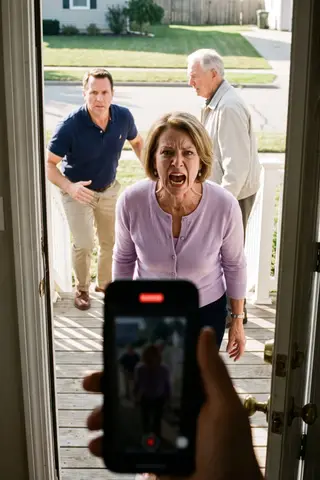
And then, heavy, furious pounding echoed from my front porch.
The End









