 Family Demanded I Take Off My Uniform Because I Was “Embarrassing” Them
Chapter 9
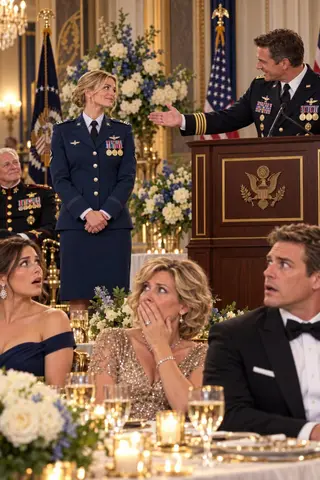
The Aftermath in the Ballroom
The formal presentation concluded with a standing ovation that seemed to last for an eternity. Flashbulbs continued to illuminate the stage as General Sterling, my grandfather, and I stood side-by-side for the official photographs that would soon be featured in newspapers and military journals across the country.
When the lights finally came up and the guests began to transition toward the grand dining hall for the evening banquet, the social dynamics of the room had undergone a seismic shift.
People who had previously ignored me—high-ranking executives, influential senators, and prominent philanthropists—now formed a respectful semi-circle at the base of the stage, waiting patiently for an opportunity to speak with me and my grandfather.
As I gently guided my grandfather down the steps of the stage to join the gathering crowd, my father and Daniel finally approached us. Their usual air of untouchable corporate arrogance had completely evaporated. My father looked ten years older, his shoulders slumped, his tie slightly loosened, and his eyes filled with a heavy, humiliating mix of regret and shame.
“Maya,” my father began, his voice barely above a whisper as he stepped into our path. He swallowed hard, struggling to find the right words. “I... I want to say that I... we had no idea—”
“You had no idea because you never bothered to ask, Dad,” I interrupted, my tone calm, measured, and entirely devoid of anger. I didn't yell; I didn't gloat. I simply stated the quiet, undeniable truth.
Daniel stepped forward, looking down at the floor before forcing himself to meet my eyes. “Maya, I was... out of line earlier. What you did... what you earned... that’s extraordinary. I’m sorry.”
I looked at my brother, seeing past the expensive suit and the corporate title to the small, insecure person standing beneath it. “Thank you, Daniel. But next time, remember that a uniform isn't a costume, and service isn't something to be embarrassed of.”
Before either of them could reply, a senior corporate CEO—one of the wealthiest donors in the country, whom my father had been desperately trying to impress all afternoon—stepped past my father and extended his hand directly toward me.
“Staff Sergeant Parker,” the CEO said with immense warmth and deep respect. “My name is Robert Vance. I run Vanguard Technologies. I just wanted to shake your hand and thank you for your service. What you did overseas... that is true leadership. If you ever decide to transition out of the military, there is a permanent executive position waiting for you at my company—on your terms.”
My father’s eyes widened in sheer shock. Robert Vance—the very man my father had spent months trying to secure a meeting with—had just bypassed my father entirely to offer me a top-tier executive position based solely on my character, my leadership, and my military service.
I smiled calmly, shaking Robert Vance’s hand. “Thank you for the kind offer, Mr. Vance. For now, my duty is to my country and my unit. But I appreciate your respect.”
The End









