 Family Demanded I Take Off My Uniform Because I Was “Embarrassing” Them
Chapter 3
Secrets Beneath the Ribbons
Months prior to this grand celebration, an event had taken place thousands of miles away from the comfort of American boardrooms—an event that my family would never have understood, let alone cared to hear about. During a high-risk humanitarian rescue mission in a volatile overseas region, my unit had been tasked with extracting trapped medical personnel from a remote outpost surrounded by hostile forces. Under heavy fire and with communication lines completely severed, I had assumed command after our senior officer was incapacitated, coordinating an emergency extraction that successfully saved twelve civilian lives without a single casualty among my team.
When the dust settled and the Pentagon reviewed the after-action reports, word reached my command that I was to be awarded the Defense Meritorious Service Medal—one of the nation's highest commendations for exceptional non-combat leadership and valor.
When the Department of Defense first contacted me about scheduling a formal presentation ceremony at Fort Myer, I had made a specific request. Knowing that my grandfather’s ninetieth birthday celebration was scheduled for late October just outside Washington, D.C., and knowing how much he cherished his own military history, I asked if the Pentagon could coordinate the presentation to coincide with his event. I wanted the spotlight to remain firmly on him for his lifetime of service, but I also wanted to share a moment of mutual military pride with the only family member who had ever truly understood what it meant to wear the uniform.
The Pentagon agreed, orchestrating a dual-recognition program that would take place during the final segment of the afternoon ceremonies. My family, caught up in their superficial obsession with corporate titles and elite social networking, had assumed the entire afternoon was exclusively about my grandfather—and more importantly, an opportunity for my father and brother to parade their wealthy associates around.
I took one final breath of the crisp autumn air, rolled my shoulders back, and walked back inside the grand ballroom.
The atmosphere inside had shifted from casual mingling to seated expectancy. String music drifted softly from a live quartet stationed near the grand staircase. Guests were beginning to take their seats at the round tables adorned with towering floral centerpieces.
I scanned the room and spotted my family’s table near the front—prime real estate reserved for the immediate family of the guest of honor. Daniel was still laughing loudly, clinking his champagne glass with a prominent tech investor while checking his watch every few minutes. My father was busy shaking hands with a local congressman, playing the role of the gracious, successful patriarch to absolute perfection.
Not a single person at that table bothered to look around for me. Not one of them cared where I had gone during the last twenty minutes, assuming I had probably slipped out to hide my “embarrassing” uniform somewhere out of sight.
Quietly, without drawing a single glance, I walked toward the very back of the massive ballroom. I found a lone, unoccupied seat at a small table near the service doors, far away from the flashing cameras and the sea of designer gowns. I sat down, folded my hands neatly in my lap, and waited.
Roughly an hour later, the murmur of conversation gradually died down as the overhead chandeliers dimmed into a warm, amber glow. A spotlight flickered to life, cutting through the darkness and illuminating the expansive mahogany stage at the front of the room.
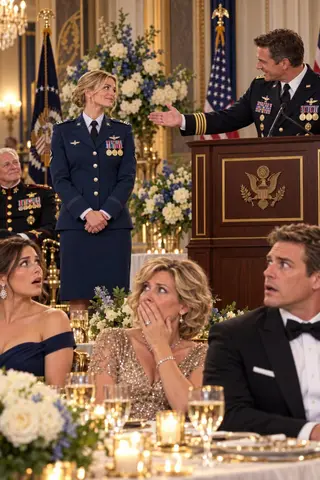
A tall, impeccably dressed man with silver hair and four distinct silver stars gleaming proudly on the shoulders of his dress uniform stepped calmly onto the stage. General Arthur Sterling, Commander of the Military District of Washington, approached the mahogany podium.
The entire room fell into an absolute, breathless silence.
The End









